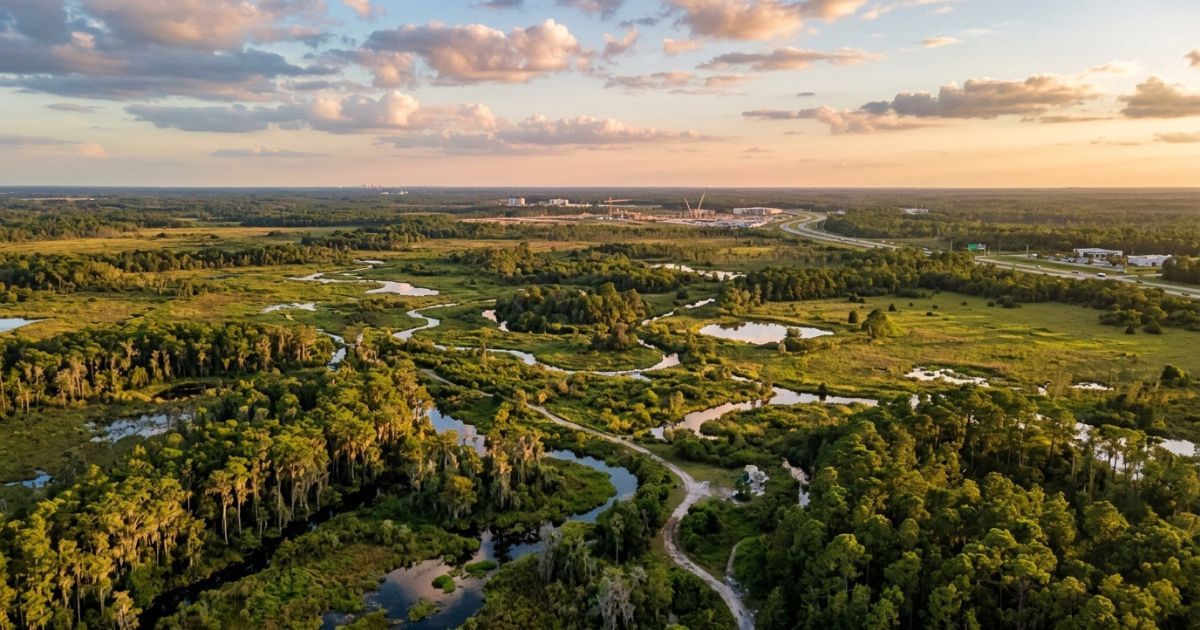
Counties like Marion, Polk, and Lake have drawn institutional capital for years — offering land prices that coastal Florida left behind long ago, backed by documented population growth and expanding infrastructure across the state's interior.
When most people think about buying land in Florida, they picture the coast — Miami, Tampa, Fort Lauderdale, the Gulf side corridor. And they’re not wrong to go there first. Those are the markets with the most name recognition, the most media coverage, and the deepest liquidity.
They’re also the markets where the easiest appreciation has already happened.
Institutional buyers — private equity funds, real estate investment trusts, land banking operations, large family offices — understood this before it became obvious. They moved inland years ago, buying land in counties where prices still reflected economic conditions that coastal Florida had long outgrown. Some of those positions have already produced substantial returns. Others are still accumulating, waiting for infrastructure and population pressure to do the work.
The opportunity in inland Florida isn’t gone. But it’s not as simple as buying whatever’s cheap and waiting. Here’s what’s actually driving activity in Florida’s interior counties — and what serious buyers need to understand before making any decisions.
Table of Contents
- Why did institutional buyers move inland before anyone else noticed?
- Which inland Florida counties are drawing the most attention?
- How do inland land prices actually compare to coastal markets?
- What forces are driving growth into Florida’s interior?
- What are the real risks of buying inland Florida land?
- Common mistakes buyers make chasing market opportunities
- Hidden costs that show up after the purchase
- 📚 Glossary
- ✅ Immediate Actions
- FAQ
Why did institutional buyers move inland before anyone else noticed? {#why-institutional}
Short answer: institutional investors analyze leading indicators — population flow data, infrastructure spending approvals, logistics facility announcements, and county-level housing permit trends — that typically lead retail buyer awareness by three to five years. By the time a region appears in a news article about "up-and-coming" markets, much of the early-entry advantage has already been captured.
Real estate markets don’t move uniformly. Florida’s land market, in particular, has at least three distinct layers of maturity operating simultaneously:
Consolidated markets: Miami-Dade, Broward, Palm Beach, Sarasota, Collier, Pinellas. These markets have been appreciating for decades. Land prices in these counties reflect years of compressed supply, strong demand, and high construction costs. Entry is possible, but the margin for a buyer arriving today is narrow.
Expansion markets: Orange County (Orlando), Hillsborough County (Tampa), Duval County (Jacksonville). These are actively growing — still adding population and housing at pace — but the most accessible land near their urban cores has already been absorbed. Prices have moved substantially over the past decade.
Early-stage interior markets: Marion, Polk, Lake, Hernando, Citrus, Alachua, Putnam. These counties still carry price levels that reflect where Florida’s expansion markets were five to eight years ago. Infrastructure is catching up. Population pressure is building from adjacent areas. And the land prices haven’t yet moved to reflect what’s coming.
Institutional buyers are comfortable analyzing five-to-ten-year return horizons. Individual buyers often aren’t — and that mismatch is exactly what creates the gap institutional capital exploits.
What signals institutional buyers actually track
The playbook isn’t mysterious: watch where Amazon, Walmart, and Home Depot open distribution centers. Track state DOT road expansion projects. Monitor county school board capital spending approvals. Follow water and sewer utility extension plans. Each of these signals infrastructure investment arriving ahead of the residential demand it will eventually serve.
By the time a parcel shows up on a real estate listing with a “growth area” description, the people reading the infrastructure filings have already bought it.
Which inland Florida counties are drawing the most attention? {#which-counties}
Short answer: Marion County (Ocala), Polk County, Lake County, Hernando County, and Citrus County are the most actively tracked inland markets — each at a different stage of the expansion cycle and each with distinct characteristics that affect land use, pricing, and development potential.
Marion County — Ocala’s emergence as a regional hub
Ocala doesn’t get the recognition it deserves in broader Florida real estate discussions. Marion County has over 400,000 residents, sits directly on I-75, and connects to both Gainesville to the north and Tampa to the south within 90 minutes of driving. In the past several years, the county has attracted major logistics investment — including large distribution center operations — that created a new layer of employment demand independent of tourism or retirement services.
The combination of infrastructure access, comparative affordability, and employment growth makes Marion one of the more systematically defensible positions in inland Florida.
Polk County — the corridor between Florida’s two largest metros
Polk County occupies a position few Florida counties can claim: it sits directly between Tampa and Orlando on the I-4 corridor, less than an hour from each. Lakeland has been growing as a secondary business hub, and Winter Haven continues to attract distribution, light manufacturing, and professional services activity.
For workers priced out of Orange or Hillsborough County, Polk offers a realistic solution — lower land and housing costs within commutable distance of both metros. That demographic pressure doesn’t reverse easily.
Lake County — Orlando’s pressure valve
Lake County borders Orange County to the west, which makes it a natural receiving area for population overflow from Orlando. Tavares, Mount Dora, and Leesburg serve as regional anchors. The county is growing steadily — not explosively — and land prices still trail Orange County by a meaningful margin even for similar acreage and zoning classifications.
Hernando and Citrus — the northern arc above Tampa
North of Hillsborough County, Hernando and Citrus Counties absorb a portion of Tampa’s suburban expansion. Spring Hill in Hernando is already an established Tampa bedroom community. The counties further north are earlier in the cycle, with prices that reflect it — and infrastructure investment that follows the population, not the other way around.
How do inland land prices actually compare to coastal markets? {#price-comparison}
Short answer: inland Florida land typically sells for 40% to 75% less per acre than comparable parcels in coastal or primary metro markets — a gap that reflects development stage, not necessarily long-term value. The difference narrows significantly when specific lots are analyzed for utility access, zoning, and flood zone classification.
| Region | Approximate Price Range per Acre (Vacant Land) | Market Stage |
|---|---|---|
| Miami-Dade / Broward | $150,000 – $500,000+ | Consolidated |
| Tampa / St. Petersburg | $80,000 – $250,000 | Consolidated / late expansion |
| Orlando (Orange County) | $60,000 – $180,000 | Active expansion |
| Polk County | $20,000 – $70,000 | Early expansion |
| Marion County (Ocala) | $15,000 – $55,000 | Early expansion |
| Hernando / Citrus County | $10,000 – $40,000 | Early stage |
These are reference ranges — not asking prices for a specific parcel. Individual lots within any county can vary dramatically based on whether they’re in an approved subdivision, whether utilities are accessible, and whether they’re in a FEMA-designated flood zone. A serviced lot in a subdivided community trades at a significant premium over a raw, unimproved parcel in the same county.
Price per acre is a starting point for comparison. Cost-to-usable-condition is the number that actually matters.
What forces are driving growth into Florida’s interior? {#growth-drivers}
Short answer: three overlapping forces are pushing residential and commercial activity from Florida's coastal markets toward its interior counties — demographic overflow from saturated urban areas, logistics and industrial expansion driven by infrastructure investment, and a remote work adoption that allows households to optimize for cost rather than proximity to a specific office.
Demographic overflow from coastal counties
Florida is adding roughly 400,000 net new residents per year — and most of them can’t afford to live in Broward, Palm Beach, or Sarasota at current prices. Households that want to be in Florida but can’t absorb the cost of established coastal markets move inward. That movement is documented in US Census Bureau migration data, which shows inland counties like Marion, Hernando, and Polk growing at rates that rival or exceed many coastal counties in percentage terms.
The underlying demand doesn’t disappear when the closest market gets expensive. It shifts.
Logistics and industrial expansion
Florida has been attracting logistics infrastructure at a scale that most people outside the commercial real estate industry haven’t tracked closely. Distribution centers, cold storage facilities, light manufacturing plants, and last-mile delivery hubs have been clustering along the I-4 and I-75 corridors — in exactly the inland counties where land is cheapest per acre.
Each of those facilities creates direct employment — and direct demand for housing within commutable distance. That demand, over time, drives residential real estate pressure into surrounding areas.
Remote work as a structural realignment
Remote work didn’t dissolve after 2022. A meaningful portion of the US workforce — particularly in technology, finance, professional services, and consulting — has settled into permanent hybrid or fully remote arrangements. For those workers, the primary cost of living is housing, not transportation. That makes Florida’s interior counties genuinely competitive: lower land and housing costs, no state income tax, and full access to the outdoor lifestyle that draws people to Florida in the first place.
A worker who was previously constrained to a 30-minute commute from a downtown office can now live in Ocala, Lakeland, or Spring Hill without career consequences. The math has changed.
What are the real risks of buying inland Florida land? {#real-risks}
The structural opportunity is real. So are the risks. Conflating the two is the most common analytical mistake individual buyers make when they enter a market where institutional capital is already active.
Zoning and permitted use
Not every parcel in inland Florida can be developed for residential use — or for any use — without additional regulatory steps. Agricultural zoning is common in interior counties, and converting agricultural-zoned land to residential or commercial use requires a county rezoning process that can take months and cost thousands of dollars — with no guaranteed outcome.
Before purchasing any inland parcel, verify the current zoning classification directly with the county planning department. Also check for deed restrictions, which can impose limits on land use regardless of zoning and regardless of any HOA.
Utility access — or the absence of it
Inland Florida parcels frequently lack access to municipal water and sewer systems. That’s not necessarily disqualifying, but it means that building on the land requires installing a private septic system and a water well — costs that typically range from $8,000 to $25,000 or more depending on soil conditions, required tank size, and drilling depth.
Electrical service availability also varies. Some rural parcels require utility extensions that can cost several thousand dollars beyond standard connection fees.
These aren’t deal-breakers, but they’re costs that must be calculated before comparing two parcels on price alone.
Flood zone classification
Florida’s interior is flatter than most people expect, and portions of every inland county fall within FEMA-designated flood zones. Properties in high-probability flood zones (Zone A and Zone AE) require separate flood insurance — not included in standard homeowners policies — and may have building elevation requirements that increase construction costs.
Check the FEMA Flood Map Service Center before analyzing any specific parcel. This is a five-minute step that can eliminate months of due diligence on a property that doesn’t fit your use case.
Time horizon and liquidity
Inland Florida land at early market stages is not a liquid asset. If your financial situation requires selling within two to three years, you may find limited buyer demand at the price point you expect. This is a medium-to-long-term category — typically five years or more to realize meaningful value in early-stage counties.
Institutional buyers account for this explicitly in their underwriting. Individual buyers should too.
Common mistakes buyers make chasing market opportunities {#mistakes}
Skipping the land survey. A licensed land survey confirms the exact parcel boundaries, identifies encroachments from adjacent properties, and verifies that the actual acreage matches what the listing describes. Without one, you may close on a lot that’s materially different from what you paid for. Cost: $400–$1,500. Risk avoided: potentially tens of thousands.
Not using a title company. A title company researches the property’s full ownership history — outstanding liens, unresolved judgments, easements, and prior ownership disputes. Purchasing land without a title search leaves you exposed to inherited legal problems that can surface only after closing. Title insurance, issued at closing, protects you if a defect is discovered after purchase.
Overestimating the appreciation timeline. Institutional buyers underwrite five-to-ten-year horizons as a matter of discipline. Individual buyers often have a two-to-three-year mental model that doesn’t fit early-stage land markets. Misaligned expectations lead to poor decisions under pressure.
Comparing only price per acre. A parcel at $12,000 per acre in a county without utility infrastructure may require $20,000 in site preparation before it’s buildable. A parcel at $18,000 per acre in an approved subdivision with utilities at the lot line costs less in total. Always model the cost to reach usable condition, not just the purchase price.
Ignoring physical access. Some inland parcels don’t have direct access to a public road. Without a documented easement — a legally recorded right to cross a neighboring property — the land may be legally inaccessible for practical purposes. Always confirm road access and verify that any existing easements are recorded in the property title.
Hidden costs that show up after the purchase {#hidden-costs}
Inland land in Florida is cheaper to acquire than coastal property. It is not free to develop, hold, or prepare for eventual sale:
- Septic system installation: $5,000–$15,000 depending on tank size and soil absorption capacity. Required when no municipal sewer connection is available.
- Water well drilling: $3,000–$10,000 depending on depth. Costs rise significantly for deeper aquifer access.
- Electrical service extension: ranges from a few hundred dollars for nearby connection to well over $10,000 for remote parcels requiring significant line extension.
- Site clearing and grading: heavily vegetated or low-lying lots may require clearing, grading, and drainage work before any construction can begin. Environmental regulations may restrict clearing of certain native species.
- Property taxes: even on vacant land, Florida counties levy an annual property tax based on the assessed value. Interior county rates are generally lower than coastal counties, but the tax is real and ongoing.
- Land survey and title search: both are upfront costs that should be budgeted before closing, not treated as optional.
- Building permits: when the time comes to develop, county permit fees vary by structure type and county — budget for these as part of any development pro forma.
📚 Glossary
Land survey: a licensed professional measurement of a parcel's exact boundaries, area, and physical characteristics — used to confirm the property matches its legal description and identify any encroachments or boundary disputes.
Title company: a neutral third-party firm that researches a property's full ownership history, coordinates the closing process, and issues title insurance to protect the buyer from undisclosed defects.
Title insurance: a policy that protects the buyer against liens, ownership disputes, recording errors, or other title defects that could affect legal ownership after the purchase closes.
Deed restriction: a legally binding limitation recorded in a property's title that restricts how the land or structures may be used — independent of zoning and enforceable against all future owners.
Zoning: county or municipal regulations that define the legally permitted uses for a specific parcel — residential, commercial, agricultural, industrial, or mixed-use. Zoning must be verified before purchase and before any development planning.
Flood zone: a classification assigned by FEMA based on the statistical probability of flooding. Properties in high-risk zones (Zone A, AE) require separate flood insurance when financed and may face building elevation requirements.
Easement: a recorded legal right granting access across another party's property. Critical for parcels without direct frontage on a public road — without it, the land may be physically inaccessible for legal purposes.
Septic system: an on-site wastewater treatment system required when municipal sewer service is not available. Standard in rural and semi-rural Florida land markets.
Property tax: an annual tax levied by the county on the assessed value of real property. Rates vary by county; vacant land does not qualify for the homestead exemption.
FIRPTA: Foreign Investment in Real Property Tax Act — a federal law requiring tax withholding when a foreign national sells US real property. Relevant for international buyers planning future disposition of Florida land.
LLC (Limited Liability Company): a US business structure commonly used to hold real estate investments, offering liability separation and, in some cases, tax or estate planning advantages.
✅ Immediate Actions — Start Now
If you’re seriously evaluating inland Florida land, these are the concrete steps that separate informed buyers from buyers who learn the hard way:
- Research the specific county you’re targeting. Marion, Polk, Lake, Hernando, and Citrus each have distinct market characteristics — growth stage, infrastructure access, and price trends that don’t move in unison.
- Check FEMA flood maps for every parcel you evaluate. Visit msc.fema.gov and enter the parcel address or coordinates before investing more time in due diligence.
- Verify zoning directly with the county planning department. Online zoning portals are available in most Florida counties. Don’t rely on listing descriptions — check primary sources.
- Engage a title company before closing on anything. A title search and title insurance policy are non-negotiable protections on any Florida land purchase.
- Commission a land survey before closing. Even if the lender doesn’t require one, a survey confirms that what’s on the deed is what you’re actually buying.
- Model the total cost to usable condition — purchase price plus septic, well, electrical, clearing, and any required infrastructure — before comparing parcels on price per acre alone.
- Work with professionals who know Florida land transactions. The due diligence requirements for vacant land are different from those for residential homes — and the costs of missing something are proportionally higher.
FAQ {#faq}
Can foreign nationals buy vacant land in Florida? Yes. Foreign nationals have the same legal right to purchase real property in the United States as US citizens, regardless of visa or residency status. The purchase process is straightforward — but non-residents should understand FIRPTA, which requires federal tax withholding on the capital gain when a foreign seller disposes of US real estate in the future.
Is it possible to finance the purchase of vacant land in Florida? Land financing is available but less accessible than standard home mortgages. Most lenders who offer land loans require larger down payments — typically 25% to 40% — and charge higher interest rates than residential financing. Lots within approved subdivisions with available utilities are generally easier to finance than raw, unimproved parcels.
How do I know if an inland Florida county has genuine appreciation potential? Look at population growth data from the US Census Bureau, proximity to major employment and logistics corridors, county-level infrastructure investment plans, and historical price trends over five or more years. No factor guarantees appreciation — but counties with documented in-migration, improving infrastructure, and employment expansion have structural demand that supports long-term land values.
What is a deed restriction and how does it affect what I can do with land? A deed restriction is a covenant recorded in the property title that limits permitted uses — for example, prohibiting commercial construction, restricting dwelling types, or limiting lot subdivision. These restrictions run with the land regardless of ownership changes, and they exist independent of local zoning. Always review the full title history before closing.
How long does closing on a Florida land purchase typically take? Cash purchases can close in two to four weeks with title company coordination. Financed purchases typically take 30 to 60 days. The title company manages the process, confirms clean title, and coordinates the deed recording.
Should I use an LLC to purchase Florida land? Whether an LLC makes sense depends on your specific goals — liability protection, estate planning, tax structure, and how you intend to develop or sell the property. There are real costs to maintaining an LLC, and the advantages aren’t universal. Consult a CPA or real estate attorney familiar with Florida law and non-resident ownership before deciding.
Do I need flood insurance on vacant land? Flood insurance on vacant land is generally not required by lenders, since there’s no structure to insure. However, if the land is in a high-risk flood zone, that affects what you can build there — including construction elevation requirements — and the future cost of insuring any structure you eventually build. This matters for your total investment model even if it doesn’t require immediate insurance coverage.
Conclusion
The inland Florida land opportunity isn’t a secret — but it is misunderstood by most of the people pursuing it. Institutional buyers moved inland because they could analyze the structural factors — population flow, infrastructure investment, employment expansion, and absorption rates — before those factors were visible in listing prices. Some of them have already made their returns. Others are still positioned for markets they expect to mature over the next decade.
Individual buyers can participate in the same markets — but with a critical difference: the due diligence burden is entirely on you. There’s no institutional compliance team running title searches, no acquisitions analyst verifying zoning, no operations group assessing utility infrastructure. Every one of those steps is something you have to commission and review yourself — or with the help of professionals who know what to look for.
The counties are real. The growth dynamics are real. The risk factors are equally real. The buyers who navigate this market successfully are the ones who do the analytical work before the purchase, not after.
TerraNoble offers expert, bilingual guidance — in English and Portuguese — for buyers evaluating Florida land opportunities. Whether you’re looking at a specific inland county, trying to understand what’s priced into a particular parcel, or comparing options across regions, our team provides straightforward, no-pressure guidance built around your goals. Get in touch to start the conversation.