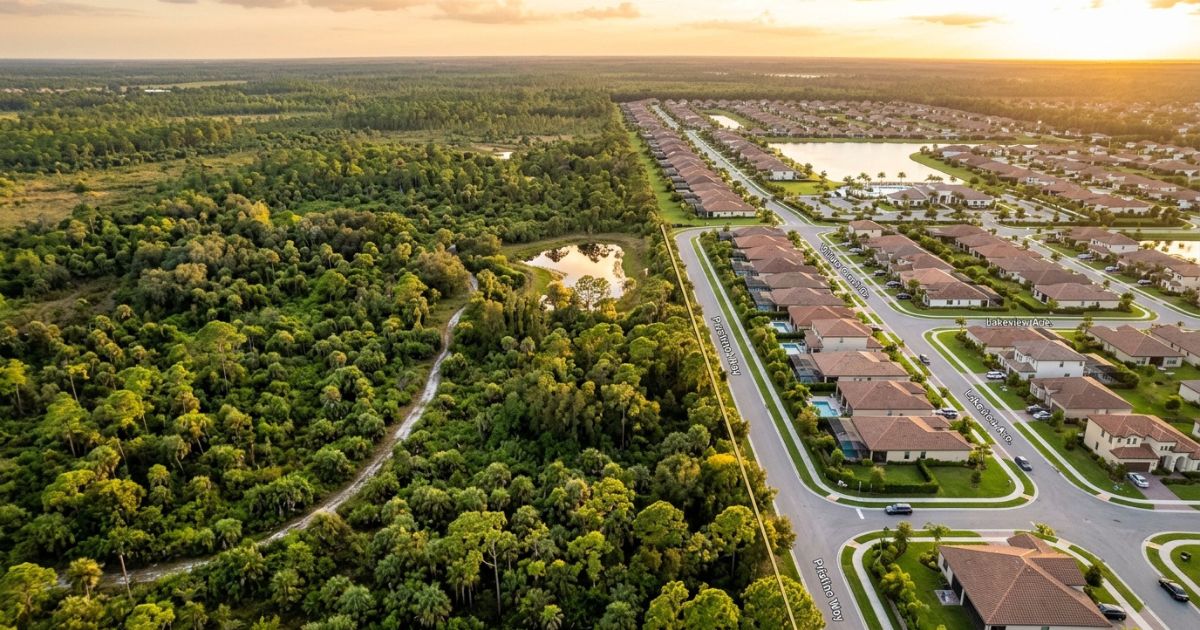
Vacant land in Florida carries a fundamentally different financial equation than a built property: no structural repairs, no tenant headaches, and no mandatory insurance stack. For investors focused on long-term returns, that simplicity often translates into a stronger net position than owning a ready-made home.
A ready-made home feels like the obvious investment. It’s already built, you can rent it out immediately, and the return is easy to picture. Vacant land, by contrast, seems incomplete — an asset that “isn’t anything yet.” That perception is costing a lot of investors real money.
Here’s the reality: when you add up what it actually costs to own a built property in Florida — insurance, maintenance, property taxes, tenant management, emergency repairs — the financial equation shifts dramatically. And the vacant lot that seemed too simple to be a good investment starts looking like the smarter move.
Most people assume buying property is mainly about the purchase price. In reality, long-term ownership costs are what determine whether a property investment actually works — and that’s exactly where vacant land consistently outperforms a ready-made home.
Table of Contents
- What makes vacant land different from a built home as an investment
- Why the entry cost for Florida land is so much lower
- How much does it cost to maintain a vacant lot vs a Florida home?
- Do you pay less in property taxes on vacant land in Florida?
- What kind of insurance do you actually need for a vacant lot?
- Why vacant land is more flexible than a built property
- Side-by-side: vacant land vs built property in Florida
- What most investors get wrong when comparing land and ready-made properties
- Glossary
- Immediate Actions
- FAQ
What makes vacant land different from a built home as an investment {#what-makes-land-different}
The fundamental difference between the two assets isn’t the purchase price — it’s what happens after you close. A built property starts demanding time and money from day one: mandatory homeowners insurance, aging systems that need servicing (HVAC, plumbing, roof, electrical), tenant management if you’re renting it out, and unexpected repair bills that arrive without warning.
A vacant lot has none of that. There’s no structure to deteriorate, no tenant to deal with, no emergency that needs a same-day response. You own the asset and hold it — with minimal carrying costs.
Short answer: The primary financial advantage of vacant land isn't its appreciation potential — it's the near absence of ongoing operating costs. While a typical Florida built home can cost between $10,000 and $25,000 per year to carry (insurance + taxes + maintenance), a vacant lot in the same region often costs less than $2,000 per year to hold.
Why the entry cost for Florida land is so much lower {#entry-cost}
Purchase price is the most immediate comparison point. Vacant lots in Florida’s growth corridors — Marion County, Highlands County, Osceola County, and parts of the Panhandle — can be found between $15,000 and $80,000 depending on size, location, and available infrastructure.
Ready-made homes in those same regions typically start at $200,000 and rarely dip below that threshold in areas with real demand.
That capital difference has two practical effects for investors:
- Accessibility: An investor with $50,000 can purchase a lot outright — no financing, no interest payments, no credit approval — while that same amount barely covers a down payment on a built home.
- Diversification: With the budget of one ready-made home, you can buy two or three lots across different Florida counties, spreading geographic risk while gaining broader exposure to regional growth.
For international buyers — including Brazilians and other foreign investors who face more restrictive financing conditions on US properties — cash purchases of vacant land are common and eliminate the biggest barrier to entry entirely.
How much does it cost to maintain a vacant lot vs a Florida home? {#maintenance-costs}
Owning a house in Florida means accepting a set of recurring costs that never appear in the listing price. Mechanical systems age. Roofs need replacing every 15 to 25 years. Air conditioning — non-negotiable in Florida’s climate — fails. Landscaping needs upkeep. And when tenants are involved, the damage compounds.
Conservative estimates for annual maintenance on a Florida residential property run between 1% and 2% of the property’s value. On a $280,000 home, that’s $2,800 to $5,600 per year — in preventive and corrective maintenance alone, before insurance or taxes.
A vacant lot’s maintenance costs are nearly nonexistent:
- Vegetation clearing if required by the county: typically $200–$500 per year
- No mechanical systems to service or replace
- No tenant-related damage to repair
- No emergency calls to return at midnight
Short answer: Over ten years, the maintenance costs alone on a Florida home can total $28,000 to $56,000 — a number that erodes investment returns directly and simply does not exist for a vacant land owner. That difference compounds quietly but significantly over a long hold.
Do you pay less in property taxes on vacant land in Florida? {#property-taxes}
Florida’s property tax system assesses each parcel based on its appraised value — but how that value is calculated differs meaningfully between vacant lots and built properties.
Vacant land is assessed on soil value only — no structure, no improvements, no HVAC system factored in. The result is a substantially lower tax base than a comparably located built home.
Built properties are assessed annually by the county Property Appraiser, who adjusts values to reflect current market conditions. As Florida’s real estate market has appreciated aggressively in recent years, many homeowners have seen their property tax bills rise significantly — even without making any improvements themselves.
| Property Type | Assessment Basis | Estimated Annual Tax (1.5% rate) |
|---|---|---|
| Vacant lot — $40,000 value | Soil value only | ~$600/year |
| Built home — $280,000 value | Land + structure + improvements | ~$4,200/year |
| Built home with homestead exemption — $280,000 | $230,000 (after $50,000 exemption) | ~$3,450/year |
One important note: Florida’s homestead exemption — which reduces the assessed value of a primary residence by up to $50,000 — is not available to investors or foreign buyers who don’t use the property as their principal home. For that audience, the tax advantage of built properties over vacant land is even smaller than it appears on paper.
What kind of insurance do you actually need for a vacant lot? {#insurance}
Florida’s homeowners insurance market is one of the most expensive in the United States — and it’s been getting worse. Hurricane exposure, flooding risk, and a wave of private carrier exits have pushed premiums to levels that surprise most buyers. In certain coastal areas, annual insurance costs for a single built home can exceed $10,000.
A homeowner typically needs three separate policies to be properly covered:
- Homeowners insurance — covers the structure and contents against wind, fire, and certain water damage
- Flood insurance — required in FEMA-designated high-risk zones; purchased separately through the NFIP or private carriers
- Wind insurance — often required in coastal counties as a separate policy from homeowners coverage
For a vacant lot, none of these are mandatory. Some landowners choose to carry a basic liability insurance policy in case someone is injured on the property — but the annual cost is a small fraction of any residential policy stack.
Short answer: A built home in Florida can require $3,000 to $12,000 or more in annual insurance premiums depending on location, flood zone, and roof age. A vacant lot typically requires $0 to $400. Over a ten-year hold, that difference represents $30,000 to $120,000 in savings — money that stays in the investor's pocket rather than going to insurance carriers.
Why vacant land is more flexible than a built property {#flexibility}
A built home is an asset with a fixed function: housing or rental income. Changing that function — demolishing to rebuild, subdividing, repurposing for commercial use — involves significant bureaucracy, cost, and time.
Vacant land starts as a blank canvas. Depending on zoning and county regulations, a landowner can:
- Build when ready — wait for further appreciation before developing
- Sell the raw lot — increasingly attractive in growth regions where builders actively seek land
- Subdivide — larger parcels can sometimes be divided and sold in separate portions
- Hold for rezoning — rural areas near expanding corridors are frequently reclassified as Florida grows
- Lease for temporary uses — RV storage, agricultural use, or recreational purposes in appropriate zones
That flexibility has real financial value. A land investor who purchased a lot near a Central Florida infrastructure expansion corridor in 2015 had options in 2023 that a homeowner simply didn’t: sell directly to a developer at a premium, build and sell, or continue holding while values climbed.
Side-by-side: vacant land vs built property in Florida {#side-by-side}
| Factor | Vacant Land | Built Property |
|---|---|---|
| Typical entry cost (Florida interior) | $15,000 – $80,000 | $200,000 – $400,000+ |
| Estimated annual maintenance | $200 – $500 | $2,800 – $8,000 |
| Estimated annual insurance | $0 – $400 | $3,000 – $12,000 |
| Estimated annual property tax | $400 – $1,200 | $2,500 – $6,000 |
| Tenant / property management | Not required | Required for rental income |
| Risk of structural damage | None | High (hurricane, flood, aging systems) |
| Structural depreciation | Does not apply | Continuous (roof, HVAC, finishes) |
| Flexibility of use | High | Limited |
| Homestead exemption eligibility | Not applicable | Primary residence only |
| Operational complexity | Low | High |
| Estimated annual carrying cost | $600 – $2,100 | $8,300 – $26,000 |
What most investors get wrong when comparing land and ready-made properties {#common-mistakes}
Calculating ROI only from rental income — without subtracting real costs
The most common error is counting gross rental income as the return, then subtracting only the mortgage payment. The actual calculation must include insurance premiums, property taxes, maintenance reserves, vacancy periods, and property management fees (typically 8–12% of collected rent). When all of those are factored in, net yield on many Florida rentals is far lower than the headline numbers suggest.
Not getting insurance quotes before closing
Many buyers discover the real cost of Florida insurance only after the deal is done. A home in a flood zone, with an aging roof, or within a mile of the coast can generate insurance quotes that fundamentally change whether the property makes financial sense. Getting quotes tied to the specific address — not regional estimates — is non-negotiable due diligence.
Underestimating remote property management
For international buyers managing a Florida rental from abroad, the operational complexity is easy to underestimate. Property managers charge a percentage of collected rent, repairs require local contractors who must be vetted and trusted, and tenant disputes can result in legal costs and extended vacancy. Many investors only discover this after their first difficult tenant.
Treating vacancy as a rounding error
A property sitting vacant doesn’t generate income — but it still generates expenses. Insurance, taxes, utilities kept running to protect the structure, and minimum maintenance costs continue regardless of occupancy. Florida’s rental market vacancy rates vary significantly by county and season; projecting 100% occupancy is a planning mistake with direct financial consequences.
Comparing purchase price and ignoring carrying costs
Vacant land is frequently dismissed as a weaker investment because it doesn’t produce immediate cash flow. But when ten-year carrying costs are stacked up side by side — insurance, taxes, maintenance — the land often ends up in a significantly stronger net position. The comparison has to include the full cost of ownership, not just the sticker price.
📚 Glossary {#glossary}
Property tax — An annual tax assessed on real estate in Florida, calculated based on the county Property Appraiser’s assessed value of the parcel. Applies to both vacant lots and built properties, but with different assessment bases.
Homestead exemption — A Florida constitutional benefit that reduces the assessed value of a primary residence by up to $50,000 for property tax purposes. Available only to owners who use the property as their principal home. Not applicable to investment properties or second homes for most foreign buyers.
Flood zone — A FEMA designation indicating the statistical flood risk of a specific area. Properties in high-risk zones (AE, VE) require flood insurance when financed through federally backed lenders. Vacant land has no mandatory flood insurance requirement.
Homeowners insurance — A residential policy required on mortgaged properties, covering structural damage from wind, fire, and certain water-related events. Does not cover flooding from external water sources. Not required for vacant land.
Zoning — County or municipal regulations that define the permitted use of each parcel: residential, commercial, agricultural, industrial, or mixed. Zoning determines what can legally be built or operated on a piece of land.
NFIP — National Flood Insurance Program; a federal program that provides flood insurance policies through private agents. The primary source of flood coverage for properties in FEMA-designated high-risk zones.
Vacancy rate — The percentage of time a rental property sits unoccupied and without income. A standard planning assumption for Florida rental properties is 5–15% vacancy per year, depending on location and property type.
Carrying cost — The total annual expense of holding a property, including taxes, insurance, maintenance, and any financing costs. A critical metric for comparing different types of real estate as investments.
Property Appraiser — The elected county official responsible for assessing the value of all real property for tax purposes. Assessment values are updated annually and may reflect broader market movements.
Liability insurance — A basic policy that protects a landowner against legal claims from third parties injured on the property. For vacant lots, it’s optional and inexpensive — often the only coverage a land investor needs.
✅ Immediate Actions — Start Now {#immediate-actions}
- Calculate the full annual carrying cost of any built property you’re comparing: add property tax + insurance (homeowners + flood + wind) + maintenance reserve (1%–2% of value) — then compare that total to the annual cost of holding a lot in the same region
- Verify the zoning classification of any lot you’re evaluating at the county Property Appraiser’s website — confirm permitted uses before any decision
- Check the FEMA Flood Map Service Center for the flood zone designation of both lots and built properties you’re considering — the classification directly affects insurance requirements and resale value
- Request actual insurance quotes for any specific built property before comparing it to vacant land — use the exact address, not regional averages
- Look up the historical property tax on any parcel you’re considering at the county Property Appraiser site — the data is public and free
- If your goal is investment without immediate income, assess whether the vacant land profile (low carrying cost, high flexibility) fits your strategy better than a built property requiring tenant management
- Speak with a bilingual professional who knows the Florida market before making any decision — due diligence on both land and built properties requires local expertise that general research cannot replace
Conclusion
The comparison between investing in Florida land versus ready-made properties doesn’t have a universal answer. Different investors have different goals, different capital, and different tolerance for operational complexity.
What this article set out to show is that vacant land is not a lesser option because it’s simpler. It’s a different asset class with a financial equation that favors investors who want lower carrying costs, less exposure to Florida’s climate-driven property risks, and more flexibility over a long hold period.
The right investment is the one that fits your capital, your strategy, and your long-term objectives — with a clear-eyed view of what each asset actually costs to own.
TerraNoble offers bilingual support in English and Portuguese for investors exploring Florida’s land market. Whether you’re comparing a specific lot to a ready-made property or need guidance on what to verify before making an offer, our team is available for a no-pressure conversation about what makes sense for your goals.