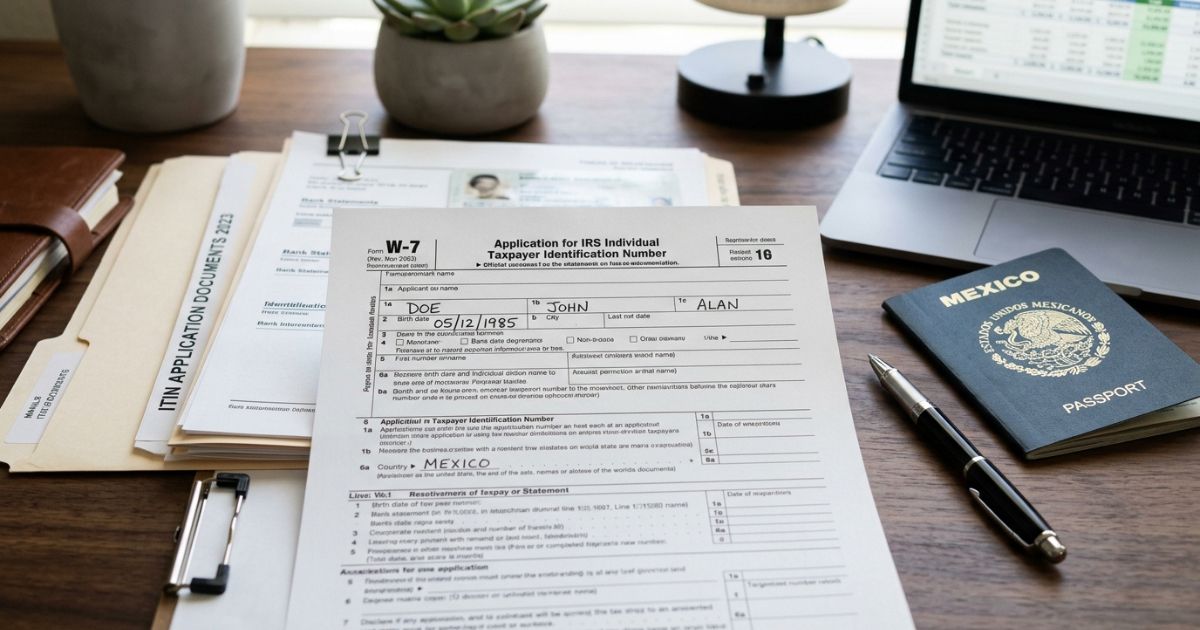
The ITIN is the tax ID that lets a foreign investor file US tax returns, recover FIRPTA withholding, and report rental income — without it, routine tax obligations can stall for months.
If you think the biggest obstacle to investing in the United States as a foreigner is not having a Social Security Number, the real problem is different — it’s not having any US tax ID at all, which means you cannot file a tax return, report rental income, or recover money the IRS withheld when you sold a property. That gap is what trips up many foreign investors well after the purchase, at the exact moment they can least afford a delay.
Most people assume that without US citizenship or a green card, there’s simply no way to interact formally with the American tax system. In reality, there’s a number created for exactly this purpose: the ITIN, or Individual Taxpayer Identification Number. Understanding what it is, when it’s required, and how to apply for it ahead of time can save months of waiting and prevent cash from sitting frozen at the IRS.
Table of Contents
- What is the ITIN Number?
- Why every foreign US investor needs an ITIN
- ITIN vs. SSN vs. EIN: what’s the difference?
- How to apply for an ITIN: step by step
- What documents does the IRS accept?
- How long it takes and what it costs
- Common mistakes foreign investors make with ITIN applications
- What happens if you don’t have an ITIN
- 📚 Glossary
- ✅ Immediate Actions — Start Now
- FAQ
What is the ITIN Number? {#what-is-itin}
Short answer: the ITIN (Individual Taxpayer Identification Number) is a tax identification number issued by the IRS to individuals who have US tax obligations but are not eligible for a Social Security Number (SSN). It's a nine-digit number that always begins with the digit 9, and it exists strictly for tax purposes.
The IRS created the ITIN in 1996 specifically to allow nonresidents, foreign nationals, and other individuals without an SSN to meet US tax obligations — reporting income, paying taxes owed, or requesting a refund of amounts withheld in error. It is not a visa, it does not grant immigration status, and it does not authorize employment in the United States.
The ITIN exists for tax purposes only
A common mistake is assuming the ITIN works as a general-purpose substitute for an SSN. It doesn’t. It exists solely so the IRS can track and process the tax obligations of people who don’t have — and can’t obtain — a US Social Security Number.
Why every foreign US investor needs an ITIN {#why-needed}
Short answer: an ITIN is not required to buy land or property in the United States, but it becomes necessary the moment any tax obligation is tied to that property — reporting rental income, recovering FIRPTA withholding on a sale, or filing a federal income tax return.
Buying property in the United States as a foreign national does not require an ITIN at closing. The problem shows up afterward, in situations most buyers only discover once they’ve already become urgent:
- Renting out the property — any rental income received by a nonresident must be reported to the IRS, which requires a valid ITIN
- Selling the property — FIRPTA withholding, which can reach 15% of the sale price, can only be recovered by filing a tax return, and that requires an ITIN
- Opening a bank account at certain US banks — some institutions ask for a valid tax ID even when they don’t require US residency
- Filing jointly with a partner or spouse — when more than one person appears on a tax return, each one needs their own tax ID number
Applying for an ITIN only after the problem has already surfaced — in the middle of a sale with FIRPTA funds held back, for example — typically delays recovering that money by several months. Applying ahead of time avoids that bottleneck entirely.
ITIN vs. SSN vs. EIN: what’s the difference? {#itin-vs-ssn-vs-ein}
| Number | Who it's for | Authorizes US employment? | Primary use |
|---|---|---|---|
| SSN (Social Security Number) | Citizens and residents authorized to work | Yes | Personal tax and Social Security identification |
| ITIN (Individual Taxpayer Identification Number) | Foreign nationals not eligible for an SSN | No | Filing personal US tax returns |
| EIN (Employer Identification Number) | Companies, LLCs, and other entities | Not applicable (belongs to the entity, not a person) | Tax identification for a legal entity |
One point that confuses many investors: if the property is purchased through a US LLC, the LLC has its own EIN — but that doesn’t eliminate the foreign member’s need for an ITIN to report their personal share of income and other tax obligations.
How to apply for an ITIN: step by step {#step-by-step}
Short answer: the ITIN is requested using IRS Form W-7, along with proof of identity and foreign status — most commonly a passport — and, in most cases, alongside a federal tax return or documentation supporting an exception to that requirement.
- Complete Form W-7 — available on the IRS website, indicating the reason for the application (property sale, rental income, LLC ownership, among others)
- Gather your identity documentation — a valid passport is the most widely accepted document, since it proves both identity and foreign status in a single document
- Attach the corresponding tax return — in most cases, the W-7 must be submitted along with Form 1040-NR or another applicable return
- Check whether your situation qualifies for an exception — investors in the middle of a property sale with FIRPTA withholding, for example, can apply for an ITIN without attaching a full tax return, using the transaction’s own supporting documents instead
- Choose your submission method — by mail directly to the IRS in Austin, through a Certifying Acceptance Agent (CAA), or in person at a Taxpayer Assistance Center in the US
- Wait for processing — the IRS reviews the application and mails the number to the address provided
Short answer: using a Certifying Acceptance Agent is usually the safest route for anyone applying from outside the US, since it avoids mailing an original passport internationally — the CAA verifies the document and certifies the copy directly to the IRS.
What documents does the IRS accept? {#accepted-documents}
A valid passport is the only document that, on its own, proves both identity and foreign status at the same time — which is why it’s the option most commonly used by Brazilian and other international investors. Without a passport, the IRS accepts a combination of at least two of the following documents:
- National identification card with photo, name, address, date of birth, and expiration date
- Birth certificate (required for applicants under 18)
- Foreign driver’s license
- Foreign voter registration card
- US immigration documents, when applicable
Documents in a language other than English require a certified translation to accompany the application.
How long it takes and what it costs {#time-cost}
The IRS does not charge a fee to issue an ITIN. When a cost is involved, it typically comes from hiring a Certifying Acceptance Agent or a CPA experienced with nonresident tax filings, who generally charges between $150 and $500 for the service, depending on the complexity of the case.
Standard IRS processing time is about 7 weeks, but it can stretch to 9–11 weeks during tax filing season (January through April) or when the application is submitted from outside the United States.
A detail that catches many investors off guard: an ITIN automatically expires if it isn’t used on a tax return for three consecutive years. Investors who buy a property, obtain an ITIN, and then don’t use it for a while can find out — right when they’re trying to sell — that they need to renew it before they can move forward with the return.
Common mistakes foreign investors make with ITIN applications {#mistakes}
Waiting until the middle of a sale to apply
When FIRPTA withholds up to 15% of a sale price, recovering that money requires a tax return filed with a valid ITIN. Waiting until that moment to apply adds weeks of processing time to an already time-sensitive transaction.
Mailing the original passport when it isn’t necessary
The IRS accepts an original passport or a copy certified by a Certifying Acceptance Agent. Mailing the original document internationally exposes the investor to the risk of losing it for weeks — a CAA removes that risk entirely.
Confusing the ITIN with work authorization or immigration status
The ITIN does not grant the right to work, is not proof of legal status in the US, and has no bearing on immigration proceedings. It exists strictly for tax purposes.
Not renewing an expired ITIN before filing
Returns filed with an expired ITIN are processed with delays by the IRS until the renewal is completed — which can push back refunds, including the recovery of FIRPTA withholding.
Filling out Form W-7 without clearly stating the reason for the application
The IRS requires the reason for the application to be clearly identified and documented. Incomplete applications or vague reasons are one of the most common causes of rejection.
What happens if you don’t have an ITIN {#hidden-costs}
- Unrecovered FIRPTA withholding — without an ITIN, there’s no way to file the tax return needed to reclaim the amount withheld at sale
- Rental income reported incorrectly, or not at all — this can trigger IRS penalties for failing to meet a tax obligation
- Delayed closings — some transactions and bank account openings are held up by the lack of a valid tax ID
- Late-filing penalties, when the obligation to file already existed and the ITIN wasn’t requested in time
- Rush costs — applying for an ITIN under pressure, in the middle of a tax deadline, typically costs more in professional fees than applying ahead of time
📚 Glossary {#glossary}
ITIN (Individual Taxpayer Identification Number) — a nine-digit tax ID issued by the IRS to individuals with US tax obligations who are not eligible for an SSN.
SSN (Social Security Number) — the Social Security number issued to citizens and residents authorized to work in the United States.
EIN (Employer Identification Number) — the tax identification number for companies and LLCs, roughly equivalent to a corporate tax ID.
Form W-7 — the official IRS form used to apply for or renew an ITIN.
Certifying Acceptance Agent (CAA) — a professional authorized by the IRS to verify identity documents and certify copies, removing the need to mail an original passport.
FIRPTA — the Foreign Investment in Real Property Tax Act, a federal law requiring withholding of up to 15% of the sale price when the seller of US real estate is a nonresident alien.
Form 1040-NR — the federal income tax return used by nonresident aliens with US tax obligations.
✅ Immediate Actions — Start Now {#actions}
- Check whether you already have a US tax obligation that requires an ITIN — rental income received, a sale in progress, or LLC ownership
- Gather your valid passport before starting the process
- Consider whether working with a Certifying Acceptance Agent makes sense to avoid mailing original documents
- Apply for your ITIN well ahead of a property sale or tax filing season
- If you already have an ITIN, confirm it’s still active or needs renewal
- Consult a CPA experienced with foreign investors before completing Form W-7
- Contact TerraNoble for bilingual guidance on the next steps of your investment
FAQ {#faq}
Do I need an ITIN to buy land or property in the US?
No. An ITIN is not required to close on a property purchase. It becomes necessary once a tax obligation is tied to that property, such as reporting rental income or recovering FIRPTA withholding at sale.
Can I apply for an ITIN from outside the United States?
Yes. You can apply by mail directly to the IRS or through a Certifying Acceptance Agent, without needing to travel to the US.
Does an ITIN grant me a visa or immigration status?
No. The ITIN is strictly a tax identification number and has no connection to visas, green cards, or work authorization.
Does an ITIN expire?
Yes. An ITIN that isn’t used on any tax return for three consecutive years expires automatically and must be renewed before its next use.
How long does it take to receive an ITIN?
On average, about 7 weeks, though it can take 9–11 weeks during tax filing season or when the application is submitted from abroad.
Conclusion
The ITIN Number isn’t just another bureaucratic detail — it’s the piece that connects a foreign investor to the US tax system whenever income, withholding, or a tax return is involved. It isn’t required to buy property, but its absence tends to surface at exactly the most sensitive moments: recovering money withheld under FIRPTA or correctly reporting rental income.
Applying for an ITIN early, with the right documentation and, when possible, the support of a Certifying Acceptance Agent, avoids delays that can cost months and leave money sitting idle at the IRS.
TerraNoble offers bilingual support — in English and Portuguese — to help foreign investors understand every tax and documentation step of investing in Florida land, from first contact through a future sale. Reach out to our team.