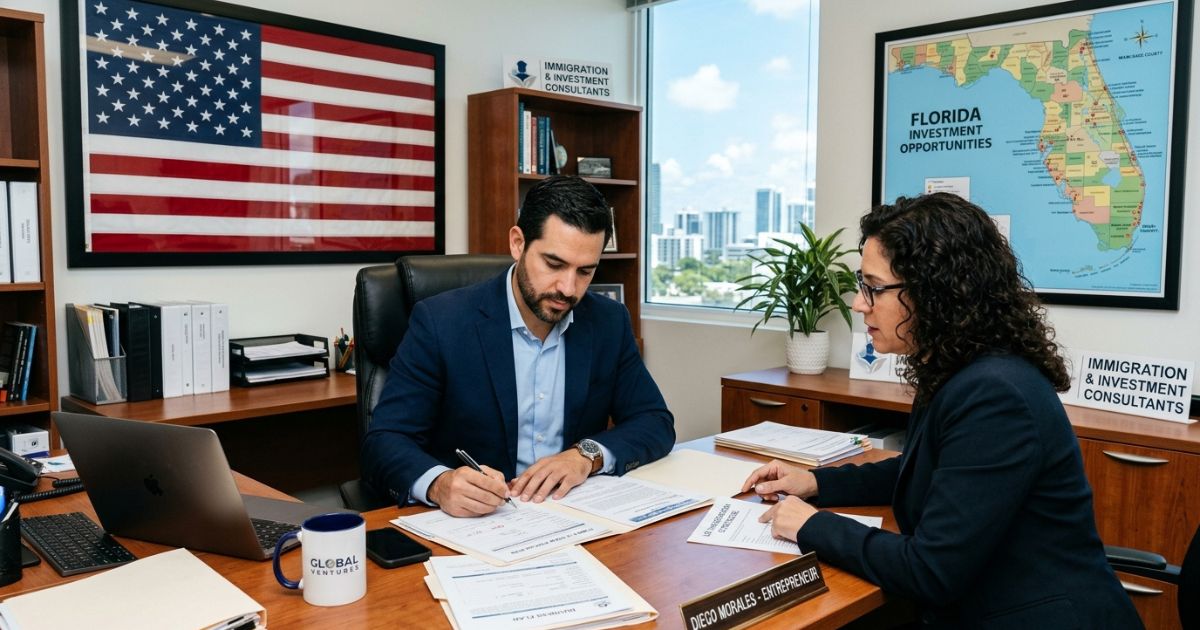
If you’re considering buying land in Florida as part of a plan to obtain an EB-5 visa, the visible task is picking the right parcel. The real risk is assuming that simply acquiring land already qualifies for the program — and finding out only after signing the contract and wiring the funds that the required legal structure was never in place. This is one of the most expensive misunderstandings foreign investors run into when trying to combine two legitimate goals: asset protection and US residency.
Most people think of EB-5 as “invest a large sum, receive a green card.” In practice, the program requires a specific business structure, documented job creation, and capital genuinely at risk — and a vacant lot bought purely as a store of value meets none of those three requirements on its own.
Table of Contents
- What the EB-5 visa actually is — and how it differs from a property purchase
- Does buying land automatically qualify for the EB-5 visa?
- Where land and the EB-5 program genuinely intersect
- Regional Center vs direct investment: what changes when land is involved
- Land bought for personal use vs land structured as an EB-5 vehicle
- Common mistakes investors make trying to use land as an EB-5 path
- Hidden costs of structuring an EB-5 land project incorrectly
- FAQ — Frequently Asked Questions
- 📚 Glossary
- ✅ Immediate Actions — Start Now
What the EB-5 visa actually is — and how it differs from a property purchase {#what-is-eb5}
Short answer: the EB-5 program is a permanent residency visa based on investment, requiring capital genuinely "at risk" in a commercial enterprise that creates or preserves at least 10 full-time jobs for US workers — a fundamentally different structure than buying a piece of land for personal use or future appreciation.
Created by Congress in 1990, the EB-5 Immigrant Investor Program grants a green card to foreign investors and their immediate families in exchange for a qualifying investment in a “new commercial enterprise” — a business that is either newly formed or substantially restructured. The current minimum investment is $800,000 when the investment is made in a Targeted Employment Area (TEA — a rural or high-unemployment region), or $1,050,000 outside those areas.
The core point that causes confusion is this: USCIS (United States Citizenship and Immigration Services) doesn’t evaluate the asset purchased — it evaluates the business. Land, by itself, is not a business. It only becomes relevant to EB-5 when it’s part of a business structure that uses that capital to generate real economic activity and verifiable jobs.
Does buying land automatically qualify for the EB-5 visa? {#does-land-qualify}
Short answer: no. A standalone land purchase — even one worth more than $800,000 — doesn't qualify for EB-5, because the program requires an active commercial enterprise with capital at risk and job creation, not simply the ownership of a real estate asset.
This is probably the most common misconception among foreign investors researching “land plus EB-5” or “green card by investing in US real estate.” The logic seems to make sense: “I’m investing more than $800,000, so I already meet the program’s minimum.” But the investment amount is just one requirement — and not the hardest one to satisfy.
To qualify, the investment needs to demonstrate:
- Capital genuinely at risk — the money needs to be exposed to real gain or loss tied to the business’s performance, not simply sitting in an appreciating asset
- A link to an active commercial enterprise — this can be a new business, or an existing one undergoing substantial restructuring
- Creation of at least 10 full-time jobs — direct or indirect, documented with the specific evidence USCIS requires within the sustainment period
Land bought to build a vacation home, to preserve wealth, or to resell later meets none of these criteria — because in that scenario there’s no commercial enterprise generating jobs at all.
Where land and the EB-5 program genuinely intersect {#where-they-intersect}
Short answer: land can be part of a legitimate EB-5 project when it serves as the physical foundation of a commercial development — such as a residential, commercial, or hospitality project — structured specifically to meet the program's requirements, typically through a USCIS-authorized Regional Center.
The real connection between land and EB-5 works like this: a developer or Regional Center structures a development project — for example, a residential community, a hotel, or a commercial complex — that requires land as part of construction. The EB-5 investor contributes capital to that project, which is used to acquire the land, build, and operate the development, generating the jobs required by the program during both the construction and operating phases.
In this model, the investor isn’t buying land directly — they’re investing in a commercial entity that, among other activities, uses land as part of a larger job-creating project. The difference between this and personally buying a parcel is critical: the first scenario can be EB-5 eligible; the second, on its own, is not.
There’s also the option of an investor forming their own “new commercial enterprise,” purchasing land through it, and developing a project that creates the required jobs — known as direct investment. This route tends to involve more complexity, more control over the business, and, typically, close involvement from an EB-5-focused immigration attorney from day one.
Regional Center vs direct investment: what changes when land is involved {#regional-center-vs-direct}
Short answer: in the Regional Center model, the investor contributes capital to a project already structured by a third party and has less operational control, but benefits from more flexible job-counting rules; in direct investment, the investor structures the business, buys the land, and manages development directly, with more control but stricter requirements to document direct employment.
Regional Center
A Regional Center is an entity authorized by USCIS to manage EB-5 investment projects on behalf of multiple investors. Land and development sit under the managing entity’s responsibility, and the investor participates as a capital partner — usually without day-to-day management involvement. Job counting can include indirect and induced jobs, calculated through economic modeling, which tends to make it easier to satisfy the 10-job requirement.
Direct investment
Here, the investor forms or acquires the business itself, which buys the land and runs the development. This path requires documenting direct jobs — employees formally hired by the business — which is often harder to sustain with a land project alone, unless the development produces ongoing operations (like a hotel, an operating commercial property, or a working farm with a documented workforce).
Land bought for personal use vs land structured as an EB-5 vehicle {#comparison-table}
| Aspect | Land for Personal Use / Appreciation | Land Inside an EB-5 Project |
|---|---|---|
| Legal structure | Direct purchase, individual or simple LLC | New commercial enterprise, with a formal business plan |
| Capital at risk | Not applicable — it's an asset purchase | Required — capital must be exposed to real gain or loss |
| Job creation | No requirement | Minimum of 10 documented full-time jobs |
| Green card eligibility | None, on its own | Possible, if all USCIS requirements are met |
| Documentation complexity | Low — contract, title, standard due diligence | High — business plan, economic job-count model, I-526E |
| Need for an immigration attorney | Not required | Essential from initial planning onward |
Common mistakes investors make trying to use land as an EB-5 path {#common-mistakes}
Assuming the amount invested, on its own, guarantees eligibility
Investing $800,000 or more in a piece of land doesn’t replace the requirement for a commercial structure and documented job creation. The amount is a necessary condition, but not a sufficient one.
Buying the land before consulting an immigration attorney
Once a purchase has already happened outside a valid EB-5 structure, fixing that afterward — restructuring ownership or forming a business retroactively — tends to be complicated, expensive, and not always possible within USCIS timelines and rules.
Confusing “real estate investment” with “EB-5 real estate investment”
Buying a property to rent or resell is traditional real estate investing. It only becomes relevant to EB-5 when structured as part of an eligible commercial enterprise with demonstrable job creation.
Ignoring the sustainment period for at-risk capital
Capital must remain at risk for a minimum period set by USCIS. Selling the land or liquidating the project before that period ends can jeopardize immigration status even after initial approval.
Not verifying that the Regional Center is properly authorized
Not every entity marketing itself as an “EB-5 project” has valid USCIS authorization. Verifying a Regional Center’s official registration is a step that can’t be skipped.
Hidden costs of structuring an EB-5 land project incorrectly {#hidden-costs}
- Losing eligibility after capital has already been invested — discovering too late that a structure doesn’t meet the requirements can mean starting the entire process over with new capital
- Legal fees to try to fix an already-formed structure — restructuring after the fact usually costs more than planning correctly from the start
- Years of delay in the immigration process — poorly structured petitions (I-526E) face requests for additional evidence (RFEs) or denials, significantly extending the timeline to a green card
- Capital tied up with no immigration payoff — the money may be soundly invested from a real estate standpoint, but deliver no immigration benefit if the structure isn’t eligible
- Risk of losing the investment in poorly vetted Regional Center projects — not every project marketed as “EB-5” has solid financial viability; due diligence on the underlying development is essential
FAQ — Frequently Asked Questions {#faq}
Does buying land worth more than $800,000 in Florida already qualify me for the EB-5 visa?
No. The investment amount is just one requirement. The capital must be tied to an active commercial enterprise, genuinely at risk, and the project must create at least 10 full-time jobs within the timeframe USCIS requires.
Is there any legitimate way for land to count toward EB-5?
Yes, when the land is part of a commercial development project — residential, hospitality, or commercial — structured as a new commercial enterprise, typically through an authorized Regional Center or through direct investment with a formal business plan.
What’s the current minimum EB-5 investment amount?
$800,000 in areas designated as a Targeted Employment Area (TEA) — rural or high-unemployment regions — or $1,050,000 outside of those areas.
Can Brazilian and Latin American investors participate in the EB-5 program?
Yes. The program is open to foreign investors of any nationality, provided they meet the requirements around lawful source of funds, minimum investment amount, and documented job creation.
Do I need an immigration attorney to invest in an EB-5 project involving land?
Yes, strongly recommended. Structuring the investment, vetting the Regional Center, and preparing the I-526E petition involve specific technical requirements that go far beyond a typical real estate transaction.
📚 Glossary {#glossary}
EB-5: a US permanent residency visa category based on investment, requiring capital at risk in a commercial enterprise and the creation of at least 10 full-time jobs.
New Commercial Enterprise (NCE): a new or substantially restructured commercial business that serves as the vehicle for an EB-5 investment.
Regional Center: an entity authorized by USCIS to manage EB-5 investment projects on behalf of multiple investors, generally allowing more flexible counting of indirect jobs.
Targeted Employment Area (TEA): a government-designated rural or high-unemployment area where the minimum EB-5 investment amount is reduced to $800,000.
At-risk capital: the requirement that invested capital be genuinely subject to gain or loss tied to the business’s performance, rather than simply parked in a static asset.
I-526E: the petition filed with USCIS by the investor to demonstrate that the investment and project meet EB-5 program requirements.
Sustainment period: the minimum length of time invested capital must remain at risk in the project, required to maintain immigration status.
✅ Immediate Actions — Start Now {#immediate-actions}
- Don’t buy land assuming it automatically qualifies for EB-5 — confirm the legal structure before transferring any funds
- Consult an EB-5-focused immigration attorney before structuring the investment, not after
- Verify that the Regional Center involved is properly authorized by USCIS
- Request the project’s business plan and job-creation economic model before investing
- Evaluate the real estate viability and the immigration eligibility of the project separately — they’re two different analyses
- Confirm the sustainment period required for at-risk capital in your specific case
- Talk to TerraNoble for bilingual guidance on Florida land projects and how they relate — or don’t — to immigration-linked investment structures
Conclusion
Land and the EB-5 visa can genuinely intersect — but not in the simple way most foreign investors assume. Buying a parcel in Florida, no matter how large the investment, doesn’t replace the program’s central requirement: capital genuinely at risk, tied to a commercial enterprise that creates at least 10 full-time jobs. The real connection happens when land is part of a development project specifically structured to meet those rules — not when it’s simply an asset bought for appreciation or personal use.
Understanding that distinction before committing capital avoids months or years of frustrated immigration expectations and protects the real estate investment itself, which remains a sound decision when evaluated on its own merits.
TerraNoble offers bilingual support — in English and Portuguese — to help foreign investors understand how Florida land fits, or doesn’t fit, into different investment strategies, including situations involving immigration planning. Get in touch with our team to discuss your specific situation.