Important notice: this article is for informational and educational purposes only. It does not constitute financial, legal, or tax advice. Decisions about allocating savings between land, gold, dollars, or any other asset should take the investor's personal situation into account and, ideally, guidance from a qualified professional.
When a local currency loses value, the first question on the mind of someone with savings isn’t “where can I earn more” — it’s “where can I put my money so I stop losing what I already have.” For millions of Latin American investors who have watched the peso, the real, the boliviano, or the bolívar lose purchasing power within a few short years, that question is anything but theoretical.
Most people assume protecting wealth just means picking the “safest” asset. In practice, land, gold, and dollars each protect in different ways — and each one has a weak point that only shows up after the money is already committed. Understanding those differences before deciding is what separates a well-built store of value from a decision made in a panic.
Table of Contents
- Why Latin American investors look for stores of value abroad
- Gold: historical protection with practical limitations
- Cash or dollar accounts: liquidity with erosion risk
- Florida land: physical protection with appreciation potential
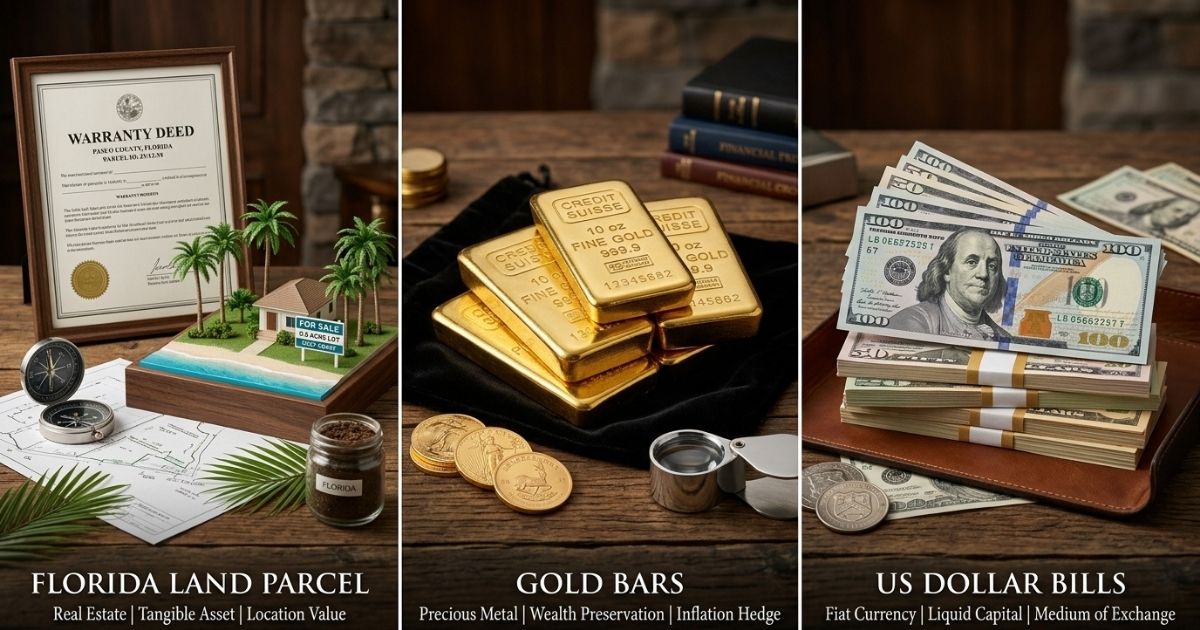
- Comparing land, gold, and dollars
- Common mistakes when choosing a store of value
- Hidden costs of each type of store of value
- FAQ — Frequently Asked Questions
- 📚 Glossary
- ✅ Immediate Actions — Start Now
Why Latin American investors look for stores of value abroad {#why}
Short answer: Latin American investors look to gold, dollars, and land in the United States mainly to protect their wealth from local currency devaluation, inflation, and political or economic instability, moving part of their savings outside their home country's financial system.
This behavior isn’t new, but it has intensified over recent decades in countries like Argentina and Venezuela, and more recently during periods of sharp currency volatility in Brazil and elsewhere in the region. The logic is simple: if a local currency can lose half its value in a few years, keeping all your savings in it represents a concentrated risk.
The three most common alternatives are:
- Gold — a physical asset historically used as a store of value for centuries.
- US dollars — a currency widely considered more stable, whether held as cash, in a bank account, or in dollar-denominated investments.
- Land in the United States — a physical, productive asset, typically in Florida, combining currency protection with long-term appreciation potential.
None of these three options is immune to risk. Each one protects against a specific problem while remaining exposed to another — and understanding that difference is exactly what needs to happen before deciding where to allocate resources.
Gold: historical protection with practical limitations {#gold}
Short answer: gold works as a store of value because it doesn't depend on any single government or currency, but it has limited practical liquidity in small quantities, carries storage and insurance costs, and generates no income while it sits in a vault.
Gold’s appeal is historical: it has outlasted empires, wars, and currency crises while holding relative purchasing power. For a Latin American investor, buying physical gold or paper gold is a relatively simple way to step outside the local currency without depending on a foreign banking system.
Key points about gold as a store of value:
- High theoretical liquidity, variable practical liquidity — gold can, in theory, be sold quickly, but selling a large bar at the right time, at a fair price, requires access to reliable buyers.
- Storage and insurance costs — keeping physical gold at home is risky; storing it in a bank vault or with a specialized custodian carries an ongoing cost.
- No income generation — unlike a rented property or an interest-bearing investment, idle gold produces no cash flow — it only preserves (or appreciates in) value over time.
- Short-term volatility — despite its long-term stability, gold’s price can swing significantly over short periods, reacting to central bank decisions and global risk appetite.
For someone who just wants to preserve a small portion of their wealth in something tangible and outside the banking system, gold serves that purpose well. For someone looking to grow wealth over the years, gold alone tends to fall short.
Cash or dollar accounts: liquidity with erosion risk {#dollar}
Short answer: holding US dollars in cash or in a bank account offers immediate liquidity and protection against local currency devaluation, but it's still exposed to US inflation, subject to international account limits and fees, and generates no appreciation of its own — it only preserves purchasing power relative to other currencies.
For most Latin Americans, the dollar is the most accessible way to step outside their local currency. It can be held physically, kept in a US bank account, or invested in dollar-denominated assets like US Treasury bonds or funds.
Relevant characteristics:
- Immediate liquidity — dollars in an account or in cash can be used, transferred, or converted quickly, without the sale process that gold or land requires.
- Exposure to US inflation — even as a strong currency, the dollar also loses purchasing power to inflation in the United States, though typically at a slower pace than many Latin American currencies.
- No appreciation of its own — unlike land or gold, idle dollars don’t appreciate; they only avoid devaluation relative to the investor’s home currency.
- International account costs — opening and maintaining a US bank account as a non-resident can involve fees, minimum balances, and specific documentation.
The dollar works well as a liquidity reserve and a short-term safe harbor, but it’s rarely the best standalone option for someone thinking about building wealth over decades.
Florida land: physical protection with appreciation potential {#land}
Short answer: land in Florida works as a store of value because it's a physical, dollar-denominated asset, protected from the investor's local currency devaluation, with appreciation potential tied to the state's population and economic growth — but it has lower liquidity than gold or dollars and comes with ongoing costs like property tax.
Unlike idle gold or dollars, land is a potentially productive asset: it can be used, leased, built on, or sold, and its value tends to track the growth of the region where it’s located. Florida specifically has drawn Latin American investors by combining a growing population, no state income tax, and a historically active real estate market.
Points that set land apart as a store of value:
- Physical, dollar-denominated asset — like gold, land doesn’t depend on the investor’s local currency, but unlike gold, it’s tied to a real, growing economy.
- Long-term appreciation potential — land value tends to track factors like infrastructure expansion, population growth, and regional development, though appreciation is never guaranteed.
- Lower liquidity — selling land typically takes weeks or months, unlike the near-instant liquidity of gold or dollars.
- Ongoing ownership costs — unlike gold sitting in a vault, land carries recurring obligations, such as property tax and, depending on the case, basic upkeep of the lot.
- Accessible purchase process for foreigners — Latin American investors can buy land in the United States without needing citizenship, a residency visa, or a US credit history.
Land tends to make the most sense for someone thinking in a medium-to-long-term horizon who accepts lower liquidity in exchange for a physical asset with growth potential — not for someone who needs immediate access to their funds.
Comparing land, gold, and dollars {#comparison-table}
| Criteria | Land (Florida) | Gold | Dollars |
|---|---|---|---|
| Liquidity | Low (weeks to months) | Medium to high | Immediate |
| Appreciation potential | Moderate to high, tied to regional growth | Moderate, historically stable long term | None (only preserves purchasing power) |
| Generates income | Possible (leasing, future development) | No | Possible if invested at interest |
| Ongoing costs | Property tax and basic upkeep | Storage and insurance | Possible international account fees |
| Protection against local currency inflation | High | High | High |
| Complexity for a Latin American investor | Moderate (purchase process and documentation) | Low to moderate | Low to moderate |
None of the three assets fully replaces the other two. Many Latin American investors looking for solid wealth protection combine dollar liquidity, a smaller gold reserve, and a portion in land, adjusting the proportions based on their time horizon and need for quick access to funds.
Common mistakes when choosing a store of value {#common-mistakes}
Putting all your wealth into a single asset
Concentrating everything in gold, everything in dollars, or everything in land exposes the investor to that specific asset’s weak point — whether it’s land’s low liquidity, idle dollars’ lack of appreciation, or gold’s short-term volatility.
Ignoring the need for immediate liquidity
Investing most of your savings in land, without keeping a liquid reserve in dollars, can leave an investor without quick access to funds in an emergency, since selling a property isn’t instant.
Buying land without understanding the US purchase process
Some investors treat buying land as being just as simple as buying gold or opening a dollar account, without accounting for due diligence, zoning, documentation, and the closing process — steps that require more planning.
Treating gold or dollars as growth investments
Gold and idle dollars preserve value, but they don’t generate wealth growth on their own. Expecting them to play the same role as a productive asset, like well-located land, tends to lead to frustration over the long run.
Hidden costs of each type of store of value {#hidden-costs}
Short answer: beyond the amount invested, each store of value carries its own costs — gold has storage and insurance, dollars can involve international account fees and loss of purchasing power to US inflation, and land has property tax, upkeep, and transaction costs at both purchase and sale.
- Gold — secure storage costs, theft insurance, and a possible spread between buy and sell price
- Dollars — international account maintenance fees, currency exchange charges, and erosion from US inflation over the years
- Land — annual property tax, occasional lot upkeep (mowing, fencing), closing costs at purchase, and commissions at sale
Calculating these costs in advance keeps investors from overestimating the net return of any single option, especially when comparing land, gold, and dollars side by side.
FAQ — Frequently Asked Questions {#faq}
Which of these three options best protects against local currency devaluation?
All three protect, because none of them depends on the investor’s local currency. The difference is in how each one behaves afterward: dollars preserve without growing, gold preserves with some volatility, and land has appreciation potential but lower liquidity.
Can foreigners buy land in the United States?
Yes. There’s no requirement of US citizenship, a residency visa, or a US credit history to buy land in the United States, including in Florida.
Is it better to put all your wealth into land?
Generally not recommended. Since land has lower liquidity, keeping a portion of savings in dollars or another liquid asset helps cover immediate needs without depending on selling the property.
Is physical gold safer than paper gold (ETFs or certificates)?
Each format has different advantages. Physical gold eliminates counterparty risk but requires secure storage; paper gold offers more liquidity and lower storage costs, but depends on the issuing institution.
Does land in Florida generate income while it’s not sold?
It can, depending on the lot and its zoning — through agricultural leasing, storage rental, or event venue leasing, for example, though this isn’t automatic or guaranteed for every piece of land.
📚 Glossary {#glossary}
Store of value — an asset that maintains purchasing power over time, used to protect wealth from inflation or the devaluation of a specific currency.
Property tax — an annual tax on real property, assessed by the county where the property or land is located in the United States.
Dollar-denominated asset — an investment whose value is expressed and traded in US dollars, regardless of the investor’s home currency.
Liquidity — the speed and ease with which an asset can be converted into available cash without a significant loss of value.
Wealth diversification — a strategy of spreading resources across different types of assets to reduce exposure to the risk of any single investment.
Closing — the final step of buying property or land in the United States, when documents are signed and ownership is officially transferred.
✅ Immediate Actions — Start Now {#immediate-actions}
- Assess what percentage of your wealth is concentrated solely in your local currency
- Decide how much you need to keep in immediate liquidity (dollars) before considering less liquid assets
- Research the real cost of storage and insurance if you’re considering physical gold
- Check the requirements for buying land in the United States as a foreigner
- Compare the annual property tax cost of Florida land before investing
- Talk to TerraNoble about how land can fit into your wealth protection strategy
Conclusion
Land, gold, and dollars aren’t competing with each other — each one solves a different problem for the Latin American investor looking to protect their wealth. Dollars offer immediate liquidity, gold offers a historically stable physical reserve, and Florida land combines currency protection with long-term appreciation potential, at the cost of lower liquidity. The goal isn’t to pick a single winner, but to understand the role each asset plays and combine them in a balanced way based on the investor’s time horizon and needs.
TerraNoble offers bilingual support — in English and Portuguese — for Latin American investors considering Florida land as part of their wealth protection strategy, helping them understand the purchase process and what to check before investing.