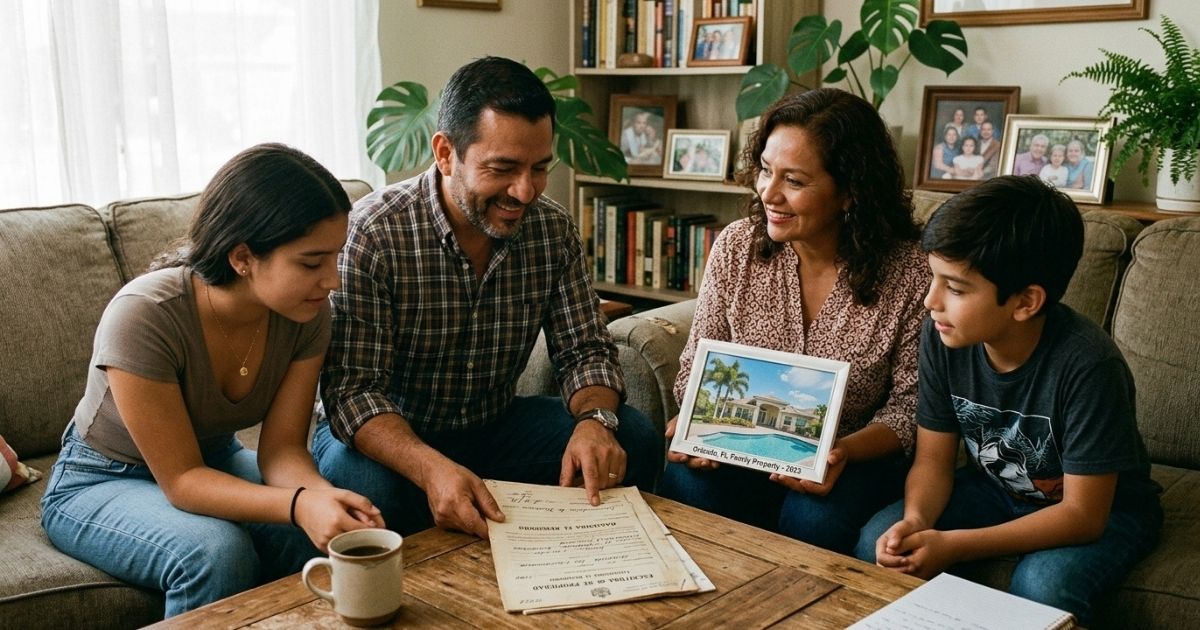
Important notice: this article is for informational and educational purposes only. It does not constitute legal or tax advice. Before structuring an inheritance, consult an attorney specializing in estate planning and a licensed accountant in the United States.
If a piece of Florida land is left to heirs with no preparation at all, the visible problem is just the probate paperwork. The real, and far more expensive, risk is that the family inherits an asset it doesn’t understand — without knowing why it was bought, what to do with it, or how to keep paying the taxes that still come due after the estate is settled. That’s where a planned inheritance stops being paperwork and becomes long-term protection.
Most parents assume that “putting the land in the kids’ names” already takes care of it. In practice, a well-transferred asset depends far more on communication, structure, and financial education than on any document signed at a title office.
Table of Contents
- Why land is different from a cash inheritance
- What a “planned inheritance” actually means
- Unplanned inheritance vs. planned inheritance
- How to prepare your children to inherit land
- Structures that make transferring land easier
- Common mistakes in land inheritance planning
- Hidden costs of a poorly planned inheritance
- FAQ — Frequently Asked Questions
- 📚 Glossary
- ✅ Immediate Actions — Start Now
Why land is different from a cash inheritance {#different-cash}
Short answer: unlike cash in a bank account, land is an illiquid asset that generates ongoing obligations — property taxes, maintenance, and in some cases association fees — even after it's inherited, which means heirs need to understand these responsibilities before receiving the property, not after.
Inheriting cash is simple: the money lands in an account and can be used right away. Inheriting land works differently because the asset stays “alive” — it needs to be managed, it carries recurring annual taxes, and it can’t be divided into equal shares as easily as a sum of money.
For families with land in Florida, this difference matters even more because:
- The property sits in another country, with different laws, deadlines, and tax obligations than heirs may be used to.
- Heirs may never have visited the land or fully understood why it was purchased in the first place.
- Without guidance, the most common reaction to an unfamiliar asset is to sell it quickly — often for less than it’s actually worth.
What a “planned inheritance” actually means {#planned-inheritance}
Short answer: a planned inheritance means the legal ownership structure, the documentation, and the heirs' understanding of the asset were all prepared while the parents are still alive — reducing transfer time, costs, and the chance of family conflict.
A planned inheritance usually rests on three layers working together:
- Legal structure, such as a trust or a family LLC, that defines how the land passes to heirs without depending solely on a will.
- Organized documentation, including the deed, tax payment history, appraisals, and the professional contacts used during the purchase.
- Human preparation, meaning the children understand the value of the land, why it exists in the family’s plan, and what will be expected of them after the transfer.
Most traditional estate planning covers only the first layer. The families that avoid conflict and preserve value are the ones who also invest in the third.
Unplanned inheritance vs. planned inheritance {#comparison-table}
| Aspect | Unplanned inheritance | Planned inheritance |
|---|---|---|
| Heirs' understanding of the asset | Low or nonexistent | Built over the years, while parents are alive |
| Time to effective transfer | Can take months in probate | Reduced with a trust or structured LLC |
| Risk of conflict between heirs | High, especially without a clear division | Low, with rules defined in advance |
| Continuity of tax payments | Can be delayed, leading to penalties | Planned and organized ahead of time |
| Decision to keep or sell | Made hastily, under emotional pressure | Discussed clearly before it becomes necessary |
How to prepare your children to inherit land {#how-to-prepare}
Short answer: preparing your children means introducing them to the land while you're still alive, explaining why it was purchased, including them in conversations about costs and decisions, and making sure they know where to find the documentation when it's needed.
Introduce the asset before you need to transfer it
Many children only learn their family owns land in the United States at the moment they inherit it. Showing them the land — in person, through photos, or during a visit — and explaining why it was bought creates emotional and practical context that no document can provide on its own.
Explain the recurring costs, not just the asset’s value
Land carries annual property taxes, possible maintenance fees, and in some cases insurance. Heirs need to understand these costs as part of the inheritance, not as an unpleasant surprise after their parents are gone.
Involve your children in decisions, gradually
Bringing an adult child along to a conversation with the accountant or attorney responsible for the land — even just as an observer — builds familiarity with the process and the professionals involved, reducing uncertainty once the responsibility is handed over.
Keep the documentation in one place
The deed, proof of taxes paid, the purchase contract, and professional contacts should be organized and accessible — ideally, heirs should already know where to look for this information before they ever need it.
Structures that make transferring land easier {#transfer-structures}
Short answer: structures like a revocable living trust or a family LLC tend to make transferring land in the United States easier because they avoid or reduce the probate process, allowing heirs to take ownership faster and with lower legal costs.
- Revocable living trust — the land is transferred into a trust during the owner’s lifetime, with the children named as beneficiaries, avoiding probate in most cases.
- Family LLC — the land is owned by the company, and parents transfer membership shares to their children over time, which can simplify succession and governance among multiple heirs.
- Traditional will — still necessary as a supporting structure, even when a trust exists, but on its own usually involves more time and probate costs.
Choosing between these structures depends on the number of heirs, the value of the estate, and the family’s goals — which is why guidance from an attorney who specializes in international estate planning is essential before deciding.
Common mistakes in land inheritance planning {#common-mistakes}
Short answer: the most frequent mistakes include never telling heirs the land exists, relying solely on a will as the transfer structure, letting the documentation go out of date, and assuming children will know what to do without any prior guidance.
- Never telling the children about the land, leaving the discovery for the moment of probate.
- Relying only on a will, without considering structures that avoid probate.
- Letting the documentation become disorganized or outdated, making it hard to locate essential information later.
- Assuming heirs will want to keep the land, without ever having discussed it with them.
- Never revisiting the plan periodically, especially after changes in the law or in the family itself.
Hidden costs of a poorly planned inheritance {#hidden-costs}
Short answer: a poorly planned land inheritance can generate probate attorney fees, unpaid property taxes accumulating during the process, outdated tax assessments, and in extreme cases a forced sale of the land by heirs who can't afford the ongoing expenses.
- Probate attorney fees, which vary by county and case complexity, reducing the net value heirs actually receive.
- Accumulated property taxes during the period when ownership is still being resolved in court.
- Lost opportunity, when the land has to be sold quickly to cover costs that could have been anticipated.
- Family conflict, with emotional strain that often outweighs the financial value in dispute.
- Legal rework, when the original structure didn’t clearly account for dividing the asset among multiple heirs.
FAQ — Frequently Asked Questions {#faq}
At what age should children start learning about the family’s land?
There’s no exact age, but estate planning professionals generally recommend starting once children are adults and can grasp basic financial concepts — typically in the late teens or early adulthood.
Is it better to put the land in your children’s names while you’re still alive?
It depends on the family’s goals. Transferring ownership during your lifetime can simplify succession, but it also carries tax and control implications that need to be reviewed with an attorney and an accountant before any decision is made.
What happens if heirs don’t want to keep the land?
If the family has already discussed this possibility, the sale can be handled in an organized, planned way instead of a rushed decision made under emotional or financial pressure right after the inheritance.
Does a trust completely eliminate the need for a will?
Not necessarily. Even with a well-structured trust, it’s common to keep a will as a backup structure, covering any assets that weren’t included in the trust.
Does TerraNoble help with planning the inheritance of the land?
TerraNoble offers bilingual support to connect families with attorneys and accountants who specialize in U.S. estate planning, along with guidance on the documentation tied to the land they purchased.
📚 Glossary {#glossary}
Probate — the court process used to validate a will and transfer assets to heirs, which can take months or years depending on the complexity of the case.
Revocable living trust — a legal structure in which the owner transfers assets into a trust during their lifetime, allowing beneficiaries to inherit without going through probate.
Family LLC — a limited liability company used to hold a property on behalf of several family members, making governance and succession among heirs easier to manage.
Step-up in basis — an adjustment to the taxable value of an inherited property, calculated using its market value on the date of death, which can reduce capital gains tax on a future sale.
Executor — the person named in a will to manage the process of distributing assets according to the instructions left behind.
Deed — the legal document that records ownership of a property and is required to transfer it from one generation to the next.
✅ Immediate Actions — Start Now {#immediate-actions}
- Talk to your children about the land’s existence, even if the inheritance still feels far off
- Organize all of the land’s documentation in a single place the family can access
- Explain the recurring costs of the land, not just its asset value
- Consult an attorney specializing in estate planning to evaluate a trust or family LLC
- Review the estate plan every few years or after major changes in the family
- Talk to TerraNoble to get referrals to bilingual professionals who specialize in wealth succession
Conclusion
A well-chosen piece of land can be one of the most lasting legacies a family leaves for the next generation — but only when the heirs are prepared to receive it. A planned inheritance isn’t just about signing the right documents in time; it’s about making sure your children understand what they’re inheriting, why that land matters, and how to care for it with the same intention that motivated the original purchase.
TerraNoble offers bilingual support — in English and Portuguese — for Latin American investors, helping families connect with experienced estate planning professionals and guiding this process with clarity, from the purchase of the land all the way through the transition to the next generation.