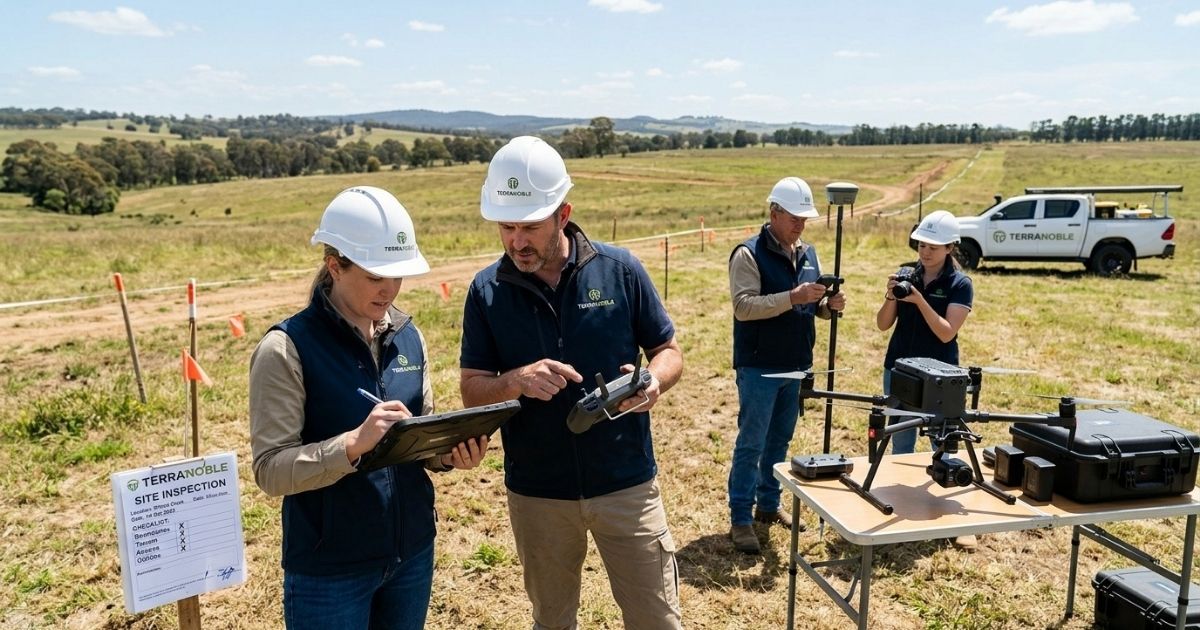
If you’ve ever searched for land in Florida on your own, you’ve probably run into something frustrating: plenty of listings look great on paper, but they hide a problem that only surfaces later — zoning that doesn’t allow what you actually want to build, a flood zone designation that quietly inflates insurance costs, or a title issue that stalls closing at the worst possible moment. The visible problem is wasted time. The real problem is making a decision on incomplete information.
Most people assume choosing land comes down to price, size, and location. In practice, what separates a safe parcel from a problematic one rarely shows up in the listing photos — it’s buried in county records, zoning maps, and title documents. This article walks through, transparently, the criteria TerraNoble checks before any parcel is recommended to a buyer.
Table of Contents
- Why not every listed parcel makes it to you
- What we check before recommending land
- Zoning and permitted land use
- Flood zone and flood risk exposure
- Property title and deed restrictions
- Utility access and legal road access
- Approved vs. rejected: how a parcel compares
- Mistakes buyers make without this kind of screening
- Hidden costs this screening helps you avoid
- FAQ — Frequently Asked Questions
- 📚 Glossary
- ✅ Immediate Actions — Start Now
Why not every listed parcel makes it to you {#not-every-parcel}
Short answer: TerraNoble reviews far more parcels than it ever recommends. Land with unclear zoning, serious flood zone exposure, title problems, or questionable legal access gets filtered out before it ever reaches a buyer.
That’s because vacant land in Florida behaves differently from an existing home. A finished home has already gone through municipal inspections and approvals at some point in its history. Vacant land hasn’t — the buyer is the one who ends up discovering, after closing, whether that piece of ground actually allows the project they had in mind.
That’s why, before any parcel gets presented as an opportunity, it goes through screening that covers legal documentation, municipal restrictions, and environmental risk. The goal isn’t to approve as many properties as possible — it’s to reduce the chance a buyer discovers a serious problem after the deal has already closed.
What we check before recommending land {#what-we-check}
Short answer: TerraNoble's screening process covers four main areas — zoning and land use, flood zone exposure, title status and deed restrictions, and legal access to utilities and public roads. A parcel only gets recommended once these four areas have been checked against official county records.
This screening doesn’t replace the due diligence a buyer and their attorneys should still perform before closing. It functions as a first filter — removing parcels with clear problems before a buyer spends time evaluating land that should never have made the list in the first place.
Zoning and permitted land use {#zoning}
Short answer: zoning determines what can legally be built on a parcel — residential, agricultural, commercial, or mixed-use — and checking this before recommending a property prevents a buyer from finding out after purchase that their intended project isn't actually allowed.
Every Florida county has its own zoning code, and it’s common to find land marketed as “residential” that, in practice, carries restrictions on minimum building size, setbacks from property lines, or the number of units permitted. Before recommending a parcel, we verify the zoning classification directly with the county’s planning department — not just what the listing description claims.
When a buyer has a specific goal, like building a single-family home or a small rural property, this is the first filter we apply: does the current zoning allow that use, or would it require a variance or rezoning process that can take months with no guarantee of approval?
Flood zone and flood risk exposure {#flood-zone}
Short answer: we check the FEMA flood zone designation for every parcel before recommending it, because flood risk classification directly affects insurance cost, foundation elevation requirements, and, in some cases, whether a project is financially viable at all.
A parcel located in a high-risk zone, such as AE or VE, can require an elevated foundation, mandatory flood insurance, and construction costs meaningfully higher than a similar parcel in a minimal-risk zone X. None of this typically comes through clearly in the original listing — it takes cross-referencing the exact parcel location against official FEMA flood maps.
That doesn’t mean parcels in a flood zone are automatically ruled out. Plenty of highly desirable areas of Florida carry some degree of flood exposure. What we do is make sure the buyer knows exactly what classification applies before deciding, instead of finding out when they call for an insurance quote.
Property title and deed restrictions {#title}
Short answer: before recommending a parcel, we check that the title is free of significant issues — liens, ownership disputes, or deed restrictions that could limit how the land can be used in ways a buyer wouldn't expect.
A title with problems can delay or even derail closing — and certain deed restrictions, such as limits on the type of construction allowed or easements granting access to third parties, remain in effect after the sale regardless of what the buyer originally planned to do with the land.
This step involves pulling public records in the county where the parcel is located. Land with a history of title problems, or with deed restrictions that conflict with a buyer’s intended use, gets flagged or removed from the recommendation list.
Utility access and legal road access {#utility-access}
Short answer: a parcel without confirmed legal access to a public road, or without a clear path to water, power, and sewer service (municipal or septic), can add tens of thousands of dollars to the cost of making it buildable — which is why this check is part of our screening before any recommendation.
Land in more remote areas sometimes lacks direct access to a public road, depending instead on an easement that needs to be formally recorded to be enforceable. Similarly, a parcel far from municipal sewer service may require a septic system, and the cost and feasibility of that system depend on soil type and the county health department’s rules.
We verify these conditions before recommending a parcel so the buyer enters negotiations already knowing whether they’ll need additional infrastructure investment — instead of discovering it once they’re deep into the design phase.
Approved vs. rejected: how a parcel compares {#comparison-table}
| Criteria | Parcel Approved for Recommendation | Parcel Rejected or Flagged |
|---|---|---|
| Zoning | Intended use is permitted under current classification | Requires a variance or rezoning with no guaranteed approval |
| Flood Zone | Risk classification confirmed and disclosed to the buyer | Exposure not clearly disclosed in the original listing |
| Title | No significant liens or disputes in county records | Pending liens, disputes, or conflicting deed restrictions |
| Access & Utilities | Legal road access and water/sewer feasibility confirmed | Access depends on an unrecorded easement or uncertain infrastructure |
Mistakes buyers make without this kind of screening {#common-mistakes}
Trusting the listing description alone
Land listings tend to highlight location and lot size, but rarely spell out exact zoning, flood zone, or deed restrictions. Relying only on the listing description, without checking county records, is one of the most common mistakes first-time land buyers make.
Assuming “residential zoning” means unlimited freedom to build
Even within a residential classification, there are usually rules on minimum building size, setbacks, height, and, in some counties, additional HOA restrictions. Assuming a zoning classification guarantees any type of construction is a frequent and costly misunderstanding.
Skipping legal access verification
A parcel can look accessible on a map without having a legally recorded road to reach it. Without this check, a buyer often only discovers the problem once it’s too late to renegotiate.
Overlooking septic system feasibility
In areas without municipal sewer service, not every soil type supports a conventional septic system. Skipping this check can turn an inexpensive parcel into an expensive infrastructure project.
Hidden costs this screening helps you avoid {#hidden-costs}
- Rezoning or variance process — can take months, requires attorney and planning fees, and has no guaranteed outcome
- Flood insurance in a high-risk zone — significantly higher annual premiums, plus elevated construction requirements
- Resolving title issues — attorney fees and closing delays when a problem is discovered late in the process
- Establishing road access or formalizing an easement — legal and engineering costs to secure enforceable access to the parcel
- Installing a septic system on unfavorable soil — soil testing, engineering, and installation can run tens of thousands of dollars above expectations
FAQ — Frequently Asked Questions {#faq}
Does TerraNoble guarantee a recommended parcel will have zero problems?
No. TerraNoble’s screening process significantly reduces the risk of recommending land with obvious zoning, title, flood zone, or access problems, but it doesn’t replace the independent due diligence a buyer and their attorneys should complete before closing.
Is every parcel in a flood zone automatically rejected?
No. Many highly desirable areas of Florida carry some degree of flood exposure. What we do is confirm the risk classification and disclose it clearly to the buyer before the decision, rather than leaving it to surface at insurance quote time.
How do I know if a vetted parcel will support the specific project I want to build?
The verified zoning indicates the general permitted use, but the specific project should still be reviewed with a local architect or engineer, considering setbacks, minimum building size, and other municipal code requirements.
Does TerraNoble offer support in Portuguese during this process?
Yes. TerraNoble offers bilingual support, in English and Portuguese, to help Brazilian buyers understand the selection criteria and documentation behind each parcel before making a purchase decision.
📚 Glossary {#glossary}
Zoning: municipal classification that determines the permitted use of a parcel, such as residential, agricultural, or commercial, along with rules on building size and setbacks.
Flood zone: a FEMA-designated flood risk classification that influences insurance requirements and construction elevation standards.
Deed restriction: a limitation recorded against a property's title that remains in effect after the sale, potentially restricting the type of construction or land use allowed.
Title search: a review of public county records to identify liens, disputes, or other issues affecting ownership of a parcel.
Easement: a recorded legal right allowing access to, or use of, part of a parcel by another party, such as a road providing access to a neighboring lot.
Septic system: an individual wastewater treatment system used on parcels without access to municipal sewer service, with feasibility depending on the parcel's soil type.
✅ Immediate Actions — Start Now {#immediate-actions}
- Request the parcel's official zoning classification directly from the county planning department.
- Check the parcel's flood zone designation on the official FEMA flood map before estimating insurance costs.
- Order a title search to identify liens, disputes, or deed restrictions before making an offer.
- Confirm the parcel has legally recorded access to a public road, not just visual access on a map.
- Evaluate septic system feasibility or distance to municipal sewer service before assuming infrastructure costs.
- Talk to TerraNoble about parcels that have already been through this screening before they reach you.
Conclusion
Choosing land in Florida shouldn’t require blind trust in a listing description. The real risk isn’t what shows up in the photos — it’s unverified zoning, undisclosed flood zone exposure, a title with pending issues, or road access that was never actually confirmed.
That’s exactly why TerraNoble applies a screening process before recommending any parcel: zoning verification, flood zone analysis, title checks, and confirmation of utility and road access. This process doesn’t remove the need for a buyer’s own due diligence, but it significantly reduces the chance of expensive surprises after closing.
TerraNoble offers bilingual support — in English and Portuguese — to help you understand every step of this screening process before you decide. Talk to our team about Florida land that has already been through this careful review.