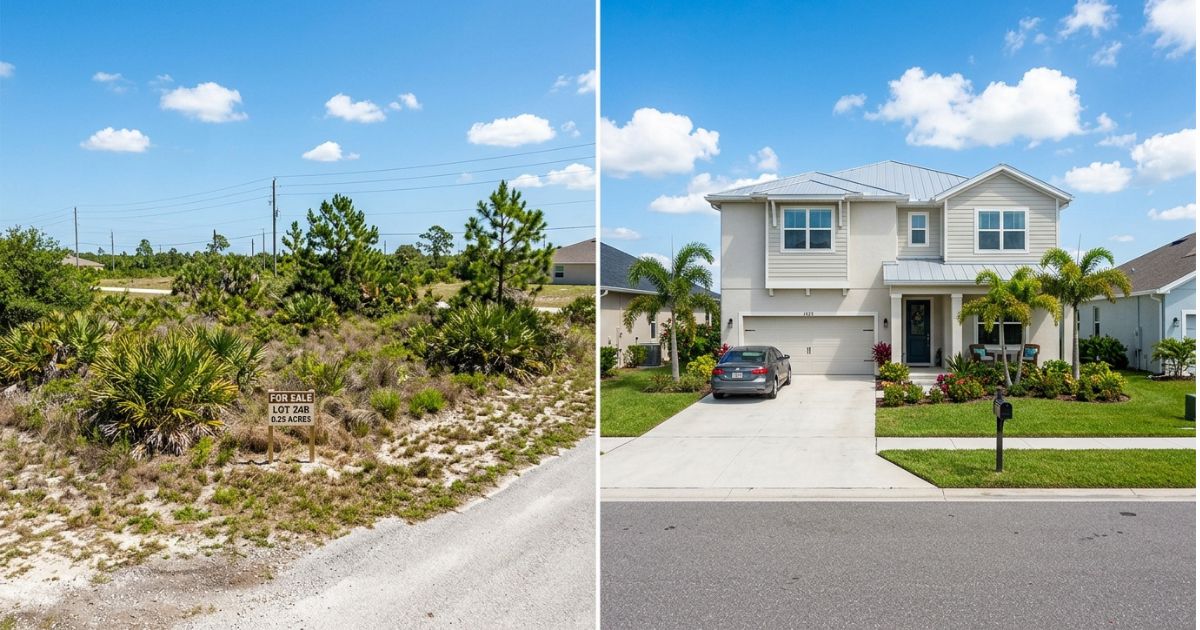
If you’re deciding between a vacant lot and a ready-built home in Florida, the visible question is which one costs less today. The real risk is choosing based on entry price alone and finding out years later that the investment isn’t paying off at the pace you expected — because land and a built home don’t generate returns the same way, or on the same timeline.
Most people treat this as a question of which property is “the better deal.” In reality, land and a ready-built home answer two different questions: one asks “how much will this ground be worth years from now,” the other asks “how much income or resale value can this property generate right now.” Mixing up those two logics is what leads to return expectations that never match reality.
Table of Contents
- What “pays off faster” actually means when comparing the two
- Vacant land: where the return comes from and how long it takes
- Ready-built home: immediate cash flow vs slower appreciation
- Land vs ready-built home side by side
- What speeds up or slows down the return on each
- Practical return scenarios
- Common mistakes when comparing the two investments
- Hidden costs that delay the return
- How to decide which option fits your profile
- FAQ — Frequently Asked Questions
- 📚 Glossary
- ✅ Immediate Actions — Start Now
What “pays off faster” actually means when comparing the two {#what-it-means}
Short answer: "pays off faster" can mean two different things — time until income starts (rent) or time until a resale profit — and vacant land and a ready-built home each serve one of those goals better, rarely both at once.
Before comparing numbers, it helps to separate the two meanings of “return”:
- Income-based return — money that comes in periodically, like rent from a ready-built home. Vacant land, in most cases, doesn’t generate this kind of return unless it’s leased for agricultural use, storage, or parking — narrow, situational cases.
- Appreciation-based return — the value a property gains over time, which only turns into cash when the property is sold. Vacant land depends almost entirely on this type of return.
When someone asks “which one pays off faster,” the right answer depends on which of these two returns they’re actually after — and that’s the first decision that needs to be clear before looking at any numbers.
Vacant land: where the return comes from and how long it takes {#land-return}
Short answer: the return on vacant land comes almost entirely from appreciation over time, driven by location, infrastructure, and population growth in the area — there's no fixed timeline, and the process is typically measured in years, not months.
Vacant land doesn’t generate passive income in most cases. It costs money every year — property taxes, and occasionally basic lot upkeep — without producing any revenue in return. The return only shows up when the land is sold, or when it becomes the base for a construction project that creates its own value.
The main factors that speed up land appreciation include:
- Proximity to new growth corridors — highways, new subdivisions, and public infrastructure expansion tend to come before appreciation
- Utility availability — lots with access to public water and sewer lines tend to appreciate faster than parcels that depend on a well and septic system
- Favorable zoning — a lot already zoned for its intended use avoids delays and costs that eat into the return
- The local market cycle — counties in an active growth phase tend to appreciate more consistently than stagnant areas
Because it doesn’t generate income along the way, vacant land tends to be a “return concentrated at the end” investment — the money comes in all at once, at resale, rather than in installments over time.
Ready-built home: immediate cash flow vs slower appreciation {#home-return}
Short answer: a ready-built home can start generating a return immediately through rent, but its long-term appreciation tends to be slower and more predictable than land in a fast-growth area, since part of the property's value is already "realized" in the structure itself.
The practical advantage of a ready-built home is cash flow: if rented out, it can start returning part of the invested capital as early as the first month, through monthly rent. That completely changes the math on “time to return” — instead of waiting years for a single appreciation event, the investor collects recurring income that, added up over time, reduces the capital effectively “at risk.”
On the other hand, a ready-built home carries higher recurring costs than vacant land:
- Maintenance of the structure, roof, electrical, and plumbing systems
- Homeowners insurance, generally more expensive than vacant land insurance
- HOA fees, where applicable
- Physical depreciation, which requires ongoing reinvestment to maintain the property’s value
Those costs reduce the net margin from rent and also compete with the capital that, on a vacant lot, would simply be left to appreciate.
Land vs ready-built home side by side {#comparison-table}
| Criteria | Vacant Land | Ready-Built Home |
|---|---|---|
| Main source of return | Appreciation and resale | Rent (income) + appreciation |
| When the return starts | Usually only at resale | Can start in month one, if rented |
| Annual recurring cost | Property tax, minimal lot upkeep | Property tax, insurance, structural maintenance, possible HOA |
| Hurricane/flood exposure | Lower (no structure to damage) | Higher (structure, roof, internal systems) |
| Liquidity (ease of a quick resale) | Generally lower | Generally higher, especially in in-demand areas |
| Predictability of the return | More volatile, depends on the local growth cycle | More predictable, supported by rental income |
What speeds up or slows down the return on each {#return-factors}
What speeds up the return on land
- Location inside or near an active growth corridor
- Zoning already compatible with the intended use, with no rezoning needed
- Access to public water and sewer, lowering the cost of any future construction
- Buying during a low-demand window, ahead of an appreciation cycle
What slows down the return on land
- Incompatible zoning, requiring a rezoning process before any use
- No utilities, raising the cost of any future construction
- A location isolated from any identifiable growth corridor
What speeds up the return on a ready-built home
- Renting it out shortly after purchase, with no extended vacancy period
- Location in an area with consistent rental demand
- A structure in good condition, with no repairs needed before renting
What slows down the return on a ready-built home
- A vacancy period (no tenant) longer than expected
- Unplanned renovations or structural repairs
- Insurance costs higher than estimated, especially in flood or hurricane risk zones
Practical return scenarios {#practical-scenarios}
The numbers below are illustrative scenarios used only to show the logic of each type of investment — they are not guaranteed projections or promises of return.
Land Scenario: a vacant lot bought in a fast-growing county may generate no income at all for several years. The entire return stays concentrated at resale, when the accumulated appreciation — if any — converts into profit all at once. During that period, the investor pays property taxes and occasional lot upkeep, with no offsetting revenue.
Ready-Built Home Scenario: a home bought move-in ready and rented out immediately starts returning part of the invested capital every month, through rent. Over the years, that recurring income reduces the effective amount of capital “sitting idle” in the property, even if the structure’s appreciation is more modest than land in a high-growth area.
The core difference: land bets on a concentrated, uncertain return that arrives later; a ready-built home trades some of that appreciation potential for predictable cash flow.
Common mistakes when comparing the two investments {#common-mistakes}
Comparing only the purchase price
Looking only at the price of the land versus the price of the home ignores that the two have completely different cost and return structures over time.
Assuming every parcel of land appreciates at the same pace
Land appreciation depends directly on location, zoning, and infrastructure — it isn’t an automatic process that happens just because time passes.
Ignoring the opportunity cost of idle capital
Land that generates no income keeps the investor’s capital “parked” until resale. That time without a return also has a cost, even if it never shows up on a monthly bill.
Not accounting for vacancy risk on a ready-built home
Many investors calculate a ready-built home’s return as if it were rented year-round, every year — without factoring in the periods between tenants that reduce actual income received.
Not separating appreciation from cash flow when deciding
Treating the two types of return as interchangeable leads to distorted comparisons. An investor who needs monthly income but chooses vacant land can end up years without any tangible return.
Hidden costs that delay the return {#hidden-costs}
- Impact fees and permit charges — if the plan is to eventually build on the land, these municipal fees can absorb a significant share of the budget and push back the point where the investment starts creating value
- Utility connection costs — land without public water and sewer access requires a well and septic system, a cost that eats into the margin on any future construction or resale
- Extended vacancy on a rental home — months without a tenant directly reduce the projected return, especially in seasonal markets
- Insurance re-rating after climate events — hurricanes and flooding in the area can raise homeowners insurance costs, eroding the net rental margin
- Deferred structural maintenance — issues left unresolved on a ready-built home tend to get worse and cost more the longer they go unrepaired
How to decide which option fits your profile {#how-to-decide}
Short answer: vacant land tends to make more sense for investors focused on long-term appreciation who can wait years without an immediate return, while a ready-built home tends to make more sense for investors who want recurring cash flow and a shorter wait for the first return.
A few questions help guide this decision:
- Do you need monthly income from this investment, or can you wait years for a single payout at resale?
- Do you have the appetite to deal with zoning and infrastructure uncertainty, or do you prefer an asset that’s already ready to use?
- Does your strategy include eventually building on the land, or is the goal purely appreciation and resale?
- Are you prepared for the higher recurring costs of owning a ready-built home, including insurance and maintenance?
There’s no universal right answer — there’s the right answer for each investor’s financial goal and time horizon.
FAQ — Frequently Asked Questions {#faq}
Does vacant land appreciate faster than a ready-built home in Florida?
Not necessarily. Land appreciation depends on the area’s location, zoning, and infrastructure — in some fast-growth areas, land can appreciate quickly; in stagnant areas, it can take much longer than a well-located ready-built home.
Can vacant land generate income?
In specific cases, yes — such as leasing it for agricultural use, storage, or parking — but those situations are limited and don’t compare to the income potential of a rented, ready-built home.
Does a ready-built home always generate positive cash flow?
No. Cash flow depends on occupancy rate, local rent levels, and recurring costs like insurance and maintenance. Vacancy periods or unexpected repairs can temporarily turn cash flow negative.
Which investment has lower climate risk in Florida?
Vacant land tends to have lower exposure to hurricane or flood damage, since there’s no physical structure to be affected — though the land’s own value can still be impacted by changes to FEMA flood risk maps.
Can foreigners invest in both land and ready-built homes in Florida?
Yes. There’s no federal restriction preventing foreigners from buying vacant land or ready-built residential properties in Florida, though it’s advisable to seek bilingual guidance to understand the purchase process, financing, and tax obligations that apply to each case.
📚 Glossary {#glossary}
Cash flow: the recurring net income generated by a property, typically through rent, after operating costs are deducted.
Appreciation: the increase in a property's market value over time, which only converts into real profit at the time of sale.
Vacancy: the period during which a rental property has no tenant and generates no income.
Zoning: the legal classification that defines the allowed uses for a parcel of land or property, set by the county or municipality.
Opportunity cost: the return given up by keeping capital invested in an asset that generates no income, instead of an alternative.
Impact fee: a municipal charge collected when a new construction permit is issued, meant to fund public infrastructure affected by the new property.
Liquidity: how easily and quickly an asset can be converted into cash through a sale.
✅ Immediate Actions — Start Now {#immediate-actions}
- Decide whether your main goal is recurring income or long-term appreciation before comparing prices.
- Research whether the land you're considering sits inside an identifiable growth corridor.
- Check zoning and utility availability before considering any parcel of land.
- If evaluating a ready-built home, research the occupancy rate and average rent in the area.
- Calculate the recurring costs of each option — property tax, insurance, maintenance, and possible HOA fees.
- Factor in the opportunity cost of capital while the land generates no return.
- Talk to TerraNoble for bilingual guidance on which investment profile fits your goals in Florida.
Conclusion
Vacant land and a ready-built home aren’t running the same race — they follow different return logics, on different timelines, with different risks. Land tends to concentrate its return in the future, through appreciation; a ready-built home tends to spread that return out over time, through rent, but with higher recurring costs.
The question “which pays off faster” only has an answer once the investor defines what they’re actually after: monthly income or future appreciation. From there, the comparison stops being about which property is “better” and becomes about which property best serves the financial goal of the person buying it.
TerraNoble offers bilingual support — in English and Portuguese — to help investors understand the real differences between vacant land and a ready-built home in Florida, and to choose the option best aligned with their time horizon and risk appetite. Reach out to our team to discuss your specific situation.