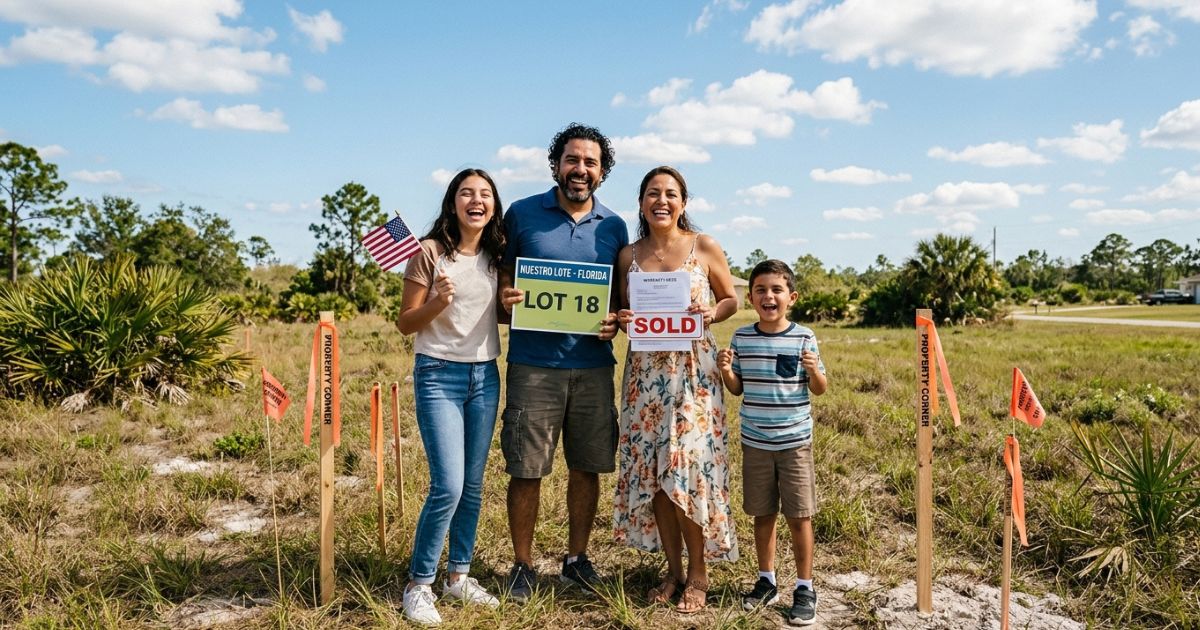
For Latin American families, buying a first parcel of Florida land is often more accessible than it looks — as long as each step, from zoning research to recording the deed, gets verified in the right order.
If you’re a Latin American buyer considering your first piece of Florida land, the most common fear isn’t the price tag — it’s not knowing what you don’t know. The visible question is usually “how much does it cost” or “what documents do I need.” The real risk is something else entirely: closing on a lot with incompatible zoning, no access to utilities, or a title with unresolved issues that only surface months after closing. Prepared Latin American buyers learn to check these details before signing anything.
Most people assume land buying comes down to price and location. In practice, what separates a smart purchase from an expensive one happens behind the scenes — due diligence, zoning verification, and ownership costs that only reveal themselves over time.
Table of Contents
- Can Latin American buyers purchase land in Florida without citizenship?
- Step-by-step: from research to recording the deed
- How much does a first Florida land purchase actually cost?
- Comparison table: vacant land vs. built property for first-time buyers
- Common mistakes first-time Latin American buyers make
- Hidden costs that catch first-time buyers off guard
- What to verify before closing
- FAQ — Frequently Asked Questions
- 📚 Glossary
- ✅ Immediate Actions — Start Now
Can Latin American buyers purchase land in Florida without citizenship? {#who-can-buy}
Short answer: Yes. Foreign nationals and Latin American residents in the US hold the same property rights as US citizens when buying Florida land — no green card, citizenship, special visa, or US company is required to purchase a lot in your own name.
This is the first myth that stalls a lot of buyers before they even start researching lots. There’s no federal law preventing a citizen of Mexico, Colombia, Venezuela, Brazil, or any other Latin American country — common examples among TerraNoble’s own clients — from buying, holding, and transferring land in Florida.
What actually changes for buyers purchasing from abroad
Buyers purchasing while still living outside the US face practical differences, not legal ones:
- Power of attorney: allows the closing to be completed without being physically present in Florida
- More limited financing: US lenders typically require a larger down payment (30% to 50%) for buyers without US credit history
- A US bank account: recommended to simplify paying property taxes and ongoing carrying costs
- Annual tax obligations: even without US residency, the owner must file and pay property taxes every year
None of this blocks the purchase — it just means planning further in advance than a local buyer typically needs to.
Step-by-step: from research to recording the deed {#step-by-step}
Short answer: buying Florida land follows six main steps — setting a budget and target region, researching available lots, completing title and zoning due diligence, signing the purchase contract, going through the inspection period, and closing with a title company, which records the deed in your name with the county.
1. Set a total budget, not just the lot price
Before browsing listings, calculate a budget that includes annual property taxes, any HOA dues, title search costs, and a reserve for future utility connections. Many first-time buyers compare only the sticker price between lots, without factoring in these recurring costs.
2. Research the region and land type
Decide between areas closer to urban centers (higher cost, existing infrastructure) or land in inland Florida (more affordable, may require a well and septic system). This decision directly shapes the total cost of ownership.
3. Complete due diligence before making any offer
Verify zoning, flood zone classification, utility availability, and the title history of the parcel. This step does more than anything else to separate a safe purchase from a costly problem years down the road.
4. Sign the purchase and sale agreement
The contract should include an inspection period — commonly called a due diligence period — typically 15 to 30 days, during which the buyer can walk away from the deal without penalty if problems surface.
5. Hire a title company for closing
The title company runs a formal title search, issues title insurance, and manages the closing — whether in person or by power of attorney for buyers purchasing from abroad.
6. Record the deed with the county
After closing, the title company records the deed with the County Recorder. This recording is what legally formalizes ownership of the land in your name.
How much does a first Florida land purchase actually cost? {#actual-cost}
Short answer: beyond the purchase price, buyers should budget 2% to 5% of the lot's value in closing costs, plus annual property taxes (typically 0.8% to 1.5% of assessed value), and, when applicable, title search fees and utility connection costs.
First-time Latin American buyers commonly underestimate the costs that sit outside the listed price. The main ones are:
- Closing costs: title company fees, recording fees, and, in some transactions, agent commission
- Title insurance: protects against future disputes over ownership of the title, generally a one-time cost paid at closing
- Annual property taxes: assessed by the county property appraiser based on the land’s evaluated value
- Land survey: recommended to confirm the exact boundaries of the lot before purchase
None of these costs should scare a buyer off — but every one of them needs to be part of the math before making an offer.
Comparison table: vacant land vs. built property for first-time buyers {#comparison-table}
| Criteria | Vacant Land | Built Property |
|---|---|---|
| Upfront investment | Generally lower | Higher, includes existing structure |
| Financing options | More limited, larger down payment | Broader range of financing available |
| Property taxes | Lower, based only on land value | Higher, includes structure value |
| Flexibility of use | High — buyer decides future use | Limited to the existing structure |
| Time to generate use value | Depends on future construction | Immediate |
Common mistakes first-time Latin American buyers make {#common-mistakes}
Relying only on listing photos and descriptions
Photos can hide drainage problems, difficult access, or proximity to flood-prone areas. Visiting the lot in person, or hiring someone trustworthy to inspect it locally, prevents unpleasant surprises after closing.
Not confirming zoning before buying
A lot listed as “residential” needs the county’s zoning code confirmed before purchase. The intended use — a home, a homestead, an investment hold — needs to match what the zoning actually permits, not just what the listing implies.
Skipping the title search
Buying without a title search is the most expensive mistake a first-time buyer can make. Unresolved liens, inheritance disputes, or prior encumbrances can go unnoticed without this formal verification.
Underestimating English-language communication during the process
Contracts, due diligence documents, and negotiations with the county are typically conducted in English. Working with bilingual support throughout these steps reduces the misunderstandings that end up being costly.
Hidden costs that catch first-time buyers off guard {#hidden-costs}
- Well and septic systems: required in areas without public water and sewer service, and can cost tens of thousands of dollars
- HOA dues: some subdivisions charge monthly or annual dues even before any construction happens on the lot
- Impact fees: charged when applying for a building permit, and the amount varies by county
- Land maintenance: mowing and brush clearing, required by many county codes even on vacant lots
- Property tax reassessment: assessed value can rise over time, increasing the annual tax bill
What to verify before closing {#before-closing}
- Current zoning and the uses the county actually permits
- Flood zone status according to the FEMA flood map
- Availability of water, sewer, and electric utilities
- A clean title history, confirmed by a title company
- Any HOA rules or deed restrictions that apply to the lot
- Results of a recent land survey confirming the parcel’s boundaries
FAQ — Frequently Asked Questions {#faq}
Can Latin American buyers purchase Florida land without a US visa?
Yes. No visa, green card, or citizenship is required to buy land in the United States. The entire process can be completed by power of attorney for buyers purchasing from abroad.
Do I need to form a US company to buy land?
No, it isn’t required. You can purchase in your individual name. Some buyers choose to purchase through an LLC for estate planning or tax reasons, but that decision should be made with an attorney or accountant — it isn’t a legal requirement for the purchase itself.
Is flood insurance mandatory to buy vacant land?
It isn’t mandatory simply to own vacant land. It typically becomes necessary once there’s a mortgage tied to future construction in a flood zone classified as high-risk by FEMA.
How long does the process take from start to recording the deed?
It usually takes 30 to 60 days, depending on the complexity of due diligence, whether the purchase is cash or financed, and how quickly the seller can provide documentation.
📚 Glossary {#glossary}
Due diligence: the process of verifying a parcel before purchase, including title history, zoning, flood zone status, and utility access.
Title company: a company responsible for researching title history, issuing title insurance, and managing the closing process.
Title insurance: insurance that protects the buyer against future disputes related to ownership of the title.
Zoning: county regulation defining what can be built on a parcel — residential, commercial, agricultural, or mixed use.
Flood zone: a FEMA-designated risk classification that can affect flood insurance requirements.
HOA (Homeowners Association): an association that may charge dues and enforce rules on land use within certain subdivisions.
Land survey: a topographic measurement confirming the exact boundaries of a parcel.
Deed: the legal document that formalizes the transfer of property ownership.
✅ Immediate Actions — Start Now {#immediate-actions}
- Set a total budget that includes property taxes and closing costs — not just the lot price.
- Research the county's zoning for the parcel before making any offer.
- Confirm the lot's flood zone status on the official FEMA flood map.
- Verify availability of water, sewer, and electric utilities in the area.
- Hire a title company to run a title search before signing the final contract.
- Work with bilingual support to review contracts and negotiations conducted in English.
Conclusion
Buying a first parcel of Florida land as a Latin American buyer doesn’t require any special immigration status or complex legal structure. It requires following the right steps in the right order: a realistic budget, complete due diligence, and a closing handled by professionals you trust.
Buyers who understand this process from the start avoid the most expensive mistakes — and turn what looked complicated into a well-informed, secure decision.
The purchase doesn’t need to be perfect to be smart. It needs to be verified.
Have questions about buying your first parcel of land in Florida? TerraNoble offers bilingual support — in English and Portuguese — for Latin American families and international investors. Reach out to our team before making any purchase decision.