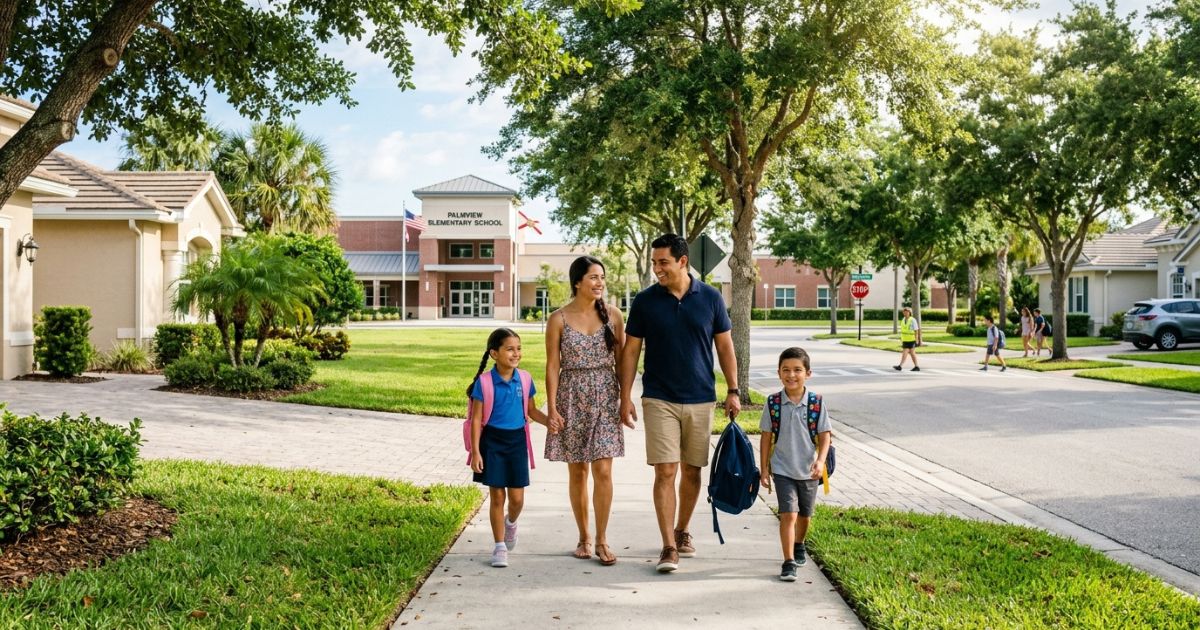
A quiet walk to school captures what most Latin families are really looking for in Florida — but reaching that everyday routine depends on researching the school, the neighborhood's safety, and the community before the move, not after.
If your family is considering a move to Florida, the visible question is usually “which neighborhood looks nice” or “which city has more Latin families.” The real risk is different: choosing a region before checking the school rating, the crime data, and the actual commute time — and only discovering the problem after the kids are already enrolled. Well-prepared Latin families flip that order. They research the school, safety, and daily routine before falling in love with a house or a piece of land.
Most people think quality of life in Florida comes down to sunshine, beaches, and no state income tax. In practice, what determines whether a move feels right or stressful is what the family lives through every day — the kids’ school, how safe the neighborhood feels, and how much time gets lost in traffic.
Table of Contents
- How to evaluate a school before choosing a neighborhood
- Neighborhood safety: how to research an area before moving
- Quality of life: what actually matters to Latin families
- Table: suburb vs. urban area vs. inland Florida for families
- Common mistakes Latin families make when choosing where to live
- Hidden costs that catch families off guard
- What to verify before buying or renting
- FAQ — Frequently Asked Questions
- 📚 Glossary
- ✅ Immediate Actions — Start Now
How to evaluate a school before choosing a neighborhood {#schools}
Short answer: before choosing where to live, check the school's rating on GreatSchools, identify which school district serves that address, and confirm whether the desired school is zoned (guaranteed by address) or accessed through school choice (subject to available seats) — that distinction changes how a family should plan the move.
In Florida, the public school your child attends is determined by the home’s exact address, not the city as a whole. Two houses just a few minutes apart can belong to schools with very different ratings and reputations.
What to check about each school
- GreatSchools rating: a 1-to-10 scale based on state test results, student progress, and equity
- School district: each county runs its own district, with different rules and performance levels
- Zoned school: the public school guaranteed to a child based on the home address
- School choice: the option to request a transfer to a different public school in the district, subject to availability
- Charter and private schools: additional options with their own enrollment processes and, for private schools, tuition
Before signing a lease or a purchase contract, it’s worth confirming the exact school tied to that address — not just the neighborhood’s general reputation.
Neighborhood safety: how to research an area before moving {#safety}
Short answer: crime data for Florida neighborhoods is available for free through the Florida Department of Law Enforcement (FDLE) and specialized crime-by-ZIP-code websites — comparing those numbers between neighboring areas often reveals differences that never show up in real estate listings.
Safety is, alongside schools, the factor that weighs most heavily on where Latin families decide to settle in Florida. It’s also one of the easiest factors to research in advance.
Reliable sources for safety data
- Florida Department of Law Enforcement (FDLE): publishes official crime statistics by county
- Crime-by-ZIP-code websites: combine local police data with the property’s specific address
- Community groups and neighborhood pages: often flag recent issues that haven’t shown up in official statistics yet
- In-person visits at different times: a neighborhood can feel calm during the day and change character at night
None of these sources replaces the others — combining official data with personal observation gives the clearest picture before deciding.
Quality of life: what actually matters to Latin families {#quality-of-life}
Short answer: quality of life for Latin families in Florida tends to hinge on four practical factors — commute time to work and school, proximity to a Latin or bilingual community, the real cost of living in the chosen area, and access to green spaces, parks, and activities for children.
Sunshine and beaches show up in the photos. What actually defines the experience of living somewhere is the daily routine — and that routine varies a lot from one neighborhood to the next, even within the same city.
Factors that most influence family satisfaction
- Commute time: neighborhoods farther out tend to have cheaper homes, but require more time in the car every day
- Latin and bilingual community: churches, markets, schools, and services in Spanish or Portuguese make the adjustment easier
- Real cost of living: includes property tax, home insurance, HOA fees, and school tuition, not just the rent or mortgage payment
- Green spaces and family amenities: parks, bike trails, and community centers matter a great deal for families with young children
Families who prioritize these four factors consistently report a faster adjustment and fewer regrets in the first two years.
Table: suburb vs. urban area vs. inland Florida for families {#table}
| Criteria | Suburb | Urban Area | Inland Florida |
|---|---|---|---|
| Average school ratings | Generally good to excellent | Vary widely by neighborhood | Vary, require detailed research |
| Perceived safety | High in most cases | Strongly depends on the specific neighborhood | Generally high, smaller communities |
| Cost of living | Medium to high | High | More affordable |
| Latin community | Present in many areas | Strong in hubs like Miami and Orlando | Smaller, growing in some cities |
| Commute time | Moderate | Can be high during peak hours | Low within the local area |
Common mistakes Latin families make when choosing where to live {#common-mistakes}
Choosing the house before choosing the school
Many families fall in love with a property and only afterward discover which school is tied to that address. The safer path is the opposite: identify the desired school first, then look for homes within that attendance zone.
Trusting a city’s general reputation
“A good city for families” is a generalization. Within the same city, neighboring areas can have very different school ratings and crime levels.
Not accounting for real commute time
A cheaper home farther from work can end up costing hours per week in traffic — time that directly affects a family’s quality of life.
Ignoring the total cost, focused only on the price of the home
Property tax, home insurance, HOA fees, and potential private school tuition combined can completely change a family’s real monthly budget.
Hidden costs that catch families off guard {#hidden-costs}
- Private or charter school tuition: even charter schools, which are public, can carry extra fees and waiting lists
- Family-focused HOA fees: communities with pools, courts, and recreation areas tend to have higher HOA dues
- Homeowners and hurricane insurance: costs vary significantly by region and distance from the coast
- School transportation: not every school offers free bus service, depending on distance from the residence
- Extracurricular activities: sports and private lessons for children add to the family’s real budget
What to verify before buying or renting {#before-deciding}
- The school rating tied to the exact address, not just the city in general
- The neighborhood’s crime data from official sources like the FDLE
- Real commute time to work and school during peak hours
- Presence of a Latin community, churches, and bilingual services in the area
- HOA rules and fees that apply to the property or community
- Total monthly cost, including property tax, insurance, and potential school tuition
FAQ — Frequently Asked Questions {#faq}
How do I find the school rating for a specific address in Florida?
The GreatSchools website lets you search by address and shows the public school assigned to that property, along with a rating from 1 to 10 based on official state results.
Are neighborhoods with good schools always safer?
In most cases there’s a correlation between high school ratings and lower crime, but it’s not an absolute rule. It’s always worth confirming both indicators separately before deciding.
Is there one best Florida city for Latin families?
There’s no single answer. Areas like Miami-Dade, Orlando, and parts of the West Coast have established Latin communities, but schools, safety, and cost of living vary neighborhood by neighborhood within each of those cities.
Are charter schools in Florida free?
Yes, charter schools are public and free, but they can have a selection process, waiting lists, and, in some cases, extra fees for specific activities.
📚 Glossary {#glossary}
GreatSchools — a platform that assigns a 1-to-10 rating to US public schools based on academic performance and student progress.
School district — the district responsible for administering the public schools of a county.
Zoned school — the public school guaranteed to a child based on the family’s home address.
School choice — the option to request enrollment at a different public school than the one zoned, subject to available seats.
FDLE (Florida Department of Law Enforcement) — the state agency that publishes official crime statistics by county and city.
HOA (Homeowners Association) — an organization that can charge fees and enforce rules on the use of properties and common areas in certain communities.
Commute — the daily travel time and distance between home, work, and school.
✅ Immediate Actions — Start Now {#immediate-actions}
- Look up the school rating tied to the exact address on GreatSchools before visiting any property
- Check the neighborhood’s official crime data on the FDLE website
- Calculate the real commute time to work and school during peak hours, not just the distance on a map
- Visit the neighborhood at different times, including at night and on weekends
- Add up all the real monthly costs — property tax, insurance, HOA, and any school tuition
- Talk to families already living in the area about their real experience with schools and safety
Conclusion
Choosing where to live in Florida as a Latin family doesn’t have to be a leap in the dark. The difference between a smooth move and one full of regrets comes down to reversing the usual order of priorities: school, safety, and daily routine first — the dream house or land second.
Families who research those three factors calmly, before falling in love with a specific property, arrive in Florida with far more emotional and financial confidence.
The decision doesn’t need to be perfect to be right. It needs to be well informed.
Is your family evaluating Florida neighborhoods based on schools, safety, and quality of life? TerraNoble offers bilingual support — in English and Portuguese — to help Latin families understand these areas before making any purchase decision. Get in touch with our team.