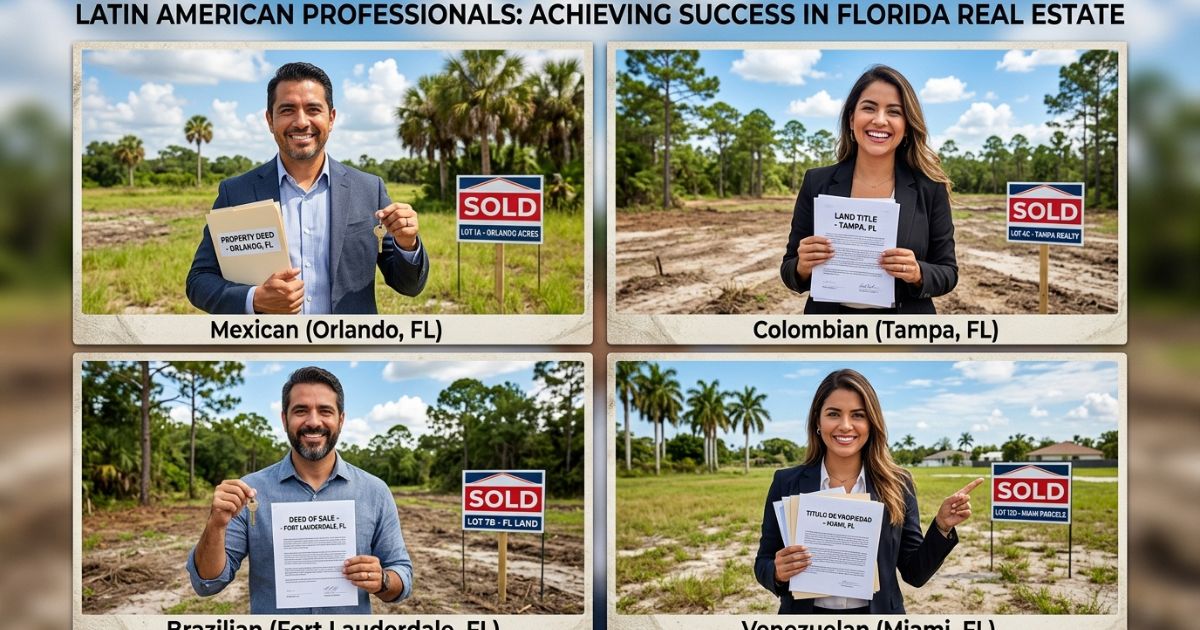
If you assume the biggest risk in investing in vacant land is picking the wrong lot, the real problem runs deeper — it’s buying without understanding why some parcels appreciate while others sit flat for decades. Three Latin American families who bought land in Florida in recent years learned this firsthand, and each ended up with a different result for reasons that can be spotted before the purchase.
Most people think a parcel’s return comes down mainly to the price paid. In reality, what separates a successful investment from a stagnant one is the combination of location, regional infrastructure, and research done before signing anything — not luck, and not just patience.
Table of Contents
- Is it actually possible to profit from buying vacant land in Florida
- Story 1: the Brazilian couple who bet on a growth county
- Story 2: the Mexican couple who bought near an expanding highway
- Story 3: the Venezuelan investor who bought farmland as a store of value
- What these stories have in common
- Table: factors that showed up in successful cases
- Common mistakes buyers make expecting profit without research
- Hidden costs that eat into real investment profit
- What to verify before buying land for investment returns
- FAQ — Frequently asked questions
- 📚 Glossary
- ✅ Immediate Actions — Start Now
Is it actually possible to profit from buying vacant land in Florida {#is-it-possible}
Short answer: yes, it's possible — but it isn't guaranteed or automatic. Returns depend on local factors like county population growth, public infrastructure expansion, the parcel's buildable status, and utility availability. The real stories in this article show Latin American buyers who researched those factors before buying and, over time, watched their land's value climb.
Florida remains one of the fastest-growing states in the country by population, which keeps demand for residential land strong across several counties. That doesn’t mean every vacant lot will appreciate — it means well-located parcels, with access to the right infrastructure, tend to benefit more from that growth than isolated lots in areas with no expansion plans.
Why real stories help more than general statistics
Average appreciation numbers hide enormous variation between counties and between individual parcels. Seeing how different Latin families researched, chose, and tracked their land helps illustrate the decision-making process — not just the final outcome.
Story 1: the Brazilian couple who bet on a growth county {#story-brazilian}
Renata and Marcelo, a Brazilian couple living in São Paulo, began researching Florida land as a way to diversify assets outside of Brazil. They compared more than ten counties over six months before deciding, reviewing public population growth data and infrastructure projects already announced by local government.
They chose a half-acre lot in a central Florida county that already had paving and electrical grid expansion confirmed for the area. The price they paid was considered fair for the region at the time of purchase.
What happened after the purchase
Two years later, the county saw new residential developments nearby, and the planned infrastructure work was completed. A formal appraisal requested by the couple showed a value above what they had originally paid, reflecting the region’s growth.
"We didn't choose the cheapest lot we found. We chose the one with the clearest signs that the area was going to grow," says Renata.
For her, the research done beforehand mattered more than the purchase price itself.
Story 2: the Mexican couple who bought near an expanding highway {#story-mexican}
Javier and Sofía, a Mexican couple based in Mexico City, bought a lot near Ocala after identifying that a nearby highway had expansion work already approved by the county. The decision factored in not just the parcel’s price, but the estimated timeline for completing the public works.
Why this particular parcel stood out
The lot already had confirmed residential zoning and public road access before the purchase, which widened the pool of interested buyers and builders in the area over time. There were no severe HOA restrictions or deed restrictions limiting the parcel’s future use.
Short answer: Javier and Sofía's parcel appreciated because of the combination of proximity to expanding road infrastructure, already-confirmed buildable status, and the absence of restrictions that would have reduced interest from future buyers.
What the couple says about the process
"We checked the zoning status and the highway project timeline before signing anything. That gave us more confidence than any promise from an agent," Javier explains.
Story 3: the Venezuelan investor who bought farmland as a store of value {#story-venezuelan}
Daniela, a Venezuelan living in Miami, bought a larger agricultural parcel in inland Florida with a different goal than the other two cases: protecting wealth from economic instability back home, rather than chasing fast appreciation.
A strategy built on stability, not quick gains
Daniela chose a lot with no urgency to build, prioritizing low maintenance costs and the absence of debts or liens on the property. Over a few years, the land didn’t see the same fast appreciation as the other two cases, but it held its value steadily even during periods of currency instability in her home country.
"My goal was never to sell fast. It was to hold a dollar-denominated asset, outside my country's financial system, that wouldn't lose value," Daniela says.
Her case shows that not every Latin American investment in Florida land chases quick profit — some pursue long-term wealth stability instead.
What these stories have in common {#common-threads}
Short answer: in all three cases, the buyers researched the county before purchasing, confirmed the parcel's buildable status or legal condition, and avoided land with severe restrictions or no planned infrastructure. None of the three bought the cheapest lot available on the market.
Researching the county before deciding
In every case, choosing the region came before choosing the specific lot — the buyers understood the growth context before falling for a particular parcel.
Verifying zoning and infrastructure
Confirming buildable status, road access, and public infrastructure plans reduced the uncertainty about each parcel’s future.
Clear goals before buying
Renata and Marcelo were after medium-term appreciation. Javier and Sofía wanted a gain tied to highway expansion. Daniela wanted wealth stability. None of them bought without knowing what they expected from the investment.
Table: factors that showed up in successful cases {#comparison-table}
| Factor | Present in successful cases | Absent in parcels that stay stagnant |
|---|---|---|
| County growth | Researched with public data before the purchase | Ignored or unknown to the buyer |
| Public infrastructure | Projects confirmed or underway in the area | No public investment planned |
| Buildable status | Confirmed with the zoning department before buying | Unverified or in a restricted-use area |
| Investment goal | Defined before the purchase (appreciation, stability, etc.) | Undefined, bought on impulse or a third party's promise |
| Parcel restrictions | No excessive deed restrictions or HOA rules | Strict rules that reduce interest from future buyers |
Common mistakes buyers make expecting profit without research {#common-mistakes}
Buying the cheapest lot without checking the county
A cheap lot in a region with no projected growth tends to stay cheap. None of the real stories in this article involved the cheapest parcel available on the market.
Trusting only the seller’s word on appreciation
Appreciation promises made by agents or sellers don’t replace public data on population growth and county infrastructure.
Skipping buildable status verification before buying
Parcels without confirmed residential zoning or public road access can take much longer to attract interest from future buyers.
Buying without a clear investment goal
Chasing fast appreciation, seeking wealth stability, or planning future construction each call for a different strategy. Buying without defining the goal makes it harder to judge whether the investment is working.
Hidden costs that eat into real investment profit {#hidden-costs}
- Annual property tax: charged throughout the entire holding period, even with no construction on the land
- Basic lot maintenance: clearing and code compliance to avoid county fines
- Appraisal fees: needed to formally confirm the parcel's new market value
- Future sale costs: commissions and closing fees reduce the net gain if the parcel is sold
- Currency exchange movement: for buyers converting the gain back into another currency, exchange rates can shift the real return
Factoring in these costs is what separates a real profit from one that only looks good on paper.
What to verify before buying land for investment returns {#before-you-buy}
- Check population growth data for the county before choosing a region
- Research public infrastructure projects already approved or in planning
- Confirm the lot's buildable status and zoning with the county
- Check for deed restrictions or HOA rules that limit future use
- Define a clear investment goal before buying
- Calculate the annual property tax and maintenance cost before projecting any gain
FAQ — Frequently asked questions {#faq}
Can Latin Americans without US citizenship invest in Florida land?
Yes. Foreign nationals can buy property in the United States without a US visa, a green card, or citizenship. What determines return potential is the parcel’s location and characteristics, not the buyer’s nationality.
Does all vacant land in Florida appreciate over time?
No. Appreciation depends on specific factors, such as county population growth, infrastructure expansion, and the parcel’s buildable status. Land in areas with no projected growth can stay stagnant in value for many years.
How long does it take for a land investment to start paying off?
It varies by region and by the buyer’s goal. In the cases in this article, noticeable changes in value happened within two to a few years, in counties with confirmed infrastructure expansion.
Is it better to buy land for fast appreciation or for wealth stability?
It depends on each buyer’s goal. Some pursue medium-term gains tied to regional growth; others prioritize holding a stable dollar-denominated asset, outside of economic instability back home.
📚 Glossary {#glossary}
Buildable land: a parcel with zoning and access that permit construction, free of restrictions that would block residential use.
County property appraiser: the county office responsible for assessing property values and calculating annual property tax.
Zoning: the set of county rules that determines what can legally be built on a parcel.
Deed restrictions: limitations recorded on the deed that restrict a property's future use.
Appraisal: a formal process of estimating a property's market value, performed by a licensed appraiser.
Lien: an outstanding financial claim recorded against a property, which must be checked before purchase.
✅ Immediate Actions — Start Now {#immediate-actions}
- Research population growth data for the county you're considering
- Check whether public infrastructure projects have been approved for the area
- Confirm the lot's buildable status and zoning with the county
- Check for deed restrictions or HOA rules on the parcel
- Decide whether your goal is medium-term appreciation or wealth stability
- Calculate the annual property tax cost before projecting any future gain
Conclusion
The stories of Renata and Marcelo, Javier and Sofía, and Daniela show that profiting from Florida land isn’t a matter of chance. Each of them researched the county, confirmed the parcel’s legal condition, and defined a clear goal before buying — and each ended up with a different result, aligned with what they were looking for.
That doesn’t mean every parcel will behave the same way. It means understanding the factors that actually move a lot’s value — and being clear about your own goal — is what allows for safer, better-informed decisions.
Considering investing in Florida land and want to understand a region’s real potential before deciding? TerraNoble offers bilingual support — in English, Spanish, and Portuguese — to help Latin American buyers evaluate each county carefully. Get in touch with our team.