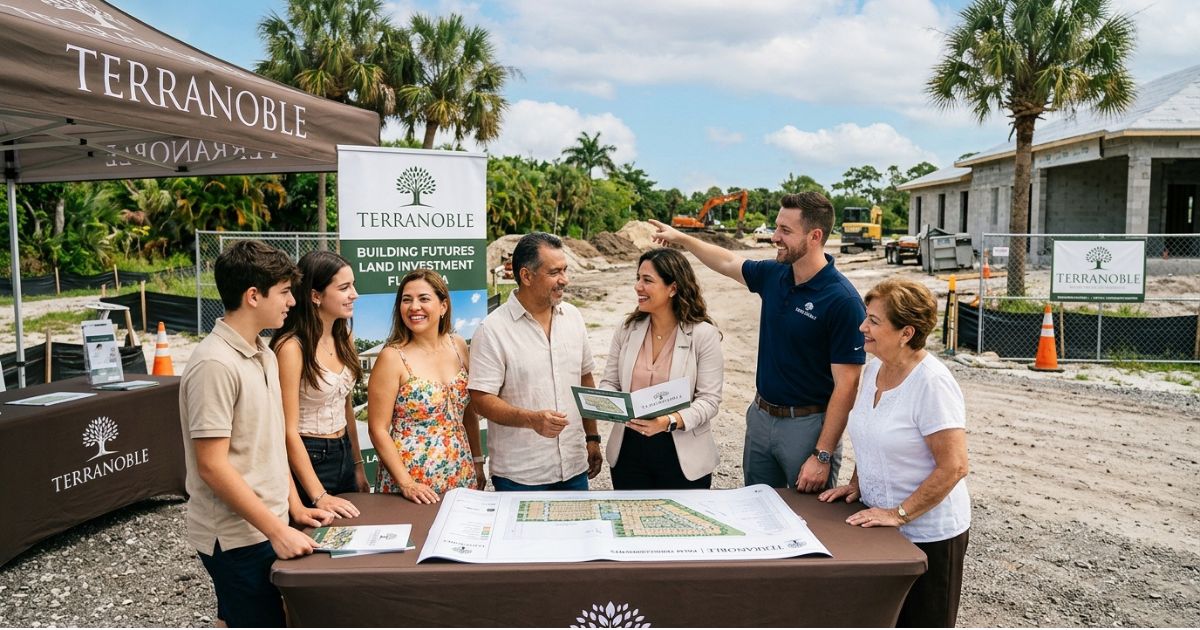
If the biggest concern for someone living outside the United States is “is this land actually what it claims to be, and is everything in order,” the visible problem was never the distance — it’s the lack of independent verification before the purchase. That’s the risk that quietly costs Latin American buyers the most, and it’s exactly the problem TerraNoble was built to solve.
Most buyers assume the main risk is overpaying. In practice, the bigger risk is buying land with a zoning conflict, an environmental restriction, or incomplete paperwork — issues that only surface after the money has already changed hands.
Table of Contents
- Why so many Latin Americans are investing in Florida land
- The real risks of buying land from another country
- How TerraNoble verifies every parcel before recommending it
- Bilingual support: why it changes the outcome of the purchase
- Buying on your own vs. buying with expert guidance
- Common mistakes Latin American buyers make
- Costs every Latin American buyer should know before closing
- FAQ — Frequently Asked Questions
- 📚 Glossary
- ✅ Immediate Actions — Start Now
Why so many Latin Americans are investing in Florida land {#why-invest}
Short answer: Latin American investors are drawn to Florida because it combines no state income tax, steady population growth, and a buying process that's simpler than most people expect — but the safety of that purchase depends entirely on the verification done before closing.
Brazilians, Colombians, Mexicans, and other Latin American buyers have increasingly turned to Florida land as a way to diversify wealth outside their home country. The most commonly cited reasons include:
- Florida does not charge a state income tax on individuals
- The real estate market has a track record of stability in high-growth regions
- Foreign buyers can purchase land without needing citizenship or residency
- The buying process, when handled correctly, is more straightforward than buying a built home
None of these factors guarantee appreciation — but together, they explain why Florida keeps showing up as a recurring destination for international diversification.
The real risks of buying land from another country {#risks}
Short answer: the biggest risks for Latin American buyers aren't in the listing price — they're in issues that only show up after document review, such as zoning restrictions, flood zone location, missing utility access, or unresolved problems with the property title.
Buying land without visiting in person, often across a language barrier and an unfamiliar legal system, exposes buyers to risks that rarely show up in the listing itself:
- Zoning that doesn’t match the buyer’s intended use for the property
- Flood zone location, which can trigger mandatory flood insurance
- Missing access to water, power, or sewer, which raises the real cost of making the lot usable
- Title issues, such as unresolved liens or ownership disputes
- HOA restrictions the buyer had no idea existed at the time of purchase
Every one of these points can be verified before closing — the problem is that many Latin American buyers don’t know they need to ask for that verification, or have no practical way to do it from abroad.
How TerraNoble verifies every parcel before recommending it {#verification}
Short answer: TerraNoble reviews zoning, FEMA flood zone maps, utility access, HOA restrictions, and the property title before presenting any parcel to a buyer, closing the gap between what's advertised and what's actually available.
TerraNoble’s role isn’t just to present available land — it’s to filter out, ahead of time, anything that doesn’t meet basic safety standards for the buyer. That process includes:
- Confirming zoning with the responsible county
- Checking the parcel’s flood zone classification against official FEMA maps
- Verifying real utility availability (water, power, sewer, or septic system)
- Reviewing deed restrictions and HOA rules, where applicable
- Requesting a clean property title, free of liens, before recommending the purchase
This process doesn’t eliminate every investment risk — no land purchase is immune to market fluctuation — but it eliminates the most avoidable category of risk: buying something that already carried an undisclosed structural problem.
Bilingual support: why it changes the outcome of the purchase {#bilingual}
Short answer: TerraNoble's bilingual support, in Portuguese and English, lets buyers understand every document and every step of the process in their own language, which reduces misunderstandings around contracts, deadlines, and tax obligations.
Most problems Latin American buyers run into don’t come from bad faith — they come from misunderstandings: a legal term translated loosely, a contract deadline misread, an HOA clause skimmed instead of studied. Having bilingual guidance means:
- Understanding contracts and disclosures in your own language, without relying on informal translation
- Asking questions directly, with no communication barrier with the title company or seller
- Understanding due diligence timelines and post-closing obligations clearly
- Having one consistent point of contact throughout the process, even while living outside the U.S.
This doesn’t replace the advice of an attorney or accountant when one is needed — but it does ensure the buyer actually understands what they’re signing before they sign it.
Buying on your own vs. buying with expert guidance {#comparison}
Short answer: buying on your own is legal and entirely possible, but it means verifying zoning, flood zone status, title, and utilities yourself — expert guidance takes on that verification before making a recommendation, lowering the odds of discovering a problem after closing.
| Step in the process | Buying on your own | With TerraNoble guidance |
|---|---|---|
| Zoning verification | Buyer's own responsibility | Verified before the parcel is recommended |
| Flood zone check | Must be done manually via FEMA maps | Included in the parcel review |
| Communication in Portuguese | Depends on your own or third-party translation | Direct bilingual support |
| Title verification | Must be requested separately | Part of the standard process |
| Post-closing support | Usually ends at signing | Ongoing support for future questions |
Neither option is wrong — the difference comes down to who takes on the verification work, and how much time and technical knowledge the buyer has available to do it alone, from another country.
Common mistakes Latin American buyers make {#common-mistakes}
Trusting only photos and the listing description
Photos don’t show zoning, flood zone status, or HOA restrictions. That information only shows up in public records and official county documents.
Not verifying the property title before putting down a deposit
A title with an unresolved lien can stall closing or create additional cost after the buyer has already made a payment.
Assuming “cheap” means “good deal”
Land priced well below the regional average usually has a limitation — access, zoning, or environmental risk — that explains the lower price.
Ignoring legal English in the communication
Contracts and disclosures use technical terms that, if mistranslated, can lead to wrong assumptions about deadlines and obligations.
Not factoring in recurring costs when deciding
Property taxes, insurance, and any HOA fees continue after the purchase — ignoring these costs distorts the real return on the investment.
Costs every Latin American buyer should know before closing {#hidden-costs}
Short answer: beyond the price of the land itself, buyers should factor in annual property taxes, possible flood insurance, HOA fees where applicable, and title insurance and closing costs — all of which are part of the real cost of owning land in Florida.
- Annual property taxes, calculated by the county based on the parcel’s assessed value
- Flood insurance, required when the lot falls within a higher-risk flood zone
- HOA fees, when the land is part of a community with a homeowners association
- Title insurance and closing costs, which vary based on the value and complexity of the transaction
- Site development costs, if the lot needs a well, septic system, or power line extension
Knowing these costs in advance prevents financial surprises and lets you plan the investment around real numbers, not just the listing price of the land.
FAQ — Frequently Asked Questions {#faq}
Can Latin Americans buy land in Florida without being U.S. citizens?
Yes. Foreign nationals can buy land and property in Florida without needing citizenship or a green card. The process follows specific rules for international buyers, but the purchase itself is fully permitted.
Do I need to visit the land in person before buying?
It’s not required, but it’s recommended whenever possible. When a visit isn’t feasible, a complete document review — zoning, flood zone, title, and utilities — significantly lowers the risk of buying from a distance.
How does TerraNoble’s bilingual support work?
TerraNoble guides buyers in Portuguese and English throughout the parcel review, negotiation, and closing, including clear explanations of documents and deadlines.
Does TerraNoble guarantee land appreciation?
No. No reputable company can guarantee appreciation on a real estate investment. TerraNoble’s role is to reduce avoidable risk through document verification, not to promise financial returns.
What documents does TerraNoble verify before recommending a parcel?
Zoning with the county, FEMA flood zone classification, utility availability, HOA restrictions, and the status of the property title.
📚 Glossary {#glossary}
Zoning — county rules that determine the permitted use of a parcel, such as residential, agricultural, or commercial.
Flood zone — a flood-risk classification assigned by FEMA that determines whether flood insurance is required.
Property title — the legal document proving ownership of land or property, considered “clean” when free of liens.
HOA (Homeowners Association) — an association that can impose rules and fees on land within certain communities.
Due diligence — the verification period before closing, used to confirm documentation, zoning, and the condition of the land.
Title insurance — insurance that protects the buyer and lender against future problems related to the property title.
✅ Immediate Actions — Start Now {#immediate-actions}
- Request zoning and flood zone verification before negotiating on any parcel
- Ask for the property title and confirm it’s free of liens
- Ask about real water, power, and sewer availability on the lot
- Factor property taxes, insurance, and any HOA fees into the total budget
- Talk to TerraNoble for bilingual guidance throughout the entire buying process
Conclusion
Investing in Florida land can be a smart financial decision, but the safety of that decision doesn’t come from the price — it comes from the verification done before closing. TerraNoble exists so Latin American buyers can access that verification in their own language, with clarity at every stage of the process, from the first review of the land through post-closing support.
TerraNoble offers bilingual support — in English and Portuguese — to guide Latin American buyers through every step of buying land in Florida. Get in touch with our team to talk about your specific situation.