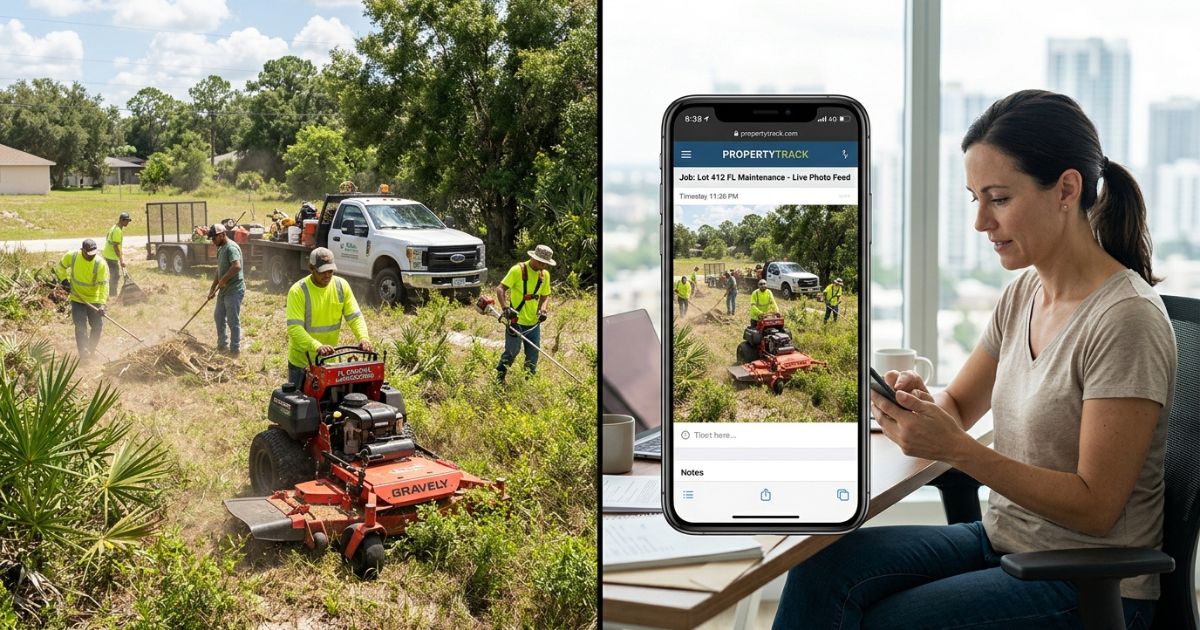
If you bought vacant land in Florida and live somewhere else — another state or another country — the visible problem is remembering to “check on the land” once in a while. The real risk is quieter than that: most Florida counties have code enforcement ordinances requiring minimum upkeep on any lot, even an empty one, and falling out of compliance triggers notices, daily fines, and in extreme cases a lien recorded against the property — all of it capable of happening before the owner ever finds out.
Most buyers assume vacant land means no maintenance obligations. In reality, “vacant” doesn’t mean “no responsibility” — the county still expects grass to be cut, debris to stay off the lot, and vegetation to stay off the sidewalk or the neighbor’s property line. Managing a lot from a distance requires a system, not good intentions.
Table of Contents
- Why an empty lot can still trigger a code violation
- What Florida code enforcement actually inspects
- How to check for violations without visiting the property
- Options for keeping the land physically maintained
- Comparing remote maintenance options
- Common mistakes owners make managing land from afar
- Hidden costs of skipping maintenance
- What to check before buying land you’ll manage remotely
- FAQ — Frequently Asked Questions
- 📚 Glossary
- ✅ Immediate Actions — Start Now
Why an empty lot can still trigger a code violation {#why-it-triggers}
Short answer: most Florida counties and cities have specific ordinances for vacant lots — maximum grass height, prohibitions on debris accumulation, and control of invasive vegetation — and these rules apply whether or not anything has ever been built on the parcel.
An undeveloped lot is still a registered property with a legally responsible owner attached to it. Florida municipalities treat vacant land as part of the surrounding neighborhood, not as an exception to it, and they enforce minimum upkeep standards on it regardless of whether the owner lives next door or on another continent.
The most common triggers for a notice include:
- Grass or vegetation above the allowed height — most counties set a limit, typically between 10 and 18 inches depending on the zoning district
- Accumulated trash, debris, or construction materials left behind by a previous owner or a third party
- Invasive vegetation or fallen trees encroaching on neighboring lots or public rights-of-way
- Standing water, which some counties classify as a sanitation or mosquito-breeding hazard
None of these violations require a structure on the property — all of them can occur on a completely empty lot, and the notice clock starts running regardless of where the owner happens to live.
What Florida code enforcement actually inspects {#code-enforcement}
Short answer: county code enforcement departments inspect the physical condition of the lot — vegetation height, debris, sanitary conditions, and land use — acting on both routine inspections and neighbor complaints, and they can levy daily fines until the violation is corrected.
Every Florida county runs its own code enforcement department, with rules spelled out in the local municipal code. The details vary, but the process usually follows a similar pattern:
- Violation identified — through a routine inspection, a neighbor complaint, or aerial and satellite imagery the county itself uses
- Notice sent to the owner — typically mailed to the address on file with the county property appraiser, which may not match the owner’s current address
- Correction window — usually 10 to 30 days, depending on the severity of the violation
- Daily fines — if the issue isn’t corrected in time, many counties impose fines that accumulate every day it remains unresolved
- Lien against the property — unpaid fines can turn into a recorded lien, which has to be cleared before the property can be sold or refinanced
The most important detail for owners living abroad: notices go to whatever address is on file with the county tax assessor. If that address is outdated, or if it’s an international address with slower mail delivery, the owner may only find out about the violation after the fines have already started stacking up.
County notices default to the mailing address on file with the property appraiser — not the owner’s current address. Updating that record is one of the cheapest compliance steps a remote owner can take.
How to check for violations without visiting the property {#remote-monitoring}
Short answer: most Florida code compliance issues can be monitored remotely by checking the county property appraiser's online portal, the county code enforcement website, and by using a local maintenance or property management service for periodic in-person inspections.
Staying compliant from a distance depends on three layers of monitoring that work together:
Periodic online checks
Most Florida counties publish a public portal where you can look up a parcel’s status — including any open code enforcement cases, recorded liens, and notice history. Checking this portal every few months is the first line of defense, even with no notice in hand.
Keeping the mailing address current
Updating the mailing address on file with the county tax assessor — including using a U.S.-based address, such as an agent’s or a management company’s, when the owner lives outside the country — meaningfully reduces the risk of a notice arriving too late to respond.
Local presence through a third party
No online portal replaces a physical inspection. Hiring a land maintenance company or a local property manager to visit periodically — even quarterly — is the most reliable way to catch a problem before it becomes a formal notice.
Options for keeping the land physically maintained {#physical-maintenance}
Once you know what to monitor, the next decision is who actually does the physical upkeep. The most common options for owners who live elsewhere are:
- Local lot mowing service — contracted on a recurring basis to cut grass and clear debris at fixed intervals, usually monthly or every six weeks
- Independent property manager — beyond physical maintenance, can also track notices, handle payments, and act as a local point of contact
- A trusted neighbor or acquaintance — a workable option for occasional checks, but rarely enough on its own as the sole line of defense against code violations
- A local real estate broker or property management firm — often already familiar with the specific deadlines and requirements of that county, reducing the risk of a notice slipping through unnoticed
The right choice depends on the lot’s size, how strict the local code is, and how hands-on the owner wants to be in day-to-day decisions.
Comparing remote maintenance options {#comparison-table}
| Option | Typical Cost | Covers Notices? | Best For |
|---|---|---|---|
| Lot mowing service | Low to moderate, per visit | No, physical maintenance only | Smaller lots already in compliance |
| Independent property manager | Moderate, recurring fee | Yes, usually tracks mail and deadlines | Owners living outside the U.S. |
| Trusted neighbor | Low or informal | No | Occasional supplementary checks |
| Online monitoring only | No direct cost | Partial, depends on county portal updates | A supplement, never a sole solution |
Common mistakes owners make managing land from afar {#common-mistakes}
Not updating the mailing address on file
Code enforcement notices still go to the address registered with the county tax assessor. If that address is outdated, the owner misses the response window before even knowing there’s an issue.
Assuming “vacant land” means “no obligations”
Many buyers associate maintenance requirements only with built structures. In Florida, vacant lots carry their own code obligations, and ignoring them is one of the most common reasons remote owners end up fined.
Relying only on occasional satellite imagery
Satellite images give a general sense of the lot’s condition, but they can’t replace a physical inspection — they won’t catch debris hidden by vegetation, drainage problems, or unauthorized land use.
Having no local point of contact
Without anyone physically near the property, every issue — from a code notice to a neighbor’s complaint — takes longer to identify and resolve, increasing the risk of fines piling up before anyone responds.
Ignoring a first notice because it seems minor
A first notice usually comes with a generous deadline and no immediate fine. Ignoring it is exactly what turns a simple warning into daily fines and, eventually, a lien against the property.
Hidden costs of skipping maintenance {#hidden-costs}
- Accumulated daily fines — many counties charge a per-day penalty for noncompliance, which can add up to hundreds or thousands of dollars before it’s corrected
- A lien against the property — once recorded, it has to be paid off before any sale, refinance, or transfer of the land
- Emergency cleanup fees — if the county clears the vegetation or debris directly, the cost is billed back to the owner, usually above market rate
- Perceived devaluation — a lot with a history of code violations can raise red flags for future buyers during due diligence
- Time lost resolving issues remotely — negotiating deadlines, paying fines, and getting back into compliance from outside the country is almost always slower and more expensive than preventive maintenance
What to check before buying land you’ll manage remotely {#before-you-buy}
Short answer: before buying Florida land you plan to manage from a distance, confirm the county's specific maintenance requirements, whether an HOA imposes additional rules on vacant lots, and whether local maintenance companies actually operate in that area.
A few questions help you estimate the maintenance workload before you close:
- Does the county have a specific ordinance on maximum vegetation height for vacant lots, and what’s the limit?
- Is there an HOA or deed restriction that adds maintenance requirements beyond the county code?
- Are there lot mowing or property management companies operating in the lot’s specific area?
- Does the land have a history of recorded code enforcement violations from before the purchase?
Land in HOA communities tends to have stricter maintenance rules than the county minimum requires — which can mean more predictability, but also more recurring cost.
FAQ — Frequently Asked Questions {#faq}
Can a Florida county fine you for tall grass on vacant land?
Yes. Most Florida counties have ordinances capping vegetation height on any lot, including vacant land, and they issue fines — often on a daily basis — once the deadline in the notice has passed.
How do I know if my land has a code violation without visiting it?
You can check the county property appraiser’s online portal or the code enforcement department’s website, which usually lists any open cases tied to the parcel number.
Do I need a property manager for a vacant lot?
It’s not required, but it’s strongly recommended for owners living outside the U.S. or in another state, since a local professional can catch problems before they become formal notices and act as a point of contact with the county.
What happens if I don’t pay a code enforcement fine?
An unpaid fine can turn into a lien recorded against the property, which must be cleared before the land can be sold, refinanced, or transferred.
Do foreign owners of Florida land have the same maintenance obligations?
Yes. Code enforcement requirements apply to the property itself, not to the owner’s nationality or country of residence — which is why bilingual support and local guidance matter especially for Latin American buyers managing land from abroad.
📚 Glossary {#glossary}
Code enforcement: the municipal department responsible for inspecting properties and enforcing the local code, including maintenance rules for vacant lots.
Lien: a legal claim recorded against a property, usually resulting from unpaid debts, that must be cleared before a sale or refinance.
Parcel number: the unique identifier assigned to a lot in the county property appraiser's system, used to look up records and open cases tied to the property.
County tax assessor: the county office responsible for property records, valuation, and mailing official notices and correspondence to the owner.
HOA (Homeowners Association): an association that can impose additional maintenance and use requirements beyond the municipal code.
Lot mowing service: a company hired to perform recurring physical maintenance on a lot, such as cutting grass and removing debris.
✅ Immediate Actions — Start Now {#immediate-actions}
- Confirm the mailing address on file with the county tax assessor and update it if needed.
- Check the county's code enforcement portal for any open case tied to your parcel number.
- Look up the local ordinance on maximum vegetation height and any other vacant lot rules.
- Hire or vet a land maintenance company operating in the lot's area.
- Check whether an HOA or deed restriction adds maintenance requirements beyond the county code.
- Set up a recurring check-in schedule — even quarterly — instead of relying only on notices.
- Talk to TerraNoble for bilingual guidance on keeping your Florida land compliant from a distance.
Conclusion
Vacant land in Florida doesn’t lose its obligations just because nothing is built on it. Code enforcement rules, minimum maintenance standards, and sometimes HOA requirements still apply — and managing the property remotely means replacing physical presence with a reliable system of monitoring and upkeep.
The combination of periodic online checks, an updated mailing address, and a local presence — whether a property manager, a maintenance company, or a trusted point of contact — is what separates remote owners who never run into trouble from those who only find out about a violation after it’s already a fine.
TerraNoble offers bilingual support — in English and Portuguese — to help Latin American investors keep their Florida land compliant, even while managing the property from outside the state or the country. Get in touch with our team for guidance on your specific situation.