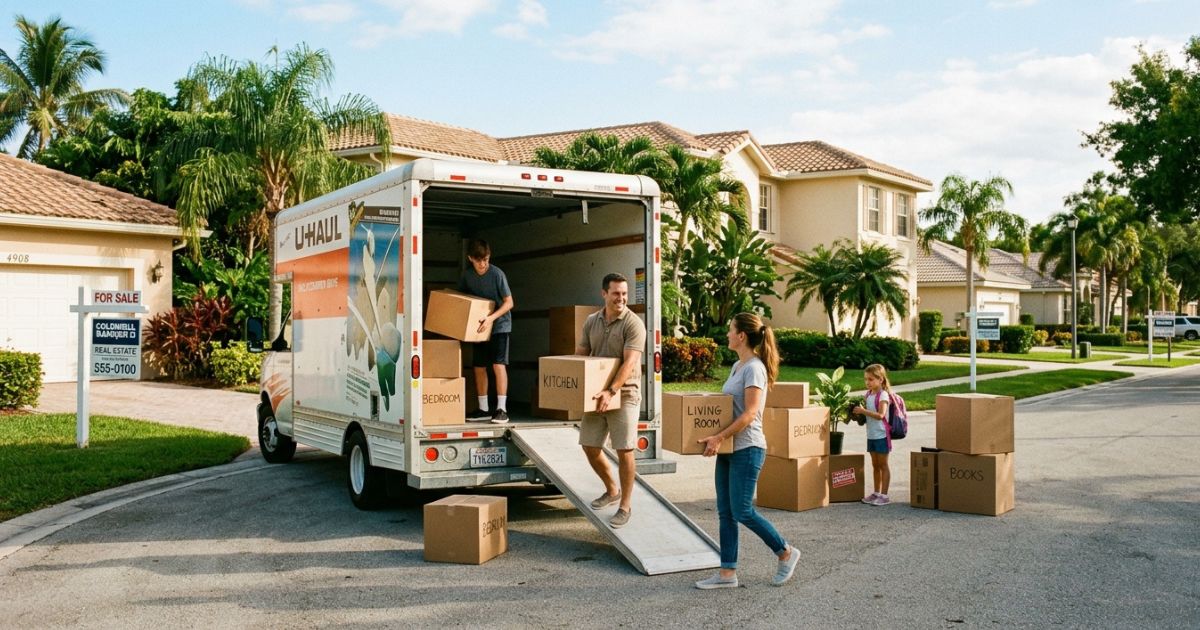
Years of consistent out-migration from California and New York — driven by high state income taxes, soaring housing costs, and shifting business conditions — have made Florida the top relocation destination in the country, with measurable upward pressure on vacant land prices across multiple counties.
There’s a widespread assumption in real estate that land values rise because of what happens locally — new roads, new employers, new zoning approvals. And that’s true. But there’s a second force that often gets overlooked: where people are coming from.
When a state consistently loses high-income residents to another state, the destination absorbs not just people but capital, purchasing power, and demand. That’s exactly what has happened in Florida over the past several years. California and New York — two of the most economically significant states in the country — have been exporting residents at a rate that has no modern precedent. And Florida has captured the largest share of that movement.
The result is a land market under sustained demand pressure. Not uniform pressure — it hits some counties far harder than others. And not permanent pressure — trends shift, markets adjust, and individual parcels can sit flat for years regardless of what’s happening regionally.
The opportunity is real. So are the mistakes buyers make when they act on it without doing their homework. Here’s what the data actually shows — and what you need to verify before any decision.
Table of Contents
- What is domestic migration and why does it affect land prices?
- Why are Californians and New Yorkers leaving their states?
- Why is Florida their top destination?
- How does population inflow actually move land values?
- Which Florida counties are feeling the most pressure?
- Land price comparison across Florida regions
- What are the real risks buyers face in a migration-driven market?
- Common mistakes buyers make chasing appreciation trends
- Hidden costs that show up after the purchase
- 📚 Glossary
- ✅ Immediate Actions
- FAQ
What is domestic migration and why does it affect land prices? {#domestic-migration}
Short answer: domestic migration is the movement of people between states within the same country. When that movement is large, sustained, and concentrated in one destination — as Florida has experienced since 2020 — it generates measurable demand pressure on housing and land, particularly in areas where supply cannot keep pace with population growth.
In the United States, people can relocate between states freely — no registration, no approval process, no government intermediary. That freedom means market forces drive migration directly: when the cost-benefit calculation of living in one state turns negative, people move. And when they move in large numbers consistently over years, the destination state absorbs real, compounding economic pressure.
That pressure shows up first in the housing market. But it traces back to land. Every home that gets built requires a lot. Every distribution center, school, and retail strip requires land. When demand grows faster than buildable supply can respond, prices move.
Why does this matter for vacant land buyers specifically?
Because land is the first asset to capture migration-driven value — before homes are built, before infrastructure is complete, before the “growth story” becomes obvious to everyone. By the time the narrative is mainstream, much of the early appreciation has already occurred. Understanding migration patterns early gives buyers the context to identify where demand is building before it’s fully priced in.
Why are Californians and New Yorkers leaving their states? {#why-leaving}
Short answer: the combination of the highest state income tax rates in the country, housing costs that have priced out middle-class families, regulatory environments that make operating businesses increasingly expensive, and a declining quality-of-life perception has created a sustained out-migration from both states that IRS data, USPS address change records, and moving company reports all confirm.
Understanding what’s pushing people out is essential to understanding what they bring with them — and why that matters for the destination market.
California:
- State income tax reaches 13.3% on the highest earners — the highest in the country
- The median home price in the San Francisco Bay Area and Los Angeles exceeds $1 million, pricing out families who could comfortably afford homes elsewhere
- Business regulations and environmental compliance costs are among the most demanding in the nation
- Companies including Tesla, Oracle, Charles Schwab, and Hewlett Packard Enterprise have relocated their headquarters out of state in recent years
- Overall cost of living consistently ranks among the top three highest in the U.S.
New York:
- State income tax reaches 10.9%, with New York City adding up to 3.876% on top of that
- Manhattan and Brooklyn rental and purchase prices remain out of reach for most middle-class households
- Property taxes in New York rank among the highest in the country even before considering city-level surcharges
- The combination of state and city taxes creates an effective marginal rate that competes with no other major U.S. metro
This isn’t a temporary shift. IRS Statistics of Income data — which tracks adjusted gross income moving between states — has shown consistent net outflows from both California and New York for multiple consecutive years. The capital leaving these states doesn’t disappear. It lands somewhere.
Why is Florida their top destination? {#why-florida}
Short answer: Florida offers zero state income tax constitutionally protected from legislative change, housing costs still meaningfully below California and New York metro markets, year-round warm weather, a growing business environment, and specific legal protections like the homestead exemption that add long-term financial stability for residents — making it the rational choice for a wide range of household types and income levels.
For a California household earning $500,000 per year, relocating to Florida represents an immediate annual tax saving of over $60,000 in state income taxes alone. That’s not a marginal benefit — it’s a structural financial improvement that compounds every year.
Beyond taxes, Florida offers:
- No state income tax — protected by the Florida Constitution; changing it would require a constitutional amendment, not just a legislative vote
- Housing costs still below Bay Area and Manhattan benchmarks, even after recent appreciation
- Climate — warm year-round, near beaches and waterways, no harsh winter season
- Homestead Exemption — Florida protects primary residences from creditors and provides up to $50,000 in assessed value reduction for property tax purposes
- Business environment — fewer regulatory burdens, faster permitting in many counties, lower corporate overhead
- Geographic position — dual coast access, strong connectivity to Latin America, time zone favorable for global business
The U.S. Census Bureau estimated that Florida gained over 300,000 net new residents per year between 2021 and 2024 — the largest absolute gain of any state in the country during that period. Moving companies like U-Haul and Atlas Van Lines have consistently ranked Florida as a top inbound destination across their annual reports.
How does population inflow actually move land values? {#how-values-move}
Short answer: population growth translates directly into housing demand, which translates into builder demand for buildable lots, which compresses vacant land supply and pushes prices upward — particularly in counties adjacent to established urban cores where supply is limited either by physical constraints or regulatory restrictions.
The mechanism is straightforward, even if the timing is not:
- People arrive → they need housing
- Homebuilders seek lots → demand for buildable land increases
- Available inventory shrinks → prices rise in areas with constrained supply
- Investors anticipate secondary markets → they acquire land in peripheral counties before infrastructure arrives
- Infrastructure follows population → roads, utilities, schools are built to serve the new residents
- Peripheral prices catch up → the appreciation cycle repeats one ring out
The critical nuance here is that not all appreciation is equal. Coastal markets — Miami-Dade, Broward, Palm Beach, Collier — absorbed the bulk of migration-driven price pressure years ago. The opportunity for a buyer arriving today is concentrated in second- and third-ring counties, where prices haven’t yet reflected the pressure building from population expansion in adjacent markets.
That said, not every parcel in a growing county appreciates at the same rate — or at all. Zoning restrictions, flood zone designations, utility access limitations, and deed restrictions can isolate specific lots from the broader market trend entirely.
Which Florida counties are feeling the most pressure? {#which-counties}
Short answer: the counties absorbing the most migration-driven demand pressure today are those adjacent to already-saturated metro cores — St. Johns south of Jacksonville, Pasco north of Tampa, Polk between Tampa and Orlando, and Marion and Volusia feeding from multiple directions. These areas still offer entry points meaningfully below their anchoring metros while receiving real and documented population pressure.
High-pressure expansion counties:
- St. Johns County — one of the fastest-growing counties in the entire U.S., driven by proximity to Jacksonville and a strong school system that attracts relocating families
- Pasco County — north of Tampa, with active infrastructure investment and land prices still well below Hillsborough County levels
- Polk County — the I-4 corridor between Tampa and Orlando, experiencing significant logistics and industrial facility growth alongside residential expansion
- Marion County (Ocala) — drawing buyers from both the north and south, with land prices that reflect conditions several years behind the major metros
- Volusia County (Daytona Beach area) — benefiting from Orlando corridor spillover and consistent coastal demand that doesn’t require beachfront pricing
The pattern is consistent across multiple market cycles: when a core county becomes too expensive for the next wave of buyers, demand cascades into adjacent counties. That secondary pressure is where land buyers have historically found the most meaningful opportunity relative to risk.
Land price comparison across Florida regions {#price-comparison}
| Region | Average price per acre (2023–2025) | Migration pressure | Infrastructure status |
|---|---|---|---|
| Miami-Dade / Broward | $200,000–$800,000+ | High (already absorbed) | Consolidated |
| Tampa / Hillsborough | $80,000–$250,000 | High (actively absorbing) | Expanding |
| Orlando / Orange | $70,000–$200,000 | High (actively absorbing) | Expanding |
| Pasco / Polk / Volusia | $25,000–$80,000 | Medium-high (building) | Being installed |
| Marion / Alachua / Hernando | $10,000–$40,000 | Medium (emerging) | Partial |
Approximate average ranges. Prices vary significantly based on zoning, utility access, flood zone designation, and specific location within a county.
What are the real risks buyers face in a migration-driven market? {#real-risks}
Buying into a growth trend without verifying the specifics of your parcel is one of the most common and expensive mistakes in land acquisition. The regional story can be completely accurate while the individual lot sits in a flood zone, lacks legal road access, or carries zoning restrictions that prevent development entirely.
Zoning incompatibility
A parcel located in a county receiving significant migration pressure can still be zoned agricultural, conservation, or industrial — none of which support the residential or commercial use a buyer expects. Always verify the current zoning designation through the county property appraiser and planning department before any negotiation.
Flood zone exposure
Florida has extensive FEMA-designated flood zones, many of which impose severe construction restrictions and mandatory flood insurance requirements. Zone X parcels carry the lowest risk. Zones AE and VE carry the highest — with restrictions that can make development impractical and insurance costs that significantly affect long-term ownership economics.
Utility access gaps
Land in expanding areas often lacks connection to public water, sewer, and electricity infrastructure. Installing that connection can cost between $10,000 and $50,000 or more, depending on distance from existing lines. This cost must be factored into the purchase price analysis — not discovered after closing.
Deed restrictions and HOA obligations
Some parcels carry deed restrictions that limit construction type, use, or property modifications. HOA obligations — including fees and architectural review requirements — can add recurring costs and constraints that weren’t visible in the original listing. A thorough title search is not optional.
Speculative pricing disconnected from fundamentals
In active migration markets, sellers price land based on the regional narrative rather than the specific characteristics of the parcel. A buyer paying regional-trend prices for a lot with access issues, flood zone exposure, or zoning restrictions is absorbing risk the seller has already priced away.
Common mistakes buyers make chasing appreciation trends {#mistakes}
- Skipping the land survey — without a professional boundary survey, you don’t know what you’re actually buying: exact limits, encroachments, easements, or legal access points
- Ignoring past land use history — parcels with prior industrial or agricultural chemical use may carry environmental liabilities that surface years after purchase
- Assuming road access exists — a parcel without legal, recorded access to a public road may be undevelopable regardless of its market value
- Focusing only on price per acre — low price per acre often signals flood zone exposure, restrictive zoning, or insufficient utility infrastructure
- Not ordering title insurance — purchasing without title insurance exposes you to ownership disputes, liens, or easement claims that can emerge years after the transaction closes
- Treating the regional trend as a guarantee — population growth in a county is a directional signal, not a promise of appreciation for any specific parcel
Hidden costs that show up after the purchase {#hidden-costs}
| Item | Estimated cost | Notes |
|---|---|---|
| Annual property taxes | 0.8%–2% of assessed value | Vacant land does not qualify for homestead exemption |
| Land survey | $500–$3,000 | Varies by parcel size and complexity |
| Title insurance | $500–$2,500 | One-time cost; protects against ownership disputes |
| Utility connection | $5,000–$50,000+ | Highly variable depending on distance from existing infrastructure |
| Lot clearing and grading | $2,000–$15,000 | Depends on vegetation density and topography |
| Flood insurance (if applicable) | $500–$5,000/year | Mandatory in certain flood zones for financed purchases |
📚 Glossary {#glossary}
Domestic Migration: the movement of people between states within the same country, tracked via IRS filings, USPS change-of-address records, and census data.
Property Tax: an annual tax levied by the county on real estate, based on the assessed value determined by the county property appraiser.
Homestead Exemption: a Florida constitutional benefit that reduces the assessed value of a primary residence by up to $50,000 for property tax purposes. Available only to permanent Florida residents — not applicable to vacant land.
Flood Zone: a FEMA-designated classification indicating the flood risk level of a specific area. Zone X = lowest risk. Zones AE and VE = highest risk with construction and insurance implications.
Land Survey: a professional boundary determination that establishes the exact legal limits of a parcel, including encroachments, easements, and legal access points.
Deed Restriction: a clause recorded in a property’s deed that limits how the land can be used, modified, or transferred — regardless of local zoning rules.
Title Insurance: a policy that protects the buyer against defects in the property’s title — including undisclosed liens, easements, or ownership disputes — that may surface after closing.
Zoning: county or municipal regulations that define the permitted uses of a parcel (residential, commercial, agricultural, industrial, conservation, or mixed-use).
Utility Access: the availability of connections to public water, sewer, electricity, and gas networks at or near a parcel’s location.
LLC (Limited Liability Company): a U.S. legal structure widely used by investors — including foreign buyers — to hold real estate, providing liability protection and potential estate planning advantages.
✅ Immediate Actions — Start Now {#actions}
If you’re considering buying land in Florida based on migration-driven growth signals, these are the verifications that matter before any decision:
- Check the FEMA Flood Map at msc.fema.gov for the specific parcel’s flood zone designation
- Verify the current zoning through the county’s official planning and zoning department website
- Request a professional land survey before executing any purchase contract
- Review the county property appraiser’s records to understand the current assessed value and property tax history
- Confirm utility availability — contact the county and local utility providers to determine what’s already accessible at the parcel
- Review all deed restrictions and HOA documents with a licensed real estate attorney or title company before closing
- Purchase title insurance — a relatively small cost that protects against significant future liability
- Calculate total cost of ownership — include annual property taxes, applicable insurance, and estimated development costs before comparing to the asking price
FAQ {#faq}
Can foreigners buy land in Florida?
Yes. Foreign nationals, including non-U.S. residents, can purchase real property in Florida without needing a visa or permanent residency status. The transaction can be structured in an individual’s name or through a U.S.-based LLC, which some buyers prefer for liability and estate planning purposes.
Is the migration from California and New York likely to continue?
The structural incentives — Florida’s zero state income tax versus California’s 13.3% and New York’s combined 10.9%+ rates — are not temporary policy positions. They reflect constitutional and long-standing legislative decisions that are difficult to reverse. That said, migration flows respond to economic conditions, interest rates, and housing availability on both ends. No buyer should treat a trend as a guarantee.
Which Florida counties offer the most accessible land prices right now?
Counties including Marion, Polk, Hernando, Putnam, and Alachua still offer entry prices significantly below the major coastal metros. However, lower price does not mean lower complexity. Zoning verification, flood zone classification, and utility access checks remain equally critical in lower-priced markets.
Do vacant land owners qualify for Florida’s homestead exemption?
No. The homestead exemption applies only to primary residences — not vacant, unimproved land. Vacant land is taxed on its full county-assessed value with no exemption offset.
What is the typical property tax rate on vacant land in Florida?
Effective rates vary by county and range roughly between 0.8% and 2% of the county-assessed value annually. The county property appraiser sets the assessed value, which may differ from the purchase price. Buyers should check the specific county’s millage rates before acquisition.
Do I need an attorney to buy land in Florida?
Florida does not legally require attorney involvement in real estate transactions. However, for foreign buyers, complex title situations, or parcels with deed restrictions and HOA obligations, engaging a licensed real estate attorney to review the contract and ownership structure is strongly advisable.
The Bottom Line
The migration of Californians and New Yorkers into Florida is not a short-term phenomenon — it’s the result of durable structural differences in tax policy, cost of living, and regulatory environment between states. That movement is real, documented, and creating measurable demand pressure on Florida’s land market.
But trend awareness alone doesn’t make a land purchase sound. The regional story can be entirely accurate while a specific parcel sits in a flood zone, lacks utility access, or carries zoning restrictions that prevent any meaningful development. The buyers who benefit most from migration-driven market growth are those who understand the macro environment — and still do every micro-level verification before signing anything.
Florida’s land market is one of the most dynamic in the country. Understanding what’s driving that dynamism is the first step. Verifying the specifics of your parcel is the one that actually protects you.
Talk to TerraNoble
TerraNoble offers bilingual support — in English and Portuguese — for buyers exploring land opportunities in Florida. If you have questions about a specific county, the right ownership structure for your situation, or where to begin your analysis, reach out. The goal is to help you make decisions you’ll feel good about for the long term — without pressure, and without rushing the process.