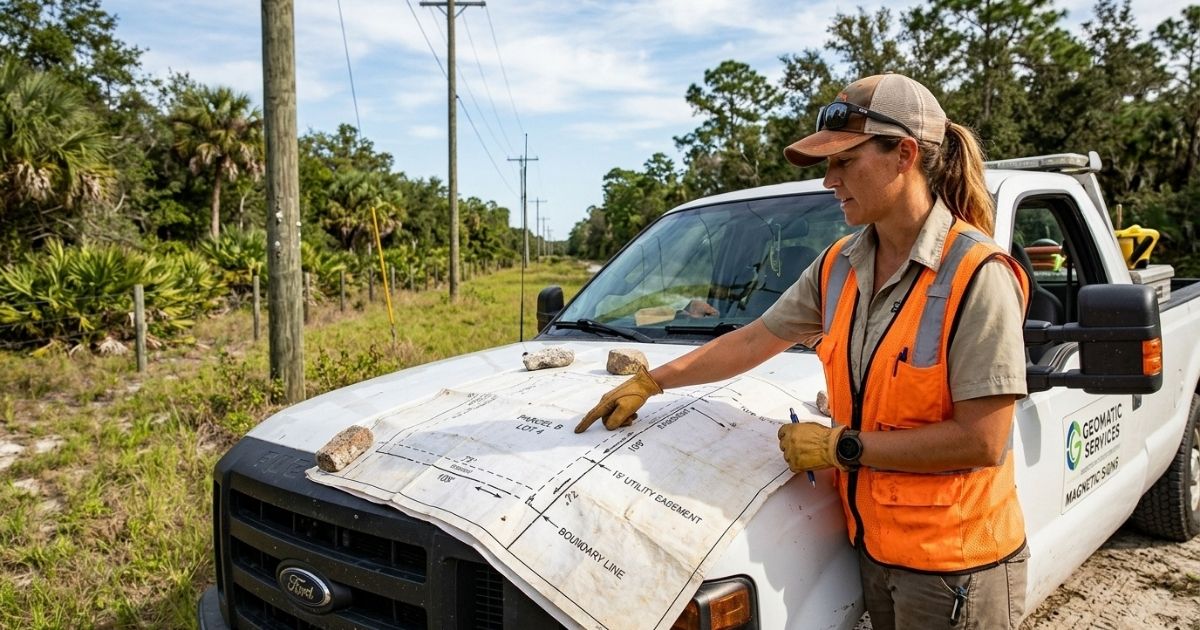
If a Florida parcel’s deed looks clean, the visible issue is assuming there’s nothing else to check. The real issue is that two of the factors that most limit a property’s future use — severed mineral rights and recorded easements — almost never show up in the listing, and often don’t even appear in a basic title report.
Most people think buying land is mainly about price, size, and location. In reality, the right to build, dig, drill a well, or even reshape the landscape can already be limited by documents recorded decades ago — and it’s the buyer’s job to catch that before closing, not after.
Table of Contents
- What mineral rights are and why they matter
- How to tell if mineral rights were severed from the land
- What easements are and the most common types in Florida
- Mineral Rights vs. Easements: a practical comparison
- How to verify mineral rights and easements before closing
- Common mistakes buyers make
- Hidden costs tied to mineral rights and easements
- FAQ
- 📚 Glossary
- ✅ Immediate Actions — Start Now
What mineral rights are and why they matter {#mineral-rights}
Short answer: mineral rights are the legal right to extract resources below a property's surface — like oil, gas, and minerals — and they can belong to someone other than the surface owner, which means owning the land doesn't always mean owning what's underneath it.
In Florida, as in most U.S. states, ownership of a parcel can be split into two distinct layers: the surface estate (the right to the surface, where you build and live) and the mineral estate (the right to what’s below ground). These two layers can belong to the same owner, or they may have been separated at some point in the property’s history, in a process called severance.
When mineral rights have been severed from the surface, the mineral estate owner may, in some cases, have a legal right to access the surface to extract those resources, even though they don’t own the parcel where you plan to build. This is less common in dense residential areas of Florida, but it still shows up in rural parcels, larger properties, and areas with a history of phosphate or oil exploration, including parts of central and northern Florida.
How to tell if mineral rights were severed from the land {#severed-rights}
Short answer: the only reliable way to know if mineral rights have been severed is to research the property's full title history through a title search at the county's public records office, looking for any prior deed that reserves or transfers mineral rights separately from the surface.
Severance of mineral rights typically happens through a reservation clause in an old deed — a previous owner sells the surface but keeps (“reserves”) the mineral rights for themselves or their heirs. That clause can be sitting in a deed from decades ago, and it won’t automatically show up in a surface-level title check.
A full title search, done by a title company or a real estate attorney, examines the parcel’s chain of title to identify mineral rights reservations, prior transfers, and any document indicating a split in ownership. That’s the only reliable way to confirm whether the land you’re buying includes the mineral rights or not.
It’s worth remembering: even when mineral rights have been severed, that doesn’t necessarily mean active extraction is happening or planned. Many severed mineral estates are never developed. But the existence of the severance itself is information every buyer needs before deciding.
What easements are and the most common types in Florida {#what-are-easements}
Short answer: an easement is the legal right granted to a third party to use part of a property for a specific purpose — like access, utility lines, or drainage — even though that party doesn't own the land itself.
Easements are extremely common on Florida parcels and, in most cases, don’t stop a purchase — but they directly affect where and how you can build. The most frequent types include:
- Utility easement — grants a power, water, or telecom company the right to install and maintain lines, poles, or pipes within a specific strip of the property.
- Access easement — allows a neighbor or third party to cross part of your land to reach their own property, common when a lot doesn’t have direct frontage on a public road.
- Drainage easement — reserves an area of the parcel for stormwater runoff, often required by the county on land near wetlands or in low-elevation areas.
- Conservation easement — permanently restricts development on part or all of a parcel to protect environmentally sensitive land, often tied to tax incentives or agreements with state agencies.
Each type of easement imposes a different limitation. A utility easement might simply block construction across a narrow strip of land; a conservation easement can permanently restrict any future development in the protected area.
Mineral Rights vs. Easements: a practical comparison {#comparison-table}
| Factor | Severed Mineral Rights | Easement |
|---|---|---|
| What's limited | Resources below the surface (oil, gas, minerals) | Specific use of an area of the surface |
| Who holds the right | A third party (mineral estate owner) | A third party (utility company, neighbor, county, environmental agency) |
| Impact on building | Generally low, unless active extraction occurs | Can block construction within the easement area |
| Where it's found | Chain of title | Deed, county plat, and public property records |
| How it's resolved | Rarely eliminated; requires negotiating to buy back the right | Can sometimes be modified or extinguished through a specific legal process |
How to verify mineral rights and easements before closing {#how-to-verify}
Short answer: before closing, request a full title search, review the title commitment line by line, check the parcel's plat at the county recorder's office, and order an updated land survey to identify any easements that are physically present on the property.
The first step is requesting a full title commitment from the title company handling the closing. This document lists exceptions to the title — including recorded easements and, when applicable, mineral rights reservations. It’s essential to read the “exceptions” section carefully, not just rely on the summary page.
The second step is checking the parcel’s plat on the county property appraiser’s or clerk of court’s website. The plat shows exactly where utility, drainage, and access easements sit within the lot — information that helps you understand where you can actually build.
The third step is ordering an updated land survey. A survey physically identifies structures, fences, easement strips, and any sign of third-party use that isn’t obvious from the documents alone — like a neighbor’s access road running across the property.
Finally, on rural or larger parcels, it’s worth asking the title company directly whether the area has a history of severed mineral rights, since some parts of Florida have a more frequent history of reserved mineral estates than others.
Common mistakes buyers make {#common-mistakes}
Trusting only the title report summary instead of reading the full exceptions list
The general summary of a title report can leave out important details that only appear in the full exceptions list — exactly where easements and mineral rights reservations tend to be described.
Assuming “vacant land” means “unrestricted land”
An empty lot can look completely open, but still carry drainage or utility easements that aren’t visible to the eye without an updated survey.
Skipping an updated land survey before closing
Relying on an old survey, or no survey at all, is one of the most common ways buyers discover an easement only after they’ve already closed — sometimes only after trying to build.
Overlooking the possibility of severed mineral rights on rural parcels
Buyers used to urban areas often assume mineral rights always come with the surface, which isn’t always true on larger or historically rural parcels.
Hidden costs tied to mineral rights and easements {#hidden-costs}
- Redesigning the building plan — repositioning a planned structure to respect an easement strip discovered late in the process
- Negotiating to extinguish an easement — a legal, and sometimes financial, process to modify or remove an easement that’s no longer needed
- Buying out mineral rights — in rare cases, negotiating to acquire the severed mineral estate to remove future uncertainty
- Additional legal fees — a deeper title review by an attorney experienced with reservations or complex easement cases
- Construction schedule delays — extra time needed to adjust plans and secure approvals when a restriction surfaces after initial planning
FAQ {#faq}
Does every parcel in Florida have severed mineral rights?
No. Most parcels, especially in residential and suburban areas, have mineral rights bundled with the surface. Severance is more common on rural land, larger properties, and regions with a history of mineral exploration, but only a title search confirms the actual status for a specific parcel.
Does an easement completely block construction on a property?
Not necessarily. An easement usually restricts only the specific area where it’s recorded — the rest of the lot can typically be built on normally. The problem arises when a buyer doesn’t know where the easement sits before planning construction.
Can an easement be removed after buying the property?
In some cases, yes, through an agreement with the easement holder or a court process, but that involves time, legal cost, and no guarantee of success. It’s always simpler and cheaper to identify an easement before buying than to try removing it afterward.
Does TerraNoble help verify mineral rights and easements before a purchase?
Yes. TerraNoble offers bilingual support, in English and Portuguese, to help buyers understand title reports, identify recorded easements, and evaluate Florida land with more confidence before closing.
📚 Glossary {#glossary}
Mineral rights — the legal right to extract resources below a property’s surface, such as oil, gas, and minerals.
Severance — the process by which mineral rights are separated from surface ownership and come to belong to a different party.
Easement — a legal right granted to a third party to use part of a property for a specific purpose, without transferring ownership of the land itself.
Title search — research into a property’s historical chain of deeds, used to identify reservations, easements, and other exceptions to the title.
Title commitment — a document issued by the title company before closing, listing the conditions and exceptions under which the title will be insured.
Plat — an official recorded map showing a property’s lot boundaries, including any easement strips within the parcel.
✅ Immediate Actions — Start Now {#immediate-actions}
- Request the full title commitment and read the exceptions section line by line
- Research the parcel’s chain of title for any mineral rights reservations
- Check the parcel’s plat on the county property appraiser’s or clerk of court’s website
- Order an updated land survey before finalizing any building plans
- Ask the title company directly about the area’s mineral rights history
- Talk to TerraNoble for a bilingual title review before closing
Conclusion
Severed mineral rights and recorded easements aren’t rare, and they’re not automatic reasons to walk away from a parcel — but they’re exactly the kind of information that never shows up in a listing and that only a careful buyer catches before closing. The difference between a smooth purchase and an expensive planning problem usually comes down to who read the full title report and who trusted only the summary.
Verifying mineral rights and easements takes time and some technical know-how, but it’s one of the highest-value due diligence steps in any land purchase — far cheaper than discovering a restriction after you’ve already bought, or already started building.
TerraNoble offers bilingual support — in English and Portuguese — to help buyers review title reports, identify easements, and understand mineral rights status before closing on land in Florida. Talk to our team before your next step.