Important notice: this article is for informational and educational purposes only. It does not constitute legal advice, and zoning, building code, and foundation requirements vary by county and municipality across Florida. Before buying land with the intent to place a modular or manufactured home on it, confirm the specific requirements with the local zoning department and, if needed, a Florida-licensed real estate attorney.
Many buyers purchase Florida land assuming any type of home can go on it — pick a model, arrange transport, and install it. The problem usually surfaces later: the county explains that the lot doesn’t allow manufactured homes, or that the modular home they chose has to meet foundation requirements the original budget never accounted for. By then, the land has already been bought, and changing course costs both time and money.
Most buyers think the difference between a modular home and a manufactured home is just branding or which factory built it. In practice, Florida law treats the two very differently — and that difference decides whether you can build, finance, and eventually resell the property without complications.
Table of Contents
- Modular vs. manufactured homes: the legal difference
- Zoning: not every lot allows a manufactured home
- Permanent foundations: why they change everything
- Modular vs. manufactured vs. site-built: a side-by-side comparison
- Permits and inspections required by the county
- Deed restrictions and HOA rules
- Rules for land in a flood zone
- Common mistakes buyers make
- Hidden costs of the process
- FAQ — Frequently Asked Questions
- 📚 Glossary
- ✅ Immediate Actions — Start Now
Modular vs. manufactured homes: the legal difference {#legal-difference}
Short answer: in Florida, a modular home is built to the Florida Building Code — the same standard used for a site-built house — while a manufactured home (formerly called a "mobile home") is built to the federal HUD Code, and that difference in code determines how the county classifies, taxes, and regulates the installation of each one.
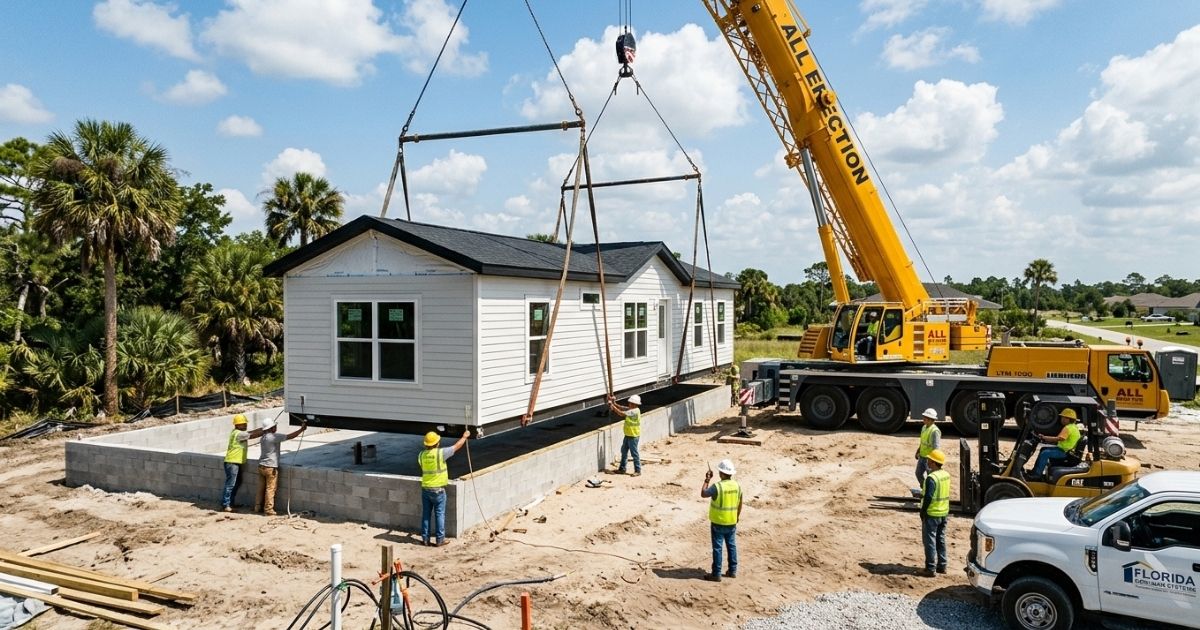
A modular home is built in sections inside a factory, transported to the land, and assembled on-site, but it must meet the exact same structural, electrical, and plumbing standards as a house built entirely on location. Once installed, the county treats it like any conventional residential structure.
A manufactured home follows a federal standard called the HUD Code, keeps a permanent steel chassis, and has historically been classified as personal property rather than real property, unless it goes through a specific conversion process. That classification directly affects financing, insurance, and resale value.
In practice, this means the same piece of land can allow a modular home and prohibit a manufactured home, or the reverse, depending entirely on local zoning.
Zoning: not every lot allows a manufactured home {#zoning}
Short answer: zoning at the county or city level determines whether a specific lot accepts a manufactured home, a modular home, both, or neither — and that has to be confirmed before buying the land, not after.
Most Florida zoning codes divide residential uses into categories, and they don’t always treat modular and manufactured homes the same way:
- Conventional residential zones (R-1, RSF, etc.) — usually allow modular homes, since they’re built to the same code as a standard house, but may restrict or prohibit manufactured homes outright.
- Manufactured/mobile home zones (RMH, MH) — created specifically to allow manufactured homes, often within dedicated parks or subdivisions.
- Agricultural zones (A-1, AG) — in many Florida counties, these allow a manufactured home as the owner’s rural residence, with their own minimum lot size rules.
- Rural or low-density zones — these vary widely; some allow both types, others require a special exception approval for a manufactured home.
The only reliable way to know is to contact the planning & zoning department for the county or city where the land is located, provide the parcel ID, and ask directly whether a manufactured home and/or a modular home are permitted uses on that specific parcel.
Permanent foundations: why they change everything {#permanent-foundation}
Short answer: for a manufactured home to be treated as real property in Florida rather than personal property, it generally needs to be installed on a permanent foundation that meets Florida Department of Highway Safety and Motor Vehicles (DHSMV) criteria, with the original chassis title retired at the county.
This detail catches many buyers off guard when they focus only on the home itself. A manufactured home installed temporarily, on blocks and without a recognized permanent foundation, can remain classified as personal property — which:
- Makes traditional mortgage financing harder or impossible to obtain
- Can affect property tax calculations and homestead exemption eligibility
- Lowers resale value compared to a home classified as real property
- May require specific “mobile home” insurance instead of a standard homeowners policy
A modular home, by contrast, is installed on a permanent foundation as a standard part of the process, since it’s built to the Florida Building Code from the start — without the extra title conversion step a manufactured home requires.
Modular vs. manufactured vs. site-built: a side-by-side comparison {#comparison}
| Criteria | Modular Home | Manufactured Home | Site-Built Home |
|---|---|---|---|
| Applicable code | Florida Building Code | HUD Code (federal) | Florida Building Code |
| Foundation | Permanent, standard to the process | Permanent foundation requires title conversion | Permanent |
| Initial classification | Real property | May be personal property until converted | Real property |
| Typical zoning | Conventional residential zones | Specific or agricultural zones | Conventional residential zones |
| Traditional financing | Generally more straightforward | May require a specific loan program | Generally more straightforward |
This comparison is a starting point — each county can adjust the details, especially around minimum lot size, setbacks, and maximum age allowed for used manufactured homes.
Permits and inspections required by the county {#permits}
Short answer: both modular and manufactured homes require a building permit, inspections during installation, and a final certificate before the home can be legally occupied — the process differs in complexity, but neither type skips county approval.
The typical process includes:
- Zoning verification — confirming that the intended residential use is permitted on the lot.
- Foundation and installation permit — approval of the foundation design, anchoring, and connections to water, sewer or septic, and power.
- Inspections during installation — the county inspects steps like the foundation, wind tie-downs, and electrical and plumbing connections.
- Certificate of Occupancy — the final document authorizing legal occupancy of the home, required before anyone can move in.
Skipping steps in the permit process — more common than it should be with informally installed manufactured homes — can lead to fines, a red-tagged home, and difficulty selling the property later.
Deed restrictions and HOA rules {#deed-hoa}
Short answer: even when county zoning allows a manufactured or modular home, deed restrictions recorded against the land or an active homeowners association (HOA) can prohibit or limit the type of home allowed, regardless of what municipal law permits.
It’s common to find subdivisions where the official zoning allows both home types, but the original plat’s deed restrictions — recorded decades ago — limit construction to “site-built homes only” or set minimum square footage and finish standards that a standard manufactured home doesn’t meet.
Before buying, it’s worth checking:
- Deed restrictions recorded with the county recorder, which can prohibit manufactured homes even in zones where they’re technically allowed
- HOA rules, if the land sits within a community with an active association
- Covenants specific to the subdivision regarding home type, minimum size, and exterior appearance
These restrictions often don’t show up in a simple zoning lookup — they require a title chain and recorded documentation review.
Rules for land in a flood zone {#flood-zone}
Short answer: land located in a FEMA-designated flood risk area may require a manufactured or modular home to be installed at a minimum elevation above the base flood level, which increases the cost of the foundation and installation.
In flood zones, counties often require the base of the structure to sit above the base flood elevation, especially for manufactured homes, which have historically suffered more flood damage due to sitting lower to the ground. That can mean:
- An elevated foundation on piers or compacted fill
- Reinforced anchoring against wind and flooding
- A flood insurance requirement as a condition of financing
Checking the FEMA flood zone map for the specific parcel before signing a purchase contract helps avoid surprises in the foundation budget.
Common mistakes buyers make {#common-mistakes}
Buying the land before confirming zoning
This is the most expensive mistake. Without confirmation from the planning & zoning department up front, the buyer only finds out about a restriction after already owning the lot — when reversing the decision costs both time and money.
Confusing county zoning approval with HOA or deed restriction approval
Municipal zoning and private deed restrictions are independent processes. A lot can be cleared by one and blocked by the other.
Underestimating the cost of a permanent foundation
Initial budgets for a manufactured home often focus on the price of the unit alone, overlooking foundation, anchoring, and title conversion costs — items that can represent a significant share of the total investment.
Ignoring elevation requirements in flood zones
Discovering after closing that the land requires an elevated foundation because it sits in a flood risk area can derail the original plan or substantially increase the budget.
Hidden costs of the process {#hidden-costs}
Short answer: beyond the price of the modular or manufactured home itself, the process involves site preparation, foundation work, utility connections, county permits, and in some cases title conversion — expenses that often don't make it into a buyer's initial budget.
- Site preparation — clearing, grading, and compacting the land before installation
- Foundation and anchoring — cost varies by home type and whether the land sits in a flood zone
- Utility connections — hooking up to public electric, water, and sewer, or installing a well and septic system
- Permits and inspections — fees charged by the county at each stage of the process
- Transport and installation — moving the modular or manufactured home to the land and setting it in place
- Title conversion — for a manufactured home, the cost of the process to retire the personal property classification and register it as real property
Adding these costs to the price of the home before buying the land helps keep the project on budget.
FAQ — Frequently Asked Questions {#faq}
Does every piece of land in Florida allow a manufactured home?
No. It depends on the specific zoning of the county or city, and some lots only permit modular homes or site-built construction. Confirm with the local zoning department before buying.
Does a modular home need a permit just like a site-built home?
Yes. Modular homes are built to the Florida Building Code and go through the same building permit and inspection process as a home built entirely on location.
Can a manufactured home be financed like real estate?
It can, but this generally depends on it being installed on a permanent foundation with the chassis title converted from personal property to real property. Without that conversion, financing typically follows specific “mobile home” loan programs, with different terms than a traditional mortgage.
Can an HOA prohibit a manufactured home even if zoning allows it?
Yes. HOA rules and deed restrictions are independent of municipal zoning and can impose stricter requirements on what type of home is allowed on the lot.
How do I find out if my land is in a flood zone before buying?
You can check FEMA’s flood zone maps using the property address or parcel ID, or request that information directly from the county during the due diligence process.
📚 Glossary {#glossary}
Modular home: a home built in sections inside a factory but constructed to the Florida Building Code, the same standard as a site-built home, and installed on a permanent foundation.
Manufactured home: a home built to the federal HUD Code, with a permanent steel chassis, historically classified as personal property until it goes through a real property conversion process.
HUD Code: the federal building standard that regulates manufactured homes across the United States, distinct from the state building code used for modular and site-built homes.
Permanent foundation: a fixed base structure recognized by the county, required for a manufactured home to be classified as real property.
Deed restrictions: restrictions recorded against the land or the subdivision's plat that can limit the type, size, or style of construction allowed, independent of municipal zoning.
Base flood elevation: the reference level set by FEMA indicating the minimum elevation required for construction in flood-risk areas.
Certificate of Occupancy: a document issued by the county legally authorizing occupancy of a home after all required inspections are complete.
✅ Immediate Actions — Start Now {#immediate-actions}
- Confirm with the county planning & zoning department whether the parcel allows a modular and/or manufactured home.
- Review the land's title chain for deed restrictions on construction type.
- Ask whether the lot sits within an HOA community and review any applicable rules.
- Check the FEMA flood zone map for the specific parcel.
- Request a budget that includes foundation, utility connections, and permits — not just the price of the home.
- If choosing a manufactured home, ask the county about the title conversion process to real property.
Conclusion
The difference between a modular home and a manufactured home goes well beyond the name — it determines whether the land you’re buying actually allows the project you have in mind, which permits will be required, and how the county will classify the home. Confirming zoning, deed restrictions, foundation rules, and flood zone requirements before buying the land is what separates a smooth project from an expensive surprise after closing.
TerraNoble offers bilingual support, in English and Portuguese, for buyers evaluating land in Florida, helping make clear which types of construction a given lot actually allows before making a decision.