Important notice: this article is for informational and educational purposes only. It does not constitute legal, financial, or tax advice. Before buying land in the United States, consult qualified professionals to evaluate your specific situation.
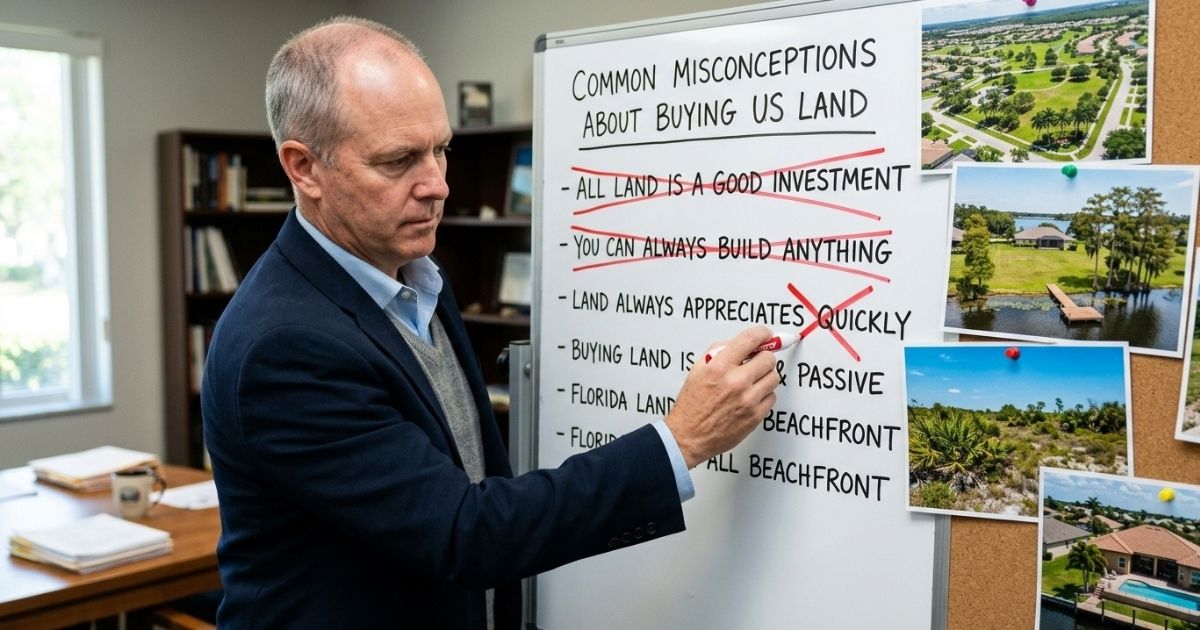
If a piece of land looks too good to be true, the visible problem isn’t the biggest risk. The biggest risk is the myth the buyer is carrying before they even look at the contract — and it only shows up after the money has already changed hands. Every year, Latin American investors lose time, money, and confidence buying land in the United States based on assumptions that sound logical but don’t match how the US market actually works.
Most people think buying land in the US is simple: pick a lot, pay, and wait for it to appreciate. In practice, the gap between what sounds true and what’s actually true is what determines whether the purchase turns into a solid investment or an expensive problem. This article breaks down the seven most common myths among Latin buyers — and what to do instead.
Table of Contents
- Why Latin buyers fall for these myths so often
- Myth 1: “Cheap land is always a good deal”
- Myth 2: “If it’s for sale, I can build on it”
- Myth 3: “I don’t need a survey if the seller already has a map”
- Myth 4: “Foreigners can’t buy land in the US”
- Myth 5: “Paying cash means I can skip due diligence”
- Myth 6: “A clear title is guaranteed by the seller”
- Myth 7: “Property tax is the same everywhere in the US”
- Myth vs. reality comparison
- Hidden costs of believing these myths
- FAQ — Frequently Asked Questions
- 📚 Glossary
- ✅ Immediate Actions — Start Now
Why Latin buyers fall for these myths so often {#why}
Short answer: Latin American buyers fall for myths about buying US land mainly because they compare the process to real estate in their home country, rely on informal information passed along by acquaintances, and often complete the purchase remotely, without visiting the land or verifying the paperwork locally.
These myths don’t come from bad intentions — they come from comparison. Buying land in Brazil, Colombia, Mexico, or Argentina involves different rules, timelines, and documents than buying land in the United States. When a buyer assumes “it should work the same way,” they skip steps that are mandatory under the US system precisely to protect the investment.
Distance is another common factor. Many Latin buyers close deals without ever visiting the property in person, relying only on photos, videos, or the seller’s word. That can be done safely — but it requires more document verification, not less.
Myth 1: “Cheap land is always a good deal” {#myth-1}
Short answer: a lot priced well below the local market average almost always has a specific reason — restrictive zoning, limited utility access, a high-risk flood zone, or title issues — and it isn't automatically an opportunity just because it's cheap.
A low price is a symptom, not an advantage. Before getting excited about a below-market number, buyers need to understand why that specific lot costs less than comparable lots in the same area.
Common reasons a lot is “too cheap”:
- Zoning that doesn’t allow residential building, or that severely restricts how the lot can be used.
- No utility access — water, sewer, and electricity — which can add tens of thousands of dollars to the total project cost.
- Location in a high-risk flood zone, raising insurance costs and construction requirements.
- Limited legal access, when the lot doesn’t have a guaranteed public right-of-way.
- Title problems the current seller hasn’t yet resolved.
A lot can absolutely be a good opportunity at a below-average price — but that’s only confirmed after investigating, never before.
Myth 2: “If it’s for sale, I can build on it” {#myth-2}
Short answer: the fact that a piece of land is legally for sale doesn't mean it's buildable — whether you can build depends on county zoning, soil type, utility access, and any environmental restrictions specific to that lot.
In the United States, any piece of land can be freely bought and sold, even if it’s currently impossible — or will always be impossible — to build on. This is one of the costliest points of confusion among Latin buyers, who assume “land for sale” automatically means “land ready to build on.”
Before assuming a lot is buildable, you need to verify:
- Zoning classification with the county, confirming the intended use is allowed.
- Soil type and topography, which may require additional engineering or rule out certain foundation types.
- Environmental restrictions, such as wetlands protected under federal or state law.
- Actual utility availability or the feasibility of a well and septic system, where applicable.
This verification is normally done with the county’s zoning department before the purchase, not after.
Myth 3: “I don’t need a survey if the seller already has a map” {#myth-3}
Short answer: a map provided by the seller doesn't replace a current land survey performed by a licensed professional, since only a survey confirms boundaries, exact acreage, and any easements or encroachments with legal accuracy.
Old maps, generic subdivision plats, or satellite images give a rough idea of a property — but they carry no legal weight for confirming exact boundaries. Buying without a current survey is taking on a risk that can surface years later, when a neighbor disputes the property line or the buyer discovers an access easement they didn’t know existed.
A professional land survey confirms:
- Exact property boundaries, preventing future disputes with neighbors.
- True lot size, which sometimes differs from what’s listed in ads or older documents.
- Easements that allow third parties to use part of the land, such as utility access.
- Possible encroachments from neighboring structures onto the lot’s boundaries.
The cost of a survey is small compared to the cost of resolving a boundary dispute after the purchase.
Myth 4: “Foreigners can’t buy land in the US” {#myth-4}
Short answer: foreigners can buy land in the United States with no requirement of US citizenship, a green card, a residency visa, or a US credit history — property ownership isn't tied to the buyer's immigration status.
This myth works in reverse: instead of leading a buyer into a risk, it keeps many Latin American investors from even considering the option, because they wrongly believe they don’t have the right to buy.
Some key facts:
- There’s no federal restriction preventing foreigners from buying land in the United States.
- A residency visa isn’t required — many buyers keep their primary residence in their home country.
- A US credit history isn’t required when the purchase is made in cash.
- An ITIN (individual taxpayer identification number) may be needed for tax purposes, but it isn’t a prerequisite for the purchase itself.
The purchase process for foreigners is, in fact, simpler than many people expect — which doesn’t mean due diligence can be skipped.
Myth 5: “Paying cash means I can skip due diligence” {#myth-5}
Short answer: paying cash for land eliminates the need for loan approval, but it doesn't replace due diligence — title verification, zoning checks, deed restrictions, and flood zone status still need to be confirmed regardless of how the purchase is financed.
When financing is involved, the lender typically requires a series of checks before releasing funds — which, incidentally, protects the buyer. Paying cash removes that layer of protection, leaving it entirely up to the buyer (or the professionals they hire) to make sure everything checks out.
Basic due diligence should include, at minimum:
- A title search to confirm the seller has the legal right to sell the land.
- Zoning and permitted-use verification with the county.
- A check of the FEMA flood zone map to understand flood risk and potential insurance cost.
- A review of deed restrictions that could limit how the lot can be used in the future.
Paying cash speeds up the transaction — it’s not a reason to skip verification steps.
Myth 6: “A clear title is guaranteed by the seller” {#myth-6}
Short answer: a seller's word isn't enough to guarantee that a title is free of liens, debts, or disputes — that confirmation requires a formal title search and, ideally, title insurance.
A seller may honestly believe the title is clear, and there can still be an unresolved lien, a past-due tax, or an heir with a legal claim to the land that the seller doesn’t even know about. These issues only surface through a formal title search, conducted by a title company.
Recommended protections before closing:
- A title search performed by a specialized company, reviewing the property’s full ownership history.
- Title insurance, which financially protects the buyer if a title issue surfaces after closing.
- Confirmation that there’s no past-due property tax attached to the lot.
Assuming “the seller vouched for it” replaces formal verification is one of the mistakes that generates the most losses after closing.
Myth 7: “Property tax is the same everywhere in the US” {#myth-7}
Short answer: property tax in the United States varies significantly by state and by county, since it's calculated based on the property's assessed value and a locally set millage rate — there's no single federal rate.
Comparing the property tax on a Florida lot to another state, or even to another county within Florida, without checking the actual numbers is a common mistake. Florida specifically has no state income tax — but that doesn’t mean property tax is low or uniform across the entire state.
Factors that affect property tax:
- The lot’s appraised value, set by the county property appraiser.
- The millage rate specific to the county and district where the lot is located.
- The presence of a CDD (Community Development District), which can add specific fees in some subdivisions.
- Applicable exemptions, such as the homestead exemption, which generally doesn’t apply to vacant land without a residence.
Before buying, it’s worth checking directly with the county property appraiser’s website to confirm the real property tax figure for that specific lot.
Myth vs. reality comparison {#comparison-table}
| Common myth | Reality |
|---|---|
| Cheap land is always a good deal | A low price usually reflects a specific restriction that needs to be investigated |
| If it's for sale, I can build on it | Buildability depends on zoning, soil, and utility access, not just the sale itself |
| The seller's map replaces a survey | Only a licensed land survey confirms boundaries with legal validity |
| Foreigners can't buy land | No requirement of citizenship, green card, or US credit history |
| Paying cash skips due diligence | Due diligence is necessary regardless of how the purchase is financed |
| Seller guarantees a clear title | Only a title search and title insurance confirm and legally protect the buyer |
| Property tax is the same everywhere | Varies by state, county, and millage rate — must be checked case by case |
Hidden costs of believing these myths {#hidden-costs}
Short answer: believing these myths can lead to hidden costs like reworked engineering plans on land that turns out not to be buildable, legal disputes over property boundaries, more expensive insurance in undisclosed flood zones, and financial loss from title problems that weren't discovered before the purchase.
- Redesign costs when land turns out not to be buildable as expected
- Boundary dispute costs with neighbors, when there’s no current survey
- Higher insurance premiums on land located in flood zones that weren’t identified before the purchase
- Financial loss from title issues, such as liens or disputes, inherited from a previous owner
- Lost time unwinding decisions that could have been avoided with upfront verification
None of these costs show up in the purchase price — they all show up later, when they’re more expensive and harder to fix.
FAQ — Frequently Asked Questions {#faq}
Can foreigners buy land in the United States without a residency visa?
Yes. There’s no requirement of US citizenship, a green card, or a residency visa to buy land in the United States, including in Florida.
Is every lot for sale buildable?
No. Whether you can build depends on county zoning, soil type, utility access, and any environmental restrictions — not simply on whether the lot is listed for sale.
Do I need a land survey even if I’m buying from a seller I trust?
Yes. A current survey protects the buyer regardless of how trustworthy the seller is, since it confirms boundaries, acreage, and any easements with legal validity.
Is property tax the same across all Florida counties?
No. The amount varies based on the lot’s assessed value, the county’s millage rate, and whether a CDD (Community Development District) applies to the area.
Does paying cash eliminate the need for a title search?
No. The payment method doesn’t replace formal title verification — a title search and, ideally, title insurance are still recommended on any purchase.
📚 Glossary {#glossary}
Buildable land — land that meets the zoning, soil, and infrastructure requirements needed to support construction.
Land survey — a professional topographic assessment that confirms exact boundaries, acreage, and easements on a property.
Title search — a formal review of a property’s legal ownership history, checking for liens, debts, and disputes before purchase.
Title insurance — a policy that financially protects the buyer against title problems discovered after closing.
Flood zone — an area classified by FEMA based on flood risk, which directly affects insurance cost.
Millage rate — the rate used to calculate property tax, applied to the county’s assessed value of the property.
Deed restrictions — restrictions recorded on the title that limit how a piece of land can be used in the future, even after it’s sold.
✅ Immediate Actions — Start Now {#immediate-actions}
- Confirm the lot’s zoning directly with the county before assuming it’s buildable
- Order a current land survey, even if the seller provides their own map
- Request a title search and consider title insurance before closing
- Check the FEMA flood zone map for the lot’s area
- Verify the lot’s actual property tax on the county property appraiser’s website
- Talk to TerraNoble for bilingual guidance on avoiding these mistakes in your purchase
Conclusion
None of these seven myths sound absurd on the surface — they all sound plausible, which is exactly why they keep costing Latin American buyers money every year. The difference between a safe purchase and an avoidable loss almost always comes down to verification: zoning, survey, title, flood zone, and property tax confirmed before signing, not after.
TerraNoble offers bilingual support — in English and Portuguese — for Latin American investors looking to buy land in the United States safely, helping separate myth from fact before any financial decision.