Important notice: this article is for informational and educational purposes only. It does not constitute legal, tax, or zoning advice, and the rules governing agricultural leases, storage use, or events vary by municipality and county across Florida. Before leasing land for any of these uses, confirm the specific requirements with the local zoning department and, if needed, a Florida-licensed real estate attorney.
Most people who buy vacant land think about it in two stages: build on it, or sell once it appreciates. What fewer people consider is that between those two moments, the land can generate income every month — without a single structure going up. In the meantime, the owner keeps paying property tax and, sometimes, upkeep, without getting anything back.
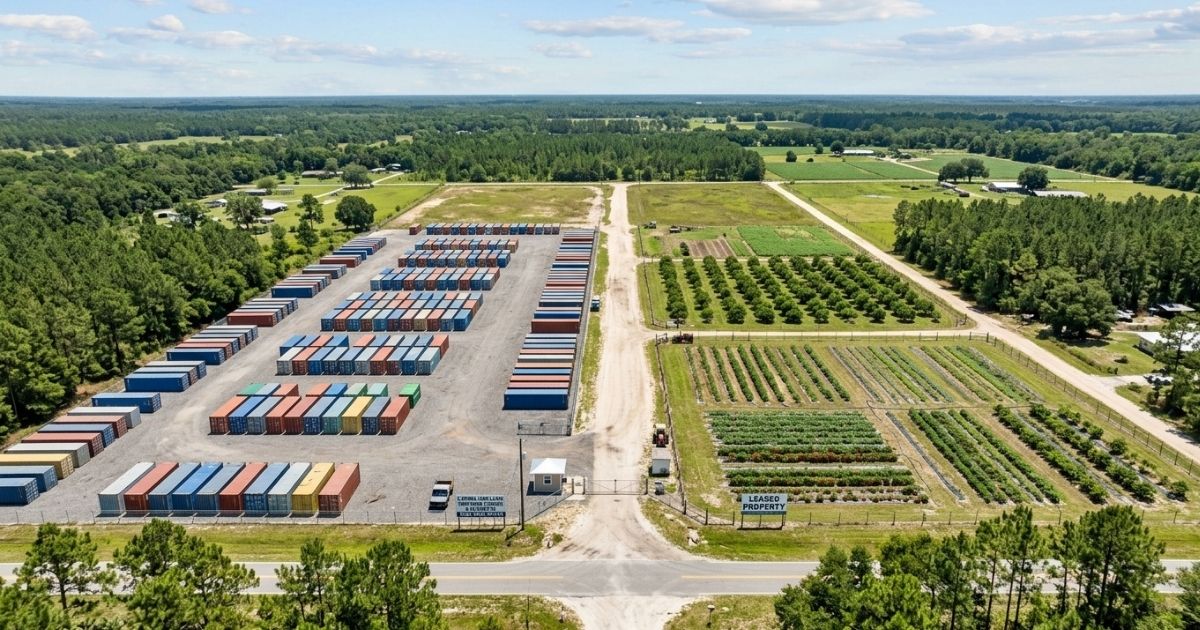
Most people assume vacant land means unproductive land. In practice, a well-located lot can be leased to farmers, storage operators, or event organizers — and each of those uses comes with its own zoning, contract, and liability rules that need to be understood before signing any agreement.
Table of Contents
- What passive income from vacant land actually means
- Agricultural leasing: how a land lease for farming works
- Storage leasing: containers, RVs and boats
- Event leasing: weddings, filming and fairs
- Zoning: what determines whether your land can generate this income
- Lease agreements: essential clauses that protect the landowner
- Comparing the three passive income models
- Common mistakes people make leasing vacant land
- Hidden costs of turning land into an income source
- FAQ — Frequently Asked Questions
- 📚 Glossary
- ✅ Immediate Actions — Start Now
What passive income from vacant land actually means {#what-it-means}
Short answer: passive income from vacant land is money earned by leasing the use of a lot — for agriculture, storage, or events — without building a permanent structure, keeping the land available for future sale or development while it earns monthly or seasonal revenue.
Unlike renting out a house or apartment, leasing vacant land usually doesn’t involve significant construction or residential-style contracts. The owner releases the use of the land for a set period in exchange for a fixed payment — monthly, annual, or per event — while keeping ownership of the lot the entire time.
The three most common models in Florida are:
- Agricultural leasing — a third party uses the land for crops, grazing, or small-scale production.
- Storage rental — the space is used to store containers, equipment, recreational vehicles (RVs), or boats.
- Event leasing — the land is rented on a one-off basis for weddings, filming, fairs, or outdoor events.
Each model has different zoning, contract, and liability requirements — mixing up the rules of one with the expectations of another is where most problems start.
Agricultural leasing: how a land lease for farming works {#agricultural-leasing}
Short answer: in an agricultural land lease, the owner rents the property to a farmer or local producer to cultivate the land, typically under an annual contract, receiving a fixed rate per acre — and in many Florida counties, that active agricultural use can also qualify the land for the agricultural tax exemption known as greenbelt.
This model is common on larger lots outside dense urban areas, where the soil and zoning allow agricultural activity. The owner doesn’t need to run the farm — just hand over use of the land while the lessee handles planting, harvesting, and upkeep.
Key points of this type of lease:
- Rate per acre — pricing typically depends on soil quality, water access, and location, and tends to run lower than storage or event leasing.
- Lease term — agricultural leases are usually annual or multi-year, since planting cycles require predictability.
- Agricultural tax exemption — in several counties, land with documented agricultural use can qualify for greenbelt classification, significantly lowering property tax, as long as the Property Appraiser’s criteria are met.
- Responsibility for inputs and equipment — the contract should spell out who’s responsible for irrigation, fencing, equipment, and any damage to the soil.
Owners considering this route should confirm with the county Property Appraiser whether the planned agricultural use actually qualifies the lot for the exemption — not every small-scale agricultural activity meets the minimum requirements.
Storage leasing: containers, RVs and boats {#storage-leasing}
Short answer: leasing land for storage — of containers, equipment, RVs, or boats — tends to generate higher monthly revenue per acre than agricultural leasing, but it requires commercial or industrial zoning and, in most counties, an approved site plan and specific permits.
This model has grown in Florida due to demand from small businesses, contractors, and residents who need outdoor space to store equipment, building materials, or recreational vehicles. Unlike agriculture, this use typically requires:
- Commercial, industrial, or conditional-use zoning — purely residential zones rarely allow commercial storage of containers or third-party vehicles.
- Fencing and access control — most counties require a perimeter fence, gate, and in some cases lighting and cameras.
- Lot surface — depending on vehicle traffic volume, compacted gravel or paving may be required instead of bare ground.
- Liability insurance — since third parties and their property circulate and stay on the land, exposure to accidents and claims is higher than with agricultural leasing.
Before advertising storage space, it’s worth confirming with local zoning whether this commercial use is allowed under the lot’s current classification, or whether it depends on a conditional use permit.
Event leasing: weddings, filming and fairs {#event-leasing}
Short answer: leasing land for one-off events — outdoor weddings, filming, or fairs — can generate higher revenue per day than the other two models, but it usually requires a temporary use permit, event-specific insurance, and attention to parking and noise rules.
This is the model with the highest revenue potential per use, but it also requires the most coordination, since every event has different characteristics:
- Temporary use permit — many counties require this for events with public attendance, even on private land, especially when there are temporary structures, tents, or heavy vehicle traffic.
- Event insurance — the event organizer usually carries the policy, but the owner should require a copy and be named as “additional insured” in the contract.
- Parking and access — the land needs enough space and road access for the expected number of guests or attendees, which can limit the type of event that’s feasible.
- Noise and time restrictions — local noise ordinances typically apply even on remote land, especially at night.
Lots with good location, easy access, and attractive scenery — near lakes, scenic rural areas, or close to growing cities — tend to be in higher demand for this type of use.
Zoning: what determines whether your land can generate this income {#zoning}
Short answer: county zoning determines which of these three uses — agricultural, storage, or events — are allowed on a given lot, and that confirmation should come directly from the zoning department before signing any lease agreement.
The same lot might allow agricultural use freely, but require special approval for commercial storage, and prohibit public events without a temporary permit. That means there’s no single answer — each use needs to be verified separately:
- Agricultural zones (A-1, AG) — generally allow agricultural land leases without extra red tape, but may restrict commercial storage unrelated to farming activity.
- Commercial or industrial zones — tend to be better suited for storing containers, equipment, and vehicles, with site plan requirements.
- Low-density rural zones — may allow all three uses depending on the county, but frequently require a conditional use permit for storage or recurring events.
Looking up the parcel ID on the county’s planning & zoning department website, or calling the department directly, is the most reliable way to confirm what’s allowed before negotiating a lease.
Lease agreements: essential clauses that protect the landowner {#lease-agreement}
Short answer: a well-structured land lease agreement should clearly define the permitted use, term, payment amount and schedule, responsibility for damages and insurance, termination conditions, and the condition the land must be returned in at the end of the lease.
Regardless of the use — agriculture, storage, or events — a few elements shouldn’t be missing from any contract:
- Exact description of the permitted use — prevents the lessee from expanding the activity beyond what was agreed without a new contract.
- Term and renewal conditions — clarifies whether the lease is monthly, annual, or per event, and how renewal or early termination works.
- Payment amount, method, and due date — includes any scheduled rate increases and late payment penalties.
- Responsibility for damage to the land — who pays for any damage to soil, fencing, vegetation, or drainage caused by the leased use.
- Insurance requirement — proof of the lessee’s liability insurance policy, with the owner named as additional insured where applicable.
- Condition of return — especially relevant for storage and events, where temporary structures and vehicle traffic can alter the lot’s surface.
A Florida-licensed real estate attorney can review the contract before signing, tailoring these clauses to the specific use and the land’s zoning.
Comparing the three passive income models {#comparison-table}
| Criteria | Agricultural Lease | Storage | Events |
|---|---|---|---|
| Typical revenue | Lower, per acre/year | Medium to high, monthly | Highest, per event/day |
| Common contract term | Annual or multi-year | Monthly or annual | One-off, per event |
| Typical zoning required | Agricultural (A-1, AG) | Commercial, industrial, or conditional use | Varies, usually with temporary use permit |
| Liability exposure | Low to moderate | Moderate to high | High during the event |
| Possible tax benefit | Greenbelt exemption (if qualified) | Not applicable | Not applicable |
None of the three models is universally “better” — the right choice depends on the land’s zoning, location, how much active management the owner wants to take on, and the level of risk they’re willing to accept.
Common mistakes people make leasing vacant land {#common-mistakes}
Signing a lease before confirming zoning
This is the most expensive mistake across all three models. A lease signed for a use that isn’t allowed can be shut down by the county, creating losses for the owner and potential conflict with the lessee.
Not requiring proof of the lessee’s insurance
Without liability insurance on the side of whoever is using the land, any accident — from a container that falls to a guest injured at an event — can fall directly on the landowner.
Treating an informal lease as if a verbal agreement is enough
Agreeing to let a neighbor or acquaintance use the land “on a handshake,” without a written contract, leaves the owner with no protection if the use changes, payment is late, or the land is damaged.
Ignoring how the use affects the land’s tax classification
Some commercial uses, like heavy storage activity, can change how the county assesses the land for property tax purposes — something that needs to be considered before entering into long-term contracts.
Hidden costs of turning land into an income source {#hidden-costs}
Short answer: beyond the lease income itself, owners can face costs for land preparation, fencing, their own insurance, permits, and a possible increase in the tax assessment — expenses that reduce net returns if they're not factored in ahead of time.
- Land preparation — grading, gravel, or drainage work, depending on the intended use
- Fencing and access control — especially relevant for commercial storage
- Owner’s own insurance — even with the lessee’s insurance in place, keeping separate coverage on the land is advisable
- Permits and county fees — costs of applying for a conditional use permit or temporary use permit
- Ongoing maintenance — mowing, fence repair, and upkeep of access roads throughout the lease
- Possible tax reassessment — heavy commercial use can influence the Property Appraiser’s assessment in future cycles
Calculating these costs before negotiating the lease rate keeps the passive income from looking bigger on paper than it actually is once expenses are deducted.
FAQ — Frequently Asked Questions {#faq}
Do I need a permit to lease my land to a farmer?
In most cases, agricultural use on land already zoned agricultural doesn’t require a special permit, but it’s worth confirming with the county, especially if support structures like greenhouses or barns are involved.
Is leasing land for container storage allowed under any zoning?
No. This commercial use generally requires commercial, industrial, or conditional-use zoning, and isn’t automatically allowed in purely residential or agricultural zones.
Can I lease my land for a one-time event, like a wedding?
Yes, but many counties require a temporary use permit for events with public attendance, along with specific insurance carried by the organizer, even for a single event.
Does leasing for agriculture lower my property tax?
It can, if the agricultural use meets the county’s criteria for greenbelt classification. Qualification depends on factors like the type of cultivation, length of use, and proof of active agricultural activity, as evaluated by the Property Appraiser.
What happens if the lessee damages the land?
It depends on what the contract specifies. That’s why it’s essential to include clear clauses on damage responsibility, liability insurance, and the condition the land must be returned in at the end of the lease.
📚 Glossary {#glossary}
Land lease — a contract in which a landowner grants a third party the use of a property for a set period in exchange for payment, without transferring ownership.
Greenbelt exemption — a Florida property tax exemption that lowers taxes on land with documented active agricultural use, subject to criteria set by each county’s Property Appraiser.
Conditional use permit — special approval granted by the county for a use that isn’t automatically allowed under the land’s current zoning, but may be approved under specific conditions.
Temporary use permit — a short-term permit required by many counties for one-off events with public attendance, temporary structures, or heavy vehicle traffic on private land.
Additional insured — a clause in an insurance policy that adds a second party, such as the landowner, to coverage carried by the lessee or event organizer.
Site plan — a technical document detailing how a piece of land will be used and physically organized, typically required by the county to approve commercial uses like storage yards.
✅ Immediate Actions — Start Now {#immediate-actions}
- Confirm with the county’s planning & zoning department which uses — agricultural, storage, or events — are allowed on your land
- Ask the Property Appraiser whether the planned agricultural use qualifies the land for the greenbelt exemption
- Check whether the planned use requires a conditional use permit or temporary use permit
- Require proof of liability insurance from any lessee before allowing use of the land
- Put all terms in writing in a lease agreement, even in arrangements with people you know
- Have a Florida-licensed real estate attorney review the contract before signing
Conclusion
Vacant land doesn’t have to sit idle between purchase and whatever comes next — building or selling. Agricultural leasing, storage rentals, and event leasing are concrete ways to generate passive income while the owner decides the property’s next chapter, as long as zoning is confirmed, the contract is well structured, and liability risk is covered by the right insurance.
TerraNoble offers bilingual support — in English and Portuguese — for buyers who already own or are evaluating Florida land, helping them understand which uses a given lot actually allows and how to turn vacant land into a safe source of income.