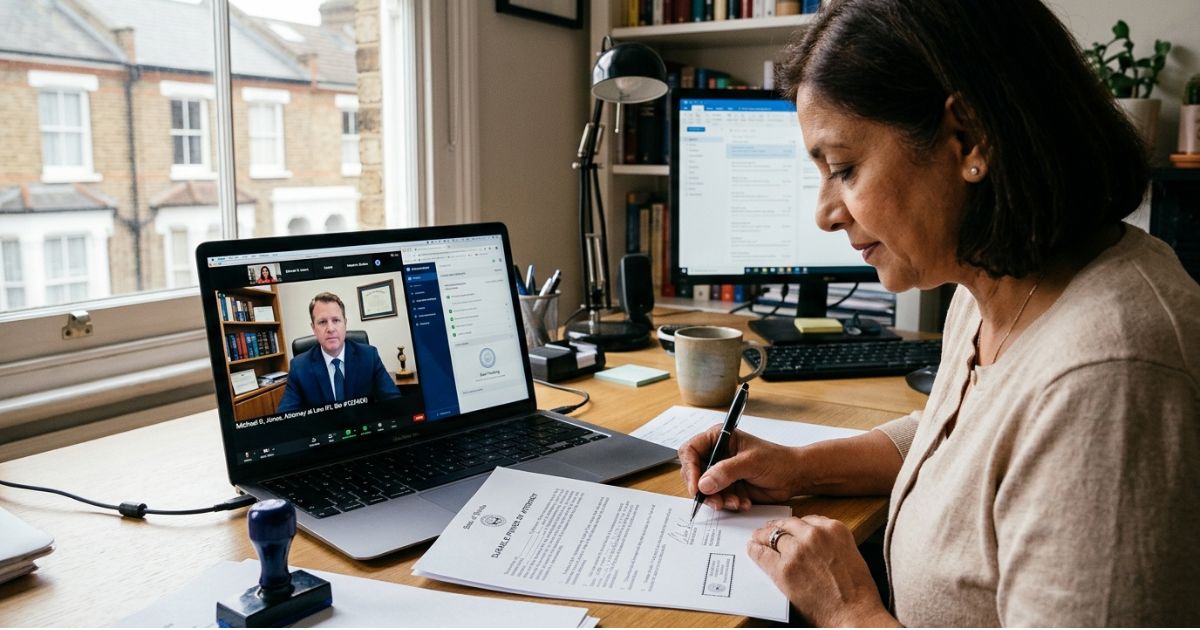
If you live outside the United States and want to buy land in Florida, the visible problem looks like travel: taking time off, booking a flight, coordinating your schedule around the closing date. The real risk is something else — a power of attorney drafted in generic terms, without the specific powers a title company or county requires, can stall the deed signing at the last minute, even after due diligence is already complete.
Most buyers assume any notarized power of attorney will do. In reality, the document that authorizes someone to sign on your behalf at a U.S. real estate closing has its own requirements — and a generic power of attorney, drafted without that purpose in mind, is one of the most common reasons a title company delays or rejects a closing.
Table of Contents
- What a power of attorney means in a land purchase
- When using a POA makes more sense than traveling
- Types of power of attorney accepted at closing
- How a foreign-signed POA gets recognized in the U.S.
- General vs. limited power of attorney: comparing the options
- Step-by-step: preparing your power of attorney
- Common mistakes that stall the closing
- Hidden costs of a poorly drafted POA
- What to check before sending the POA to the title company
- FAQ — Frequently Asked Questions
- 📚 Glossary
- ✅ Immediate Actions — Start Now
What a power of attorney means in a land purchase {#what-is-poa}
Short answer: a power of attorney (POA) is a legal document authorizing a trusted person — the "attorney-in-fact" or "agent" — to sign documents and act on the buyer's behalf during the purchase, including signing the deed at closing, without the buyer needing to be physically present.
In a U.S. land purchase, a power of attorney doesn’t replace the buyer — it’s a legal extension of them. The named agent signs documents exactly as the buyer would, and the transaction gets recorded as if the buyer had shown up in person.
It’s worth being clear on what a POA doesn’t do: it doesn’t transfer ownership on its own, and it doesn’t grant decision-making authority beyond what’s written into the document. It authorizes specific acts — typically signing the deed, the closing disclosure, and other closing documents — within limits the buyer defines in advance.
When using a POA makes more sense than traveling {#when-to-use}
Short answer: a power of attorney tends to be the more practical choice when the buyer lives outside the United States, when the closing date is uncertain or subject to change, or when the cost and time of travel don't make sense for a relatively straightforward transaction like a vacant land purchase.
A few situations where a POA solves a real problem:
- The buyer lives abroad and can’t take several days away from work or family
- The closing date isn’t confirmed yet — common with land purchases, where closing can shift due to title work, survey results, or financing
- The transaction value doesn’t justify the trip — airfare, lodging, and lost work days can outweigh the benefit of being there in person
- The buyer already visited the property beforehand and doesn’t need an in-person inspection right before closing
Vacant land purchases tend to be more straightforward than buying a finished home, which is one reason a power of attorney is such a common solution among international investors buying Florida land.
Types of power of attorney accepted at closing {#types}
Not every power of attorney serves the same purpose. Three formats come up most often in U.S. real estate closings:
General Power of Attorney
Grants broad authority covering nearly any financial and legal decision on the buyer’s behalf. This is the least recommended format for a one-time land purchase, since it exposes the buyer to unnecessary risk if the document is ever used beyond the closing itself.
Special or Limited Power of Attorney
Limits the agent’s authority to specific acts — in this case, signing the documents tied to purchasing a particular property. This is the most commonly used and most recommended format for real estate transactions, since it clearly spells out, in writing, exactly what the agent can and cannot do.
Durable Power of Attorney
Remains valid even if the buyer becomes incapacitated. In real estate purchases, it’s often paired with a limited power of attorney to make sure the document stays valid throughout the period between signing and closing.
In practice, most Florida title companies work from a standard Special Power of Attorney template built specifically for real estate purchases, already covering the powers needed to sign the deed and closing documents.
How a foreign-signed POA gets recognized in the U.S. {#recognition}
Short answer: a power of attorney signed outside the United States generally needs to be notarized, apostilled under the Hague Convention, and in some cases translated into English before a Florida title company will accept it for closing.
This is where most problems come up. A power of attorney signed abroad follows a different validation path than one signed inside the United States:
- Notarized signature — done before a local notary, attesting the signature is authentic
- Apostille — most Latin American countries, including Brazil, are signatories to the Hague Convention, so the document receives an apostille, which stands in for consular legalization and is recognized directly by U.S. authorities
- Certified translation, when required — some title companies accept the original-language document with the apostille attached, but require a certified English translation for internal review
- Prior review by the title company — before finalizing the wording, it’s worth sending the draft POA to the title company for review, confirming the powers described match exactly what the closing requires
Skipping the apostille step is the most frequent mistake among foreign buyers — many assume a notarized signature alone is enough, but U.S. authorities typically won’t accept the document without it.
General vs. limited power of attorney: comparing the options {#comparison-table}
| Criteria | General Power of Attorney | Special/Limited Power of Attorney |
|---|---|---|
| Scope of authority | Broad, covers nearly any financial decision | Limited to the specific property and purchase acts named |
| Risk to the buyer | Higher, exposure extends beyond the closing | Low, authority is clearly defined |
| Acceptance by title companies | Variable, requires case-by-case review | High, this is the industry-standard format |
| Drafting complexity | Lower, generic wording | Higher, must name the property and authorized acts |
| Best suited for | Someone with an existing trusted agent for multiple purposes | A one-time land or property purchase |
Step-by-step: preparing your power of attorney {#step-by-step}
1. Choose a trusted agent
This can be a family member, a business partner, an attorney, or the broker handling the transaction — as long as it’s someone the buyer trusts to sign documents exactly as instructed, without making independent decisions.
2. Request the title company’s specific template
Most Florida title companies already have a standard power of attorney template built for real estate purchases. Using that template, rather than drafting one from scratch, dramatically reduces the risk of rejection.
3. Review the powers described in the document
The wording should specifically authorize signing the deed, the closing disclosure, and other closing documents tied to that particular property — never open-ended, undefined powers.
4. Sign with notarization and obtain the apostille
If the signing happens outside the United States, it needs to be notarized and then apostilled under the Hague Convention.
5. Send the POA for review well before closing
Share the finalized document with the title company in advance — ideally weeks before the anticipated closing date — to confirm it will be accepted without objections.
Common mistakes that stall the closing {#common-mistakes}
Using a generic power of attorney template
A general-purpose POA that doesn’t name the specific property or the closing-related acts is frequently rejected by title companies for lacking clarity on what the agent is actually authorized to do.
Forgetting the apostille
One of the most common mistakes among foreign buyers: getting the POA notarized and assuming that alone is enough, without adding the apostille required for U.S. validity.
Sending the POA at the last minute
Reviewing and accepting a power of attorney takes time. Sending it just days before closing increases the risk of correction requests that delay the transaction.
Naming an agent without a clear conversation about the role
The agent needs to understand exactly what they’re signing and on whose behalf. Naming someone without that conversation upfront can lead to hesitation or errors at the signing table.
Not confirming the template with the title company
Requirements can vary slightly between title companies. Drafting the POA without confirming the accepted format is an avoidable source of rework.
Hidden costs of a poorly drafted POA {#hidden-costs}
- Closing delays — a rejected power of attorney can force a rescheduled closing, adding costs and putting contractual deadlines at risk
- A last-minute trip after all — if the POA isn’t accepted in time, the buyer may end up needing to travel anyway, under time pressure
- Emergency translation and apostille fees — resolving documentation under deadline pressure typically costs more than preparing ahead of time
- Additional legal fees — fixing a poorly drafted POA usually requires attorney involvement, an unplanned cost outside the original budget
- Risk to the earnest money deposit — in extreme cases, a closing delay can breach deadlines in the purchase contract and put the deposit at risk
What to check before sending the POA to the title company {#before-sending}
Short answer: before sending the power of attorney for closing, confirm the template the title company requires, verify the document correctly identifies the property and the authorized acts, and make sure the apostille and any required translation are already complete.
A quick check before sending the document avoids most problems:
- Is the template the one recommended or approved by the title company handling the closing?
- Does the document clearly identify the property — address or parcel number — and the authorized acts?
- Is the signature notarized and apostilled, if signed outside the United States?
- Is the named agent aware of their role and available on the scheduled closing date?
- Are digital and physical copies of the POA ready to send to the title company and the recording office?
FAQ — Frequently Asked Questions {#faq}
Can I buy land in Florida entirely remotely, without ever traveling to the United States?
Yes. With a properly drafted power of attorney that’s correctly notarized and apostilled, it’s possible to complete the entire purchase — including signing the deed at closing — without being physically present in the United States.
Do I need a lawyer to draft the power of attorney?
Not necessarily in most cases, since the title company usually provides a specific template built for real estate purchases. That said, legal guidance is worth having when the situation involves multiple buyers, financing, or a corporate ownership structure.
Who can be named as the agent on the power of attorney?
Anyone the buyer trusts — a family member, business partner, attorney, or the broker handling the transaction — as long as they’re available to attend the closing on the scheduled date.
Is the apostille always required for international buyers?
Yes, when the power of attorney is signed outside the United States. For buyers in Hague Convention countries, including Brazil and most of Latin America, the apostille is the standard mechanism U.S. authorities use to recognize the document internationally.
Does a power of attorney expire?
It can, if the document itself sets an expiration date or ties validity to a specific event, such as the completion of the closing. It’s best practice for the POA to clearly state its validity period to avoid any question about it later.
📚 Glossary {#glossary}
Power of Attorney (POA): a legal document authorizing one person to act and sign documents on behalf of another, within the limits defined in the document itself.
Attorney-in-fact / Agent: the person named in the power of attorney to act on the buyer's behalf.
Apostille: an international certification under the Hague Convention that recognizes the validity of a public document in another signatory country, such as the United States.
Title company: the company responsible for verifying property ownership, handling the closing, and issuing title insurance for the transaction.
Closing disclosure: the document detailing the final financial terms of the transaction, provided to the buyer before the deed is signed.
Deed: the legal document that transfers ownership of the property from the seller to the buyer.
Notarization: a notary's certification that a signature is authentic, typically required before a document can be apostilled.
✅ Immediate Actions — Start Now {#immediate-actions}
- Confirm with the title company whether they require a specific power of attorney template.
- Choose a trusted agent and talk through their role before drafting the document.
- Draft the POA naming the specific property and authorized acts — avoid generic templates.
- Sign with notarization and arrange the apostille if signing outside the United States.
- Check whether a certified English translation will be required.
- Send the POA for title company review weeks ahead of the closing date.
- Talk to TerraNoble for bilingual guidance on preparing your power of attorney to buy land in Florida.
Conclusion
Buying land in Florida without being present isn’t just possible — it’s a routine path for international investors, including buyers across Latin America. What separates a smooth closing from one that stalls at the last minute isn’t the distance involved, but the quality of the power of attorney: the right authority, a template the title company accepts, and correct authentication, including the apostille when the document is signed outside the United States.
Preparing the POA in advance, confirming the template with the title company, and naming a trusted agent turns a remote purchase into a predictable process instead of a source of last-minute stress.
TerraNoble offers bilingual support — in English and Portuguese — to help Latin American investors properly structure the documentation needed to buy Florida land remotely, including guidance on power of attorney. Get in touch with our team for guidance on your specific situation.