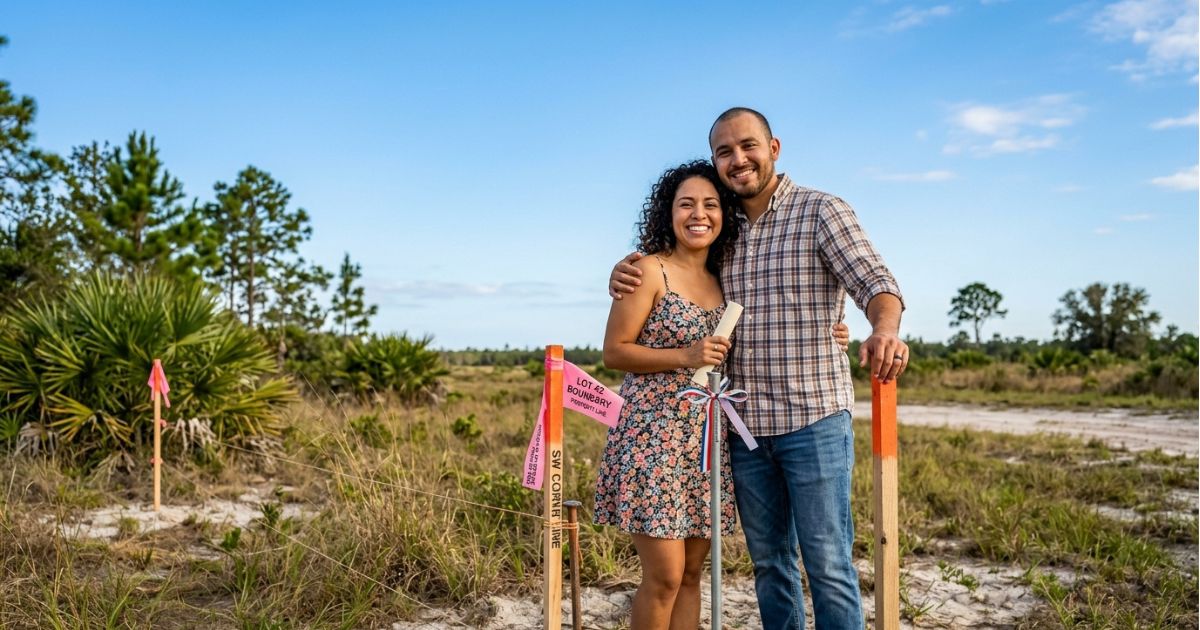
If you think the biggest obstacle to leaving renting behind is saving up a huge down payment, the real problem is different — it’s not knowing there’s a more accessible path than buying a finished house. That’s what Carlos and Daniela Reyes, a Venezuelan couple living in Kissimmee for eight years, discovered after seven years of paying rent without ever building equity of their own.
Most people assume owning property in Florida means committing to a decades-long mortgage on a built home. In reality, buying vacant land can be a cheaper, simpler, and faster first step away from paying someone else’s mortgage — and the Reyes family’s story shows exactly how that process worked in practice.
Table of Contents
- Why do so many Hispanic families in Florida still rent?
- The Reyes family’s journey: from renting in Kissimmee to their first parcel of land
- What changed after becoming landowners
- Renting vs. owning land: comparing long-term costs
- Common mistakes families make when trying to leave renting behind
- Hidden costs of becoming a landowner in Florida
- What to verify before trading rent payments for land ownership
- FAQ — Frequently asked questions
- 📚 Glossary
- ✅ Immediate Actions — Start Now
Why do so many Hispanic families in Florida still rent? {#why-still-renting}
Short answer: many Hispanic families living in Florida keep renting because they assume buying property requires a large down payment, an extensive US credit history, or income documented entirely in dollars. Vacant land usually requires far less of that than a finished home, which makes it a more realistic entry point for families who want to stop renting.
Carlos and Daniela had lived in central Florida for eight years and, like many Latin American immigrant families, spent most of that time paying monthly rent without seriously considering property ownership. “We always thought we needed a home mortgage to stop renting. We never imagined that buying land could be such a simpler option,” Carlos says.
The myth that a financed home is the only path
Much of that hesitation comes from a lack of information about alternatives. Buying vacant land generally involves less paperwork, lower down payments, and in many cases direct financing with the seller — without requiring an extensive US credit history.
The Reyes family’s journey: from renting in Kissimmee to their first parcel of land {#reyes-journey}
The Reyes family had been renting a two-bedroom apartment in Kissimmee for seven years. The rent climbed almost every year, and Carlos began to realize they would keep paying indefinitely without ever owning anything. “We ran the numbers and realized that in seven years we had paid enough for a down payment on several properties. Except that money was just gone, with no return for us,” he says.
What motivated the family to leave renting behind
The turning point came when their rent increased for the third time in two years. Carlos and Daniela started researching alternatives and discovered that vacant land in central Florida counties had entry prices far more accessible than they had imagined, especially in areas outside the most sought-after urban centers.
How the family chose the county and the parcel
The Reyes spent about four months comparing counties, reviewing public population growth data, and confirming that available parcels had buildable status. They avoided areas with uncertain zoning and prioritized land with public road access and nearby utility availability.
“We didn’t want to buy just any cheap parcel. We wanted a lot where we could eventually build a small home for our kids — even if that took a few years,” Daniela explains. They chose a quarter-acre parcel in a county with consistent population growth, within their budget.
The land-buying process, step by step
The process took about two months, from the initial offer to the title verification and closing. The family hired a title search to confirm the land was free of liens or recorded claims, and used seller financing, which reduced the need for traditional bank documentation.
Short answer: the Reyes family's purchase came together through three main factors — a relatively low-cost parcel, direct seller financing, and an upfront title search that prevented surprises at closing.
What changed after becoming landowners {#what-changed}
Short answer: after buying the land, the Reyes family stopped paying monthly rent to a landlord and now pays only annual property tax and basic lot maintenance — amounts significantly lower than the rent they used to pay. They still rent their current home while planning future construction, but now they own an appreciating asset of their own.
“The psychological difference was huge. Before, we’d look at the bank statement and know that money was gone forever. Now we know we’re paying for something that’s actually ours,” Carlos says. The family didn’t build right away — the plan is to keep saving toward financing construction of a small home on the land in the coming years, but the parcel already belongs to them, free of any landlord relationship.
Why they didn’t build immediately
The Reyes family chose to keep the land vacant for now, paying only basic maintenance costs while they plan construction financing. This strategy is common among buyers who want to lock in a parcel before prices rise, even without immediate means to build.
Renting vs. owning land: comparing long-term costs {#comparison-table}
| Aspect | Continuing to rent | Buying your own land |
|---|---|---|
| Return on money paid | None — money doesn't come back to the tenant | Builds equity over time |
| Annual adjustments | Subject to increases set by the landlord | Property tax reassessed by the county, more predictable |
| Stability | May need to relocate at the end of a lease | Permanent ownership of the parcel, no eviction risk |
| Required down payment | Security deposit, typically 1–2 months | Variable down payment, often lower than a finished home |
| Future use | No control over the property | Freedom to build, resell, or hold as a reserve asset |
Common mistakes families make when trying to leave renting behind {#common-mistakes}
Buying without verifying the title
Skipping the title search step can mean inheriting liens or recorded disputes on the land. The Reyes family considers this the most important step in the entire process.
Choosing the cheapest lot without checking zoning
Cheap land in an area without confirmed buildable status can become useless for a buyer’s future plans, even if it costs very little upfront.
Not calculating the total cost of ownership
Property tax, lot maintenance, and any HOA fees need to factor into the decision before buying — not just the purchase price of the land.
Assuming seller financing carries no risk
Owner financing can be more accessible, but buyers still need to carefully review the contract terms, including interest rates and default clauses.
Hidden costs of becoming a landowner in Florida {#hidden-costs}
- Annual property tax: charged by the county even without any construction on the land
- Basic lot maintenance: mowing and compliance with county rules to avoid fines
- Title search and closing costs: fees for verifying the title and closing the transaction
- Land survey: a boundary survey is recommended before or shortly after the purchase
- Cost of waiting to build: buyers who don’t build right away keep paying maintenance costs the whole time
The Reyes family recommends budgeting for these costs from the start, so the transition from renting to land ownership doesn’t come with financial surprises.
What to verify before trading rent payments for land ownership {#before-you-buy}
- Confirm the parcel’s buildable status and zoning with the county
- Request a title search before signing any purchase agreement
- Calculate the annual cost of property tax and lot maintenance
- If considering seller financing, review every term of the contract carefully
- Verify public road access and proximity to utilities
- Decide whether the plan is to build in the short term or hold the land as a store of value
FAQ — Frequently asked questions {#faq}
Can foreigners buy land in Florida without US citizenship?
Yes. Foreign nationals can purchase property in the United States without a US visa, green card, or citizenship. Carlos and Daniela, for example, bought their parcel as foreign residents in Florida.
Is buying land cheaper than buying a finished home?
Generally, yes. Vacant land tends to have lower down payments and lower total prices than built homes, which makes it a more accessible entry point for families looking to leave renting behind.
Do you have to build right away after buying land?
No. Many buyers, like the Reyes family, keep the land vacant for a period while they plan construction financing, paying only property tax and basic maintenance in the meantime.
What is seller financing (owner financing)?
It’s an arrangement where the seller finances the land purchase directly with the buyer, without requiring approval from a traditional bank. It reduces paperwork but requires careful review of the contract terms.
📚 Glossary {#glossary}
Owner financing — an arrangement in which the seller finances the land purchase directly with the buyer, without a bank intermediary.
Title search — a records search confirming the land is free of liens, disputes, or claims before purchase.
Buildable land — land with zoning and access that allow construction, without restrictions preventing residential use.
Property tax — an annual tax charged by the county based on the property’s value, even without any construction on it.
Land survey — a boundary survey confirming the exact limits of the parcel.
Closing costs — the set of administrative and legal fees charged when a property purchase closes.
✅ Immediate Actions — Start Now {#immediate-actions}
- Calculate how much you’ve already paid in rent over the past few years, with no return
- Research Florida counties with parcels within your budget
- Verify the buildable status and zoning of any lots you’re considering
- Request a title search before signing any purchase agreement
- Evaluate whether seller financing is a viable option for you
- Set a realistic plan: build soon, or hold the land as a store of value
Conclusion
The Reyes family’s story shows that leaving renting behind doesn’t necessarily require buying a finished home with a decades-long mortgage. Vacant land, researched carefully and purchased with the right verifications, can be the real first step toward building equity of your own in Florida.
That doesn’t mean the path looks the same for everyone. It means there’s an alternative more accessible than many Hispanic families realize — one worth understanding before signing another lease.
Tired of paying rent without building any equity of your own? TerraNoble offers bilingual support — in English, Spanish, and Portuguese — to help Hispanic families understand the process of buying land in Florida, from the first county researched to the day the deed is signed. Get in touch with our team.