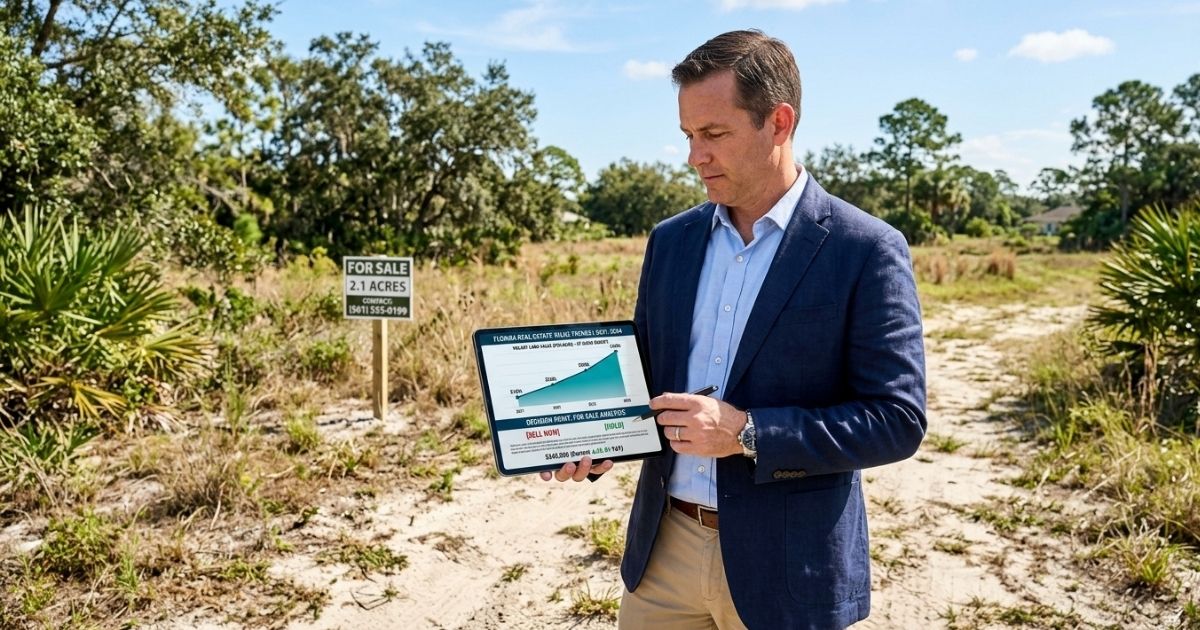
If you bought land in Florida a few years ago, the visible problem is deciding whether to sell now or wait longer. The real problem is that most owners make this call based on gut feeling — “the market looks good” or “it’s not time yet” — instead of comparing the actual return on holding against the actual return on selling and redeploying the capital elsewhere. That gap can add up to tens of thousands of dollars over the years.
Most people assume selling land is mainly about market price. In reality, the sell-or-hold decision comes down to a set of factors — annual carrying costs, how fast the region is still appreciating, capital gains taxes, and what you’d do with the money if you sold today — that together form the real equation.
Table of Contents
- Signs it might be time to sell
- Signs it’s worth holding onto the land
- How to calculate the real cost of continuing to hold
- How FIRPTA and taxes affect a sale
- Sell vs. Hold: a practical comparison
- Common mistakes when making this decision
- Hidden costs of selling land
- FAQ — Frequently Asked Questions
- 📚 Glossary
- ✅ Immediate Actions — Start Now
Signs it might be time to sell {#signs-to-sell}
Short answer: selling usually makes sense when the land has already appreciated significantly above the purchase price, when annual carrying costs (taxes, insurance, upkeep) have started outweighing the pace of appreciation, or when there's a better opportunity for the capital tied up in the parcel.
The first signal is purely financial: if the area where the land sits has been through a strong appreciation cycle — new infrastructure, highway expansion, new developments moving in — the gain may already be “mature.” Waiting longer doesn’t always mean earning more; in many cases, the appreciation curve slows down after the initial growth spike.
The second signal is the weight of recurring costs. Property taxes, insurance, and basic upkeep eat into the return every single year. Once those annual costs start representing a meaningful share of the expected appreciation, the net return on continuing to hold the land starts to shrink.
The third signal is opportunity cost: if there’s another parcel, property, or investment with a more attractive potential return available right now, it’s worth asking whether the capital sitting in this specific piece of land is still the best use of it.
Signs it’s worth holding onto the land {#signs-to-hold}
Short answer: holding usually makes sense when the region is still in an early growth phase, when annual carrying costs are low relative to the property's value, or when the original plan was to build a home or keep the land as a long-term wealth reserve.
Parcels located in counties still in the early stages of an expansion cycle — with recently announced highways, growing school districts, or major employers moving in — tend to have the most appreciation potential still ahead of them. Selling too early in those cases means giving up the most significant part of the investment’s gain.
It’s also worth weighing how much the land actually costs to hold. In many Florida counties, vacant land carries relatively low annual property taxes compared to built properties, especially when there’s no CDD (Community Development District) attached. If the carrying cost is low, the pressure to sell quickly goes down.
Finally, if the original purpose of the purchase was future personal use — building a seasonal home, retiring in Florida, or leaving the land to family as an inheritance — that personal goal should weigh into the decision just as much as the pure financial return.
How to calculate the real cost of continuing to hold {#carrying-cost}
Short answer: to know whether holding still makes sense, add up the annual costs (taxes, insurance, upkeep, and any HOA or CDD fees) and compare that total to the region's average annual appreciation — if carrying costs eat up a large share of the expected appreciation, the net return on holding is smaller than it looks.
Many owners only look at gross appreciation — “I bought it for X, it’s worth Y today” — without subtracting what it actually cost to hold the land over the years. That simplified math inflates the perceived return and can lead to the wrong call: continuing to hold an asset whose real net return is already modest.
The more honest calculation adds up every annual cost — property taxes, vacant land insurance, basic upkeep (mowing, pest control, fencing where the county requires it) — and compares that total, multiplied by the number of years owned, against the accumulated appreciation gain. If the costs consumed a meaningful chunk of the gain, the real annualized return can be well below what the owner initially assumed.
This exercise also helps project the future: if carrying costs are trending upward (for example, a new CDD forming in the area) while the pace of appreciation has already slowed, the case for selling gets stronger.
How FIRPTA and taxes affect a sale {#firpta-taxes}
Short answer: foreign sellers in the US are subject to FIRPTA, a withholding on part of the sale proceeds, plus federal capital gains tax — both of which reduce the net amount received and should be calculated before deciding to sell, not after.
FIRPTA (Foreign Investment in Real Property Tax Act) requires a portion of the gross sale price to be withheld at closing when the seller is a foreign non-resident. That withholding isn’t the final tax owed — it’s an advance payment — but it directly affects how much cash reaches the seller right after closing, before any adjustment on the US tax return.
Beyond FIRPTA, the capital gain from the sale is taxable in the US. The amount owed depends on how long the land was held and the difference between the purchase price and the sale price. Sellers who plan the sale in advance — and consult an accountant experienced with non-resident tax matters — can estimate the real net proceeds more accurately, avoiding surprises partway through the process.
Skipping this calculation is one of the most common mistakes among foreign owners: deciding to sell based purely on the land’s market value, without factoring in what will be withheld and taxed, can make a sale look more attractive than it actually is.
Sell vs. Hold: a practical comparison {#comparison-table}
| Factor | Favors selling | Favors holding |
|---|---|---|
| Region's appreciation stage | Growth cycle already advanced or mature | Region still in early expansion phase |
| Annual carrying costs | Taxes, insurance, and upkeep rising | Costs low and stable |
| Planned use of the land | No future personal-use plan | Plan to build or personally use the property |
| Alternative investment options | A more attractive opportunity is available | No clear alternative right now |
| Seller's tax situation | Favorable moment to realize the gain | Withholding and taxes would eat too much of the proceeds now |
Common mistakes when making this decision {#common-mistakes}
Selling for the first attractive number without checking the local market
Accepting the first offer without checking recent comparable land sales in the same county can mean leaving money on the table.
Not subtracting carrying costs from the return calculation
As covered above, looking only at purchase price versus current value — without subtracting taxes and upkeep paid over the years — inflates the perceived return.
Ignoring how FIRPTA affects the sale timeline
Foreign sellers who don’t prepare for the FIRPTA withholding can be caught off guard by how much less cash actually arrives at closing.
Deciding based on emotion instead of numbers
Holding onto land out of attachment to the original plan — even after the numbers no longer support it — is just as risky as selling in a rush out of market anxiety.
Hidden costs of selling land {#hidden-costs}
- Broker commission — typically a percentage of the sale price, which should be subtracted from the net return calculation
- FIRPTA withholding — a portion of the gross sale proceeds withheld at closing when the seller is a foreign non-resident
- Capital gains tax — calculated on the difference between purchase price and sale price, under US tax rules
- Title company and closing costs — deed preparation, title search, and closing processing fees
- Potential price adjustments — land that sits on the market too long may need a price cut, reducing the expected return
FAQ — Frequently Asked Questions {#faq}
Is there a minimum amount of time I need to hold the land before selling?
There’s no legal rule requiring a minimum holding period, but how long the land was held affects how the capital gain is taxed in the US. Talking to an accountant before the sale helps clarify the tax impact of the timing you choose.
Does FIRPTA apply to every foreign seller?
Generally, yes — FIRPTA applies to foreign non-resident sellers, with withholding calculated on the gross sale amount. There are exceptions and ways to adjust that withholding, which should be evaluated case by case with a qualified professional.
Is it better to sell directly or through a broker?
It depends on the parcel and the local market. A broker experienced with vacant land in the area typically helps reach a wider pool of buyers and negotiate a price closer to true market value, but that comes with a commission cost that needs to be factored in.
Does TerraNoble help owners decide if it’s time to sell?
Yes. TerraNoble offers bilingual support, in English and Portuguese, to help owners understand the land’s current value, local market conditions, and the options available before making this decision.
📚 Glossary {#glossary}
FIRPTA — the Foreign Investment in Real Property Tax Act, a US federal law requiring withholding on part of the sale proceeds when the seller is a foreign non-resident.
Capital gain — the taxable difference between the purchase price and the sale price of a property or parcel.
CDD (Community Development District) — a special district that finances infrastructure in certain Florida developments, billed to owners as an additional fee.
Opportunity cost — the return given up by keeping capital tied to one specific asset instead of redeploying it elsewhere.
Net return — the real gain on an investment after subtracting all associated costs, such as taxes, upkeep, and commissions.
✅ Immediate Actions — Start Now {#immediate-actions}
- Add up total spending on taxes, insurance, and upkeep for the land since purchase
- Research recent sale prices for comparable land in the same county
- Talk to an accountant experienced with non-resident taxation about how FIRPTA and capital gains tax apply to your situation
- Assess whether the region is still in a growth phase or if the appreciation cycle has already matured
- Decide whether a more attractive investment alternative exists for the current capital
- Talk to TerraNoble for a bilingual assessment of your land’s current market value and timing
Conclusion
Selling or holding land in Florida shouldn’t be a decision based on market mood — it should come down to a clear calculation: how much the land has already appreciated, how much it costs to keep holding it, how much will be withheld and taxed on a sale, and what you’d do with the capital if you decided to sell today. Once those numbers are laid out side by side, the right answer usually becomes clearer than it seemed.
There’s no universal answer — it depends on the region’s growth stage, the owner’s tax situation, and personal plans for the property. What matters is making this call with real information about the local market and the tax picture, not just the expectations you had when you first bought the land.
TerraNoble offers bilingual support — in English and Portuguese — to help you evaluate the right time to sell or hold your Florida land. Reach out to our team to talk through your specific situation.