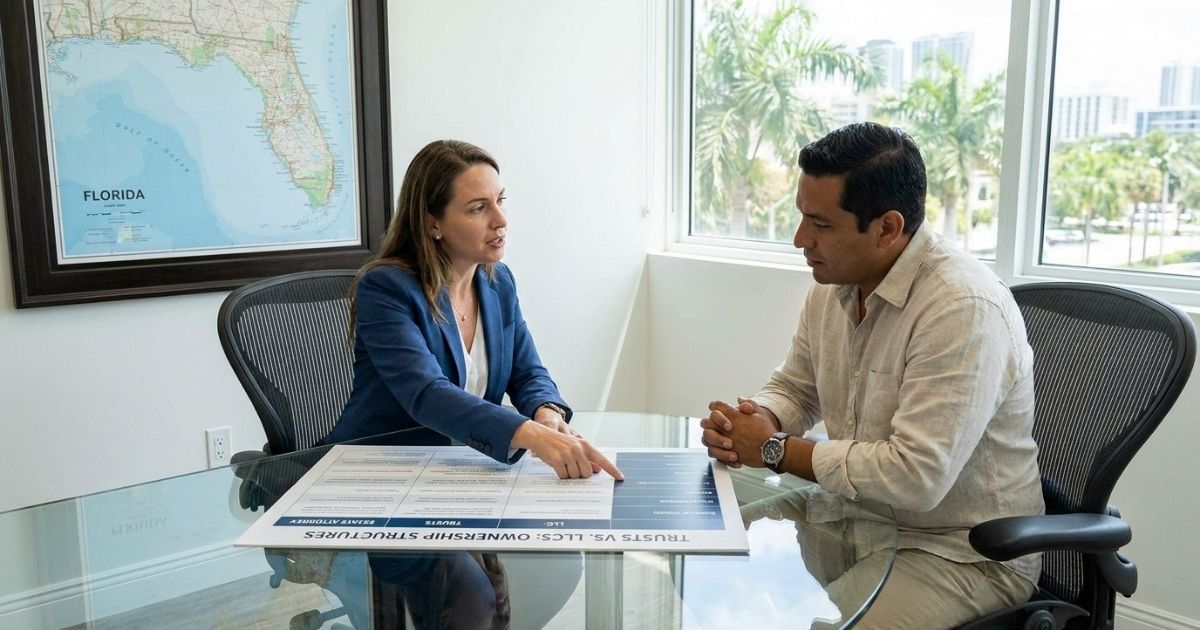
If you’re about to buy land in Florida, the question that usually comes last — after price, location, and zoning — is one of the ones that matters most in the long run: whose name will actually be on the deed? The visible problem is picking between two acronyms, trust and LLC. The real problem is that this choice determines how your heirs receive the property, how much it costs them to get it, and whether your personal assets stay exposed if something goes wrong on that land.
Most buyers treat ownership structure as a detail to sort out after closing. In practice, deciding this ahead of time avoids rework, restructuring costs, and — in the worst case — a Florida probate process that can take months and cost heirs thousands of dollars.
Table of Contents
- What a trust is and how it holds land
- What an LLC is and how it holds land
- Trust vs. LLC: what’s the real difference
- When a trust makes more sense
- When an LLC makes more sense
- Comparison: trust vs. LLC for land ownership
- Common mistakes buyers make choosing a structure
- Hidden costs of each structure
- FAQ — Frequently Asked Questions
- 📚 Glossary
- ✅ Immediate Actions — Start Now
What a trust is and how it holds land {#what-is-trust}
Short answer: a trust — most commonly a revocable living trust — is a legal arrangement where land is titled to a trustee who manages the property for beneficiaries the buyer names, allowing the land to pass directly to heirs without going through Florida probate.
In practice, the buyer creates the trust, names themselves as trustee while they’re alive, and names a successor trustee who automatically steps in after death. The land is titled in the name of the trust — something like “Jane Smith, Trustee of the Smith Family Trust” — rather than in the buyer’s personal name.
That means when the owner passes away, the land is already outside their individual name, and it transfers to the named beneficiaries according to the trust’s own terms, without going through the probate court in the county where the property sits.
What an LLC is and how it holds land {#what-is-llc}
Short answer: an LLC (Limited Liability Company) is a state-registered business entity that becomes the legal owner of the land — the buyer becomes a member of the LLC rather than a direct property owner, which creates a layer of separation between personal assets and any risk tied to the property.
When land is purchased through an LLC, the deed is recorded in the company’s name, not the individual’s. That matters most for buyers planning to use the land commercially, rent it out, build and resell, or who simply want to keep their personal name off public county records.
An LLC also tends to be the preferred structure for buyers acquiring multiple parcels, because it lets them separate risk: each property, or a group of them, can sit under its own LLC, isolating a problem on one parcel from the rest of the portfolio.
Trust vs. LLC: what’s the real difference {#trust-vs-llc}
Short answer: a trust exists primarily to organize succession and avoid probate, while an LLC exists primarily to shield personal assets from lawsuits and property-related liability — and many more cautious buyers end up using both structures together.
This is the most common point of confusion for land buyers: treating a trust and an LLC as interchangeable options, when they actually solve different problems. A trust does nothing to protect personal assets from a lawsuit — if someone is injured on the land and sues, the trust’s beneficiary can still be held personally liable. An LLC protects against exactly that kind of risk, but on its own it doesn’t avoid probate if the LLC membership interest itself is titled in the buyer’s personal name at death.
That’s why a common structure among more experienced investors is to buy the land through an LLC, then transfer the LLC’s membership interest into a trust — combining liability protection with simplified succession.
When a trust makes more sense {#when-trust}
Short answer: a trust is usually enough for buyers purchasing land for personal or family use — as a store of value, a future homesite, or a retreat property — where the main concern is making sure heirs receive the property smoothly, without much exposure to third-party liability risk.
If the land won’t be rented out, won’t have regular visitors, and isn’t tied to any commercial activity, the risk of a liability lawsuit connected to the property is relatively low. In those cases, the trust’s core benefit — avoiding probate and simplifying inheritance — usually outweighs the need for an added layer of liability protection.
Another common scenario: families who already hold other investments through an LLC, but who are buying one specific parcel for future personal use, often prefer to keep that parcel separate, inside a trust, to make clear it isn’t a business asset.
When an LLC makes more sense {#when-llc}
Short answer: an LLC tends to be the better fit when the land is meant for investment, income generation, build-to-sell development, or any use that brings third parties onto the property — situations where the risk of a lawsuit against the owner is higher.
Investors buying land to develop and resell, lease for storage or events, or who plan to build out multiple properties over time, tend to benefit from the asset separation an LLC provides. If something goes wrong — an accident on the property, a contract dispute with a builder — liability is generally limited to the LLC’s assets rather than extending to the investor’s personal wealth.
An LLC also makes co-ownership more manageable when more than one buyer is involved, such as a partnership between family members or friends, since ownership shares, profit splits, and exit terms can all be formalized in the company’s operating agreement.
Comparison: trust vs. LLC for land ownership {#comparison-table}
| Feature | Trust | LLC |
|---|---|---|
| Primary purpose | Succession planning and transferring the property without probate | Asset protection and separation of personal liability |
| Protects against lawsuits? | Not on its own | Yes — limits liability to the company's assets |
| Avoids Florida probate? | Yes — this is its core function | Not directly — depends on how the membership interest is titled |
| Best suited for | Personal or family use, land held as a store of value, simplified inheritance | Investment, rental income, resale, multiple properties |
| Ongoing cost and complexity | Generally simpler, with no recurring state filing obligations | Requires a registered agent, annual report, and state fees |
| Can they be combined? | Yes — an LLC for liability protection plus a trust for succession is a common combination | |
Common mistakes buyers make choosing a structure {#common-mistakes}
Assuming a trust and an LLC solve the same problem
They’re built for different purposes. Assuming either one covers both liability protection and succession is one of the most common mistakes first-time land buyers make.
Buying under a personal name and figuring out the structure later
Restructuring ownership after the purchase usually means a new deed, county recording fees, and in some cases tax consequences. Deciding on the structure before closing avoids that rework entirely.
Overlooking FIRPTA and foreign-buyer rules
Foreign buyers face specific withholding requirements (FIRPTA) when the property is eventually sold, and the structure chosen — individual, trust, or LLC — can change how that withholding is calculated and reported.
Setting up a structure without qualified legal guidance
Trust and LLC documents involve specific legal language around trustees, successors, and members’ rights. Signing without fully understanding those clauses can create problems at exactly the moment the structure is supposed to protect the family.
Hidden costs of each structure {#hidden-costs}
- Annual state filing fees for the LLC — most states require an annual report and a maintenance fee to keep the LLC active, whether or not the land generates income
- Registered agent fees — LLCs must maintain a registered agent in the state where they’re formed, typically a recurring annual cost
- Legal fees to draft the trust — a well-structured trust with clear succession language usually calls for an estate planning attorney
- Cost of transferring land into a structure after purchase — if the decision comes late, expect a new deed and county recording costs
- Added tax complexity for non-residents — depending on the structure chosen, there may be additional US filing obligations, which makes qualified tax guidance worth the cost
FAQ — Frequently Asked Questions {#faq}
Can a foreign buyer set up a trust or an LLC in the US?
Yes. Both trusts and LLCs can be created by non-resident foreign buyers, with no green card or US citizenship required. It’s advisable to obtain an ITIN (Individual Taxpayer Identification Number) for tax matters tied to the property.
Can I switch structures after already buying land under my own name?
Yes, it’s possible to transfer the land into a trust or an LLC after purchase, but that typically requires a new deed, county recording fees, and — depending on the situation — tax guidance to evaluate any consequences of the transfer.
Do a trust or an LLC eliminate US estate tax entirely?
Not necessarily. They help avoid probate, but US estate and gift tax rules for non-residents follow their own separate framework, which should be reviewed with a qualified accountant or attorney.
Does TerraNoble help buyers decide between a trust and an LLC?
Yes. TerraNoble offers bilingual support, in English and Portuguese, to help buyers understand ownership structure options before closing, always alongside qualified legal and tax professionals.
📚 Glossary {#glossary}
Trust (revocable living trust): a legal arrangement where land is held in the name of a trustee for the benefit of named beneficiaries, allowing it to transfer without probate.
LLC (Limited Liability Company): a state-registered business entity that legally owns the land, separating personal assets from risk tied to the property.
Trustee: the person or entity responsible for managing a trust's assets on behalf of its named beneficiaries.
Probate: the US court process used to transfer a deceased person's assets to their heirs when no structure is in place to avoid it.
Registered agent: a person or company designated to receive legal documents and official correspondence on behalf of an LLC in its state of formation.
FIRPTA: a federal law requiring withholding on a portion of the sale price when the seller of US real estate is a foreign person, which also applies to non-resident-owned trusts and LLCs.
✅ Immediate Actions — Start Now {#immediate-actions}
- Decide whether the land's main purpose is personal/family use or investment — that alone points toward a trust, an LLC, or a combination of both.
- Talk to an attorney experienced in US estate planning and real estate before signing the purchase contract.
- Apply for an ITIN if you don't have one, since it's required for several tax matters tied to the property.
- Ask your attorney for an estimate of the annual cost of maintaining the structure you choose (registered agent, annual report, legal fees).
- Avoid signing trust or LLC formation documents without a full explanation of the clauses involved.
- Talk to TerraNoble to understand the ownership structure options available for your specific situation.
Conclusion
A trust and an LLC aren’t competing options — they’re different tools for different problems. A trust exists to simplify succession and avoid probate; an LLC exists to protect personal assets from property-related liability. Understanding that difference before deciding whose name goes on the deed avoids rework, extra cost, and decisions made under pressure at the closing table.
For many buyers, the answer isn’t choosing one over the other — it’s understanding which concern matters most for their situation, and, when it makes sense, combining both. What matters most is making that decision with qualified legal guidance, before closing, not after.
TerraNoble offers bilingual support — in English and Portuguese — to help you understand the ownership structure options available before you buy land in Florida. Get in touch with our team to talk through your specific situation.