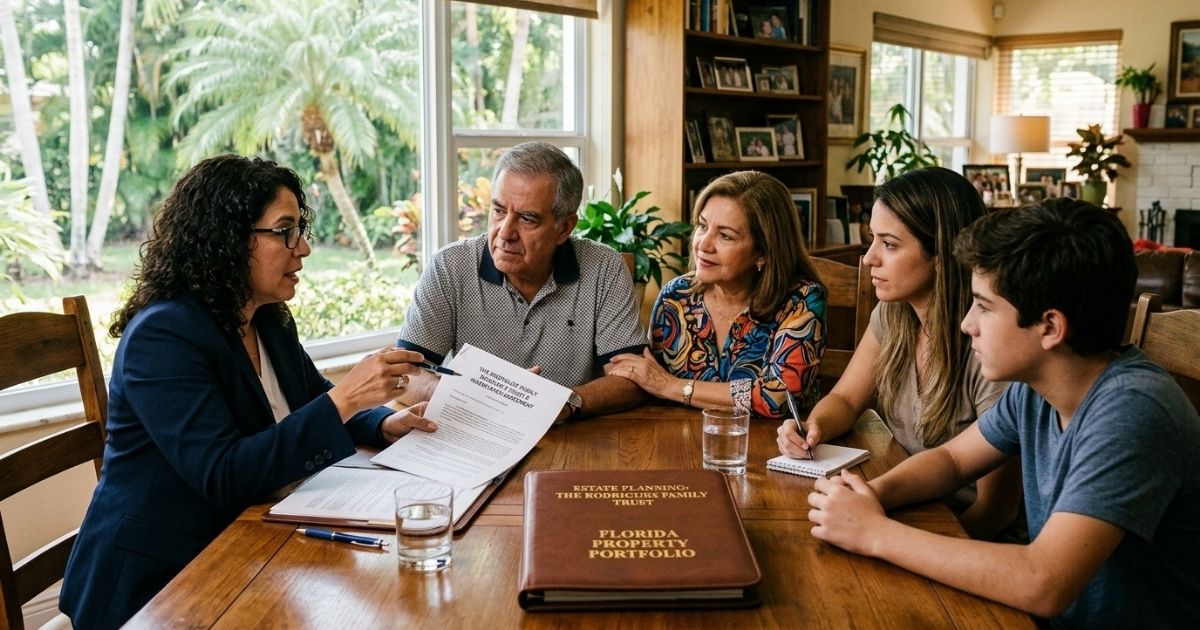
If a foreign investor passes away while owning land or property in the United States, the visible problem for the family is the loss itself. The real financial risk — quiet, and rarely discussed before the purchase — is different: without estate planning, that property can get pulled into a probate process that takes anywhere from six months to more than two years to resolve, and it can become subject to a federal estate tax exemption of just $60,000, a fraction of what applies to US citizens and residents.
Most foreign investors treat inheritance as something to “figure out later,” or assume that a will drafted in their home country already covers assets in the United States. In practice, US property follows its own succession rules, independent of what was decided under another country’s law — and how the title is held at the moment of purchase is the single biggest factor in whether heirs inherit smoothly or spend years in court.
Table of Contents
- Why how you hold title matters more than your will
- What probate is and why it catches foreign families off guard
- Estate tax for non-US citizens
- Structures that help you avoid probate
- Comparing ways to hold title
- Common estate planning mistakes
- Hidden costs of skipping estate planning
- FAQ — Frequently Asked Questions
- 📚 Glossary
- ✅ Immediate Actions — Start Now
Why how you hold title matters more than your will {#title-matters}
Short answer: a will drafted in Brazil or another country doesn't replace estate planning for US property. What actually determines how the property passes to your heirs is mainly how title was held at closing — individually, jointly, inside an LLC, or inside a trust.
Many foreign buyers sign the deed in their own name, the simplest and fastest option at closing, without considering what happens to that title after they pass away. That decision, made in a matter of minutes during closing, is exactly what determines whether heirs will need to open a US court proceeding to receive the property.
A foreign will can sometimes be recognized by a US court, but that typically requires certified translation, authentication, and a supplemental court process — consuming time and money that could have been avoided with a title structure planned from the start.
What probate is and why it catches foreign families off guard {#what-is-probate}
Short answer: probate is the US court process used to transfer a deceased person's property to their heirs. When the property owner is a foreign national who never lived in the US, the process is called "ancillary probate," and it tends to be slower, more expensive, and more bureaucratic than standard probate.
Unlike what happens in many Latin American countries, in the United States a property held solely in an individual’s name doesn’t pass automatically to heirs. It stays frozen until a court in Florida — or whichever state the property sits in — formally authorizes the transfer.
For a foreign owner, that usually means:
- Hiring a US probate attorney, in addition to any proceeding already underway back home
- Translating and authenticating documents such as the death certificate and, if one exists, the foreign will
- Waiting on the local court’s schedule, which can take anywhere from six months to more than two years
- Paying court costs and attorney’s fees that, combined, often represent a meaningful share of the property’s value
While the process runs its course, the property generally can’t be sold or refinanced — a serious problem when the family overseas is counting on that asset.
Estate tax for non-US citizens {#estate-tax}
Short answer: US citizens and residents have a federal estate tax exemption worth several million dollars. A non-resident alien who owns US property has an exemption of just $60,000 on US-situs assets — anything above that can be taxed at rates up to 40%.
This is, by far, the detail that surprises foreign investors most during estate planning. A property valued at $400,000, for example, can generate significant federal estate tax on the portion above the $60,000 exemption — a very different number than most buyers picture when they hear “US inheritance tax.”
Some countries have an estate tax treaty with the United States that can meaningfully change this math. Brazil currently does not have such a treaty in force with the US, which makes it even more important to model this scenario before buying, not after a death in the family.
TerraNoble does not provide definitive tax or legal advice. This is an area that requires individual evaluation with an attorney who specializes in international estate planning and an accountant experienced with foreign property owners.
Structures that help you avoid probate {#avoid-probate}
Short answer: the structures most commonly used by foreign investors to avoid probate include revocable living trusts, LLCs (limited liability companies), and, in some cases, specific forms of joint ownership — each with different implications for estate tax exposure, privacy, and ongoing cost.
Revocable living trust
The property is transferred into a trust during the owner’s lifetime, with the buyer typically serving as trustee. When they pass away, the property goes directly to the named beneficiary without going through probate. This is one of the most common structures for foreign buyers who want a simpler succession process, but on its own it doesn’t eliminate exposure to federal estate tax.
LLC (Limited Liability Company)
Instead of buying the property directly, the investor buys membership interests in an LLC that owns the property. Inheriting company interests is often simpler than inheriting a physical property, and depending on how the LLC is structured, it may help reduce direct exposure to US estate tax — but the correct setup depends on how the LLC is formed and taxed, which should be evaluated with a professional.
Joint tenancy with right of survivorship
For purchases made by a couple or family, holding title as “joint tenancy with right of survivorship” can let the surviving owner automatically receive the property without going through probate. This structure alone doesn’t resolve the estate tax question for non-residents.
Comparing ways to hold title {#comparison-table}
| Title Structure | Avoids Probate? | Complexity | Point to Watch |
|---|---|---|---|
| Individual name (direct) | No | Low | Simplest way to buy, but the most exposed to ancillary probate |
| Joint tenancy with right of survivorship | Between co-owners, yes | Low to moderate | Useful for couples, but doesn't solve succession to the next generation |
| Revocable living trust | Yes, for property held in the trust | Moderate | Needs updating if the beneficiary or the property changes |
| LLC (heirs inherit membership interests) | Yes, for the company's interests | Moderate to high | Annual maintenance cost and requires its own accounting |
Common estate planning mistakes {#common-mistakes}
Assuming a foreign will already covers everything
A valid will in Brazil may need to go through court recognition in the United States before it has any effect on the US property — in practice, another court proceeding, in another language, under another legal system.
Buying in an individual name “because it’s simpler”
It is simpler at closing, but it’s also the structure most vulnerable to a long probate process. The simplicity of the purchase shouldn’t be confused with simplicity of the succession.
Never updating the structure after major life events
Marriage, divorce, the birth of children, or a change in intended beneficiaries can all make a trust or LLC set up years earlier outdated. Reviewing it periodically is part of the planning, not a one-time task.
Ignoring estate tax until it’s too late
Many investors only learn about the $60,000 exemption after a death in the family — by which point planning options are far more limited.
Hidden costs of skipping estate planning {#hidden-costs}
- Ancillary probate attorney fees — a court process specific to US assets owned by foreign nationals, with costs that vary by state and case complexity
- Certified translation and authentication of documents — death certificates, foreign wills, and other records typically need official translation and apostille
- Federal estate tax — on the value above the $60,000 exemption available to non-resident aliens
- Loss of liquidity during the process — the property generally can’t be sold or refinanced while probate is pending
- Cost of maintaining structures like a trust or LLC — state filing fees, accounting, and in some cases annual administration fees
FAQ — Frequently Asked Questions {#faq}
Do foreigners pay estate tax on US property?
Yes. When the deceased was neither a US citizen nor a US resident but owned property located in the United States, that property can be subject to US federal estate tax, with a much smaller exemption than what applies to citizens and residents.
What happens to the property if a foreign owner dies without a will?
Without a will, the property follows the intestacy rules of the state where it’s located, through a court probate process — one that tends to take even longer when there’s no clear document identifying the heirs.
Does an LLC eliminate US estate tax?
Not necessarily. An LLC can help simplify the transfer of interests to heirs and, depending on the structure, influence tax exposure, but the outcome depends on how the company was formed. This is a topic that requires individual analysis with a qualified professional.
Do I need a separate US will in addition to my will in Brazil?
In many cases, yes. A will specific to US-based assets can speed up the succession process and reduce the chance of conflict between the two countries’ legal systems, but that decision should be made with specialized legal guidance.
📚 Glossary {#glossary}
Probate: the US court process used to validate a will and formally transfer a deceased person's property to their heirs.
Ancillary probate: a probate proceeding opened specifically for US-based assets belonging to someone who died as a resident of another country.
Non-resident alien (NRA): for US tax purposes, a person who is neither a US citizen nor a US resident, subject to distinct rules for estate and income tax.
Estate tax: a US federal tax on the transfer of assets after death, with a much smaller exemption for non-residents than for citizens and residents.
Revocable living trust: a legal arrangement in which the owner transfers property into a trust during their lifetime, allowing it to pass directly to a named beneficiary without going through probate.
LLC (Limited Liability Company): a limited liability entity used, among other purposes, to hold title to property under a company rather than an individual.
Joint tenancy with right of survivorship: a form of joint ownership in which, when one owner dies, their share automatically passes to the surviving co-owner without going through probate.
✅ Immediate Actions — Start Now {#immediate-actions}
- Review how title to your US property is currently held — individual name, joint, trust, or LLC.
- Talk to an attorney who specializes in international estate planning before you buy, or as soon as possible if you already own property.
- Model your exposure to the $60,000 estate tax exemption for non-residents with a qualified accountant.
- Check whether your will back home covers your US assets, or whether it needs a US-specific companion document.
- Revisit your title structure after marriage, divorce, the birth of children, or any change in intended heirs.
- Talk to TerraNoble for bilingual guidance on structuring your next Florida property purchase with succession in mind from day one.
Conclusion
The biggest estate planning risk for a foreign investor in the United States isn’t the absence of a will — it’s assuming that how the property was purchased doesn’t matter. Between standard probate, ancillary probate for foreign owners, and an estate tax exemption of just $60,000 for non-residents, the gap between planning ahead and not planning can mean months or years of court proceedings for the family, plus an avoidable financial cost.
Structures like revocable trusts, LLCs, and specific forms of joint title exist precisely to simplify this moment — but they need to be designed before the purchase, or reviewed carefully by anyone who already owns property.
TerraNoble offers bilingual support — in English and Portuguese — to help investors understand the title-holding options available before buying land or property in Florida. Talk to our team to plan your purchase with succession in mind from the very first step.