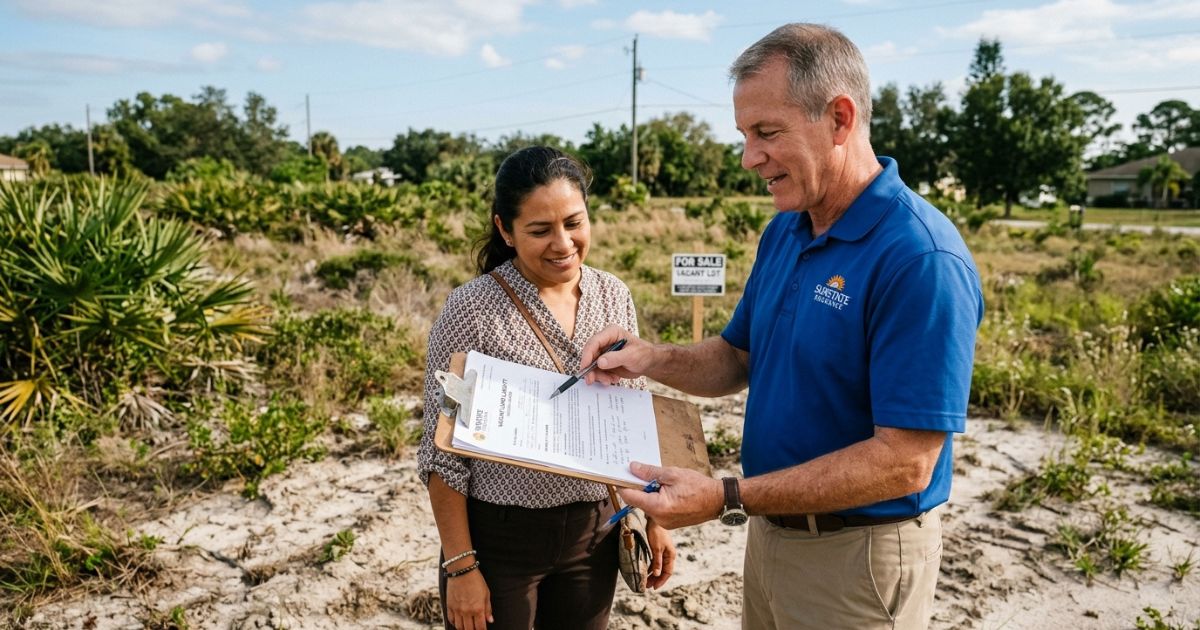
If you just bought — or are about to buy — vacant land in Florida, it’s tempting to assume insurance can wait until there’s a house to protect. The visible issue is that there’s no structure standing on the lot. The real danger is different: vacant land can still create liability exposure, trespassing risk, and storm-related damage costs, and none of that goes away just because nothing has been built yet. Here’s what informed buyers weigh before deciding.
Most people think insurance only makes sense once there’s something built to protect. In reality, simply owning the land already creates legal responsibilities — and that coverage gap is exactly what catches unprepared buyers off guard.
Table of Contents
- Do you legally need insurance for vacant land in Florida?
- What vacant land insurance actually covers
- When vacant land insurance is worth it
- How much does vacant land insurance cost in Florida?
- Vacant land vs. built property: insurance is not the same
- Common mistakes about vacant land insurance
- Hidden costs of skipping coverage
- FAQ — Frequently Asked Questions
- 📚 Glossary
- ✅ Immediate Actions — Start Now
Do you legally need insurance for vacant land in Florida? {#do-you-need-it}
Short answer: Florida has no state or federal law requiring vacant land owners to carry insurance, but that doesn't mean the land is risk-free — liability for accidents and damage caused by the property still falls on the owner, insured or not.
Unlike financing a home, where a lender typically requires homeowners insurance as a condition of the loan, buying vacant land — especially with cash — usually doesn’t come with that same requirement. That leads many buyers to assume insurance is optional in every sense.
In practice, the absence of a legal mandate doesn’t eliminate the financial risk. If someone is injured on the property, if a fire starts from dry, overgrown vegetation, or if a tree from the lot falls onto a neighboring property, the owner can still be held responsible — with or without a policy in place.
What vacant land insurance actually covers {#what-it-covers}
Short answer: a vacant land insurance policy mainly covers general liability for accidents that happen on the property, and some policies also include protection against fire damage, falling trees, or unauthorized use by third parties.
Unlike homeowners insurance, which protects the structure and its contents, vacant land policies tend to focus on:
- General liability — covers legal costs and settlements if someone is injured on the property, even without the owner’s permission
- Damage to neighboring property — protects against claims if something originating on the lot, like a fallen tree or fire, damages an adjacent property
- Minor existing structures — fencing, signage, or small improvements already installed on the lot
- Debris removal, in some policies, following storm events like hurricanes
Coverage varies significantly between insurers, and not every vacant land policy includes all of these items by default.
When vacant land insurance is worth it {#when-worth-it}
Short answer: vacant land insurance tends to be most worthwhile when the lot has easy public access, sits in a flood zone or hurricane-prone area, or when the owner lives far away and can't check on the property regularly.
Several factors increase the value of coverage:
- The lot has easy road access, which raises the risk of unauthorized visitors
- The property sits in a FEMA-designated flood zone or an area with a history of hurricane damage
- Dense vegetation or large trees sit close to the boundary line with neighbors
- The buyer lives outside Florida or outside the United States and can’t visit the lot regularly
- Partial improvements exist on the land, such as fencing, a well, or an older structure
When none of these factors apply — a small, isolated lot with no improvements and easy monitoring — the financial risk is lower, and some owners choose to go without a policy.
How much does vacant land insurance cost in Florida? {#how-much}
Short answer: vacant land insurance in Florida tends to be significantly cheaper than homeowners insurance, since it mainly covers liability rather than the value of a built structure — but the final cost depends on location, lot size, and flood zone exposure.
Factors that influence the premium include:
- The location of the lot and its proximity to flood-prone or hurricane-exposed areas
- The size and accessibility of the property
- Whether partial structures or improvements already exist on the land
- The liability coverage limit selected
- Claims history in the surrounding area
Because it’s a simpler policy than full homeowners coverage, the annual cost tends to be proportionally lower — but the exact premium can only be confirmed with a quote specific to the lot in question.
Vacant land vs. built property: insurance is not the same {#comparison}
Short answer: vacant land insurance mainly covers liability, while homeowners insurance also protects the structure, its contents, and loss of use — which is why the two policy types differ significantly in price, coverage, and lender requirements.
| Aspect | Vacant Land | Built Property |
|---|---|---|
| Primary coverage | General liability | Structure, contents, and liability |
| Lender requirement | Rarely required for financing | Almost always required by the mortgage lender |
| Average annual cost | Lower | Higher |
| Flood zone coverage | Limited or sold separately | Often bundled in or required |
| Practical necessity | Depends on risk and location | Practically indispensable |
This difference explains why many vacant land buyers put off the insurance decision — the urgency is lower, but the liability risk doesn’t disappear.
Common mistakes about vacant land insurance {#common-mistakes}
Assuming “no structure means no risk”
Accidents, fires, and unauthorized use by third parties can happen regardless of whether there’s a house on the property.
Confusing vacant land insurance with homeowners insurance
These are different products with different coverage and pricing — buying the wrong type can leave the owner without the protection they thought they had.
Not factoring in flood zone exposure
Land located in flood-prone areas may need additional coverage, even without any construction on site.
Skipping insurance because the land has low value
Liability risk isn’t necessarily tied to the value of the lot — a single accident claim can far exceed the price of the land itself.
Forgetting to update the policy once construction starts
Once building begins, a vacant land policy is generally no longer sufficient and needs to be replaced with builder’s risk or homeowners coverage.
Hidden costs of skipping coverage {#hidden-costs}
Short answer: without insurance, a vacant land owner absorbs the full legal cost of any accident, the cost of damage to neighboring properties, and storm-related debris removal directly — expenses a low-cost policy could otherwise have covered.
- Liability lawsuits, if someone is injured on the property without authorization
- Damages owed to neighboring properties, such as from a fallen tree or runoff flooding
- Debris removal costs after hurricanes or major storms, with no reimbursement
- Code enforcement fines, when property issues aren’t resolved in time
- Legal defense costs, even in cases where the owner is ultimately found not liable
Individually, each of these scenarios can seem unlikely — but the cost of a single lawsuit typically outweighs years of insurance premiums.
FAQ — Frequently Asked Questions {#faq}
Is vacant land insurance required by law in Florida?
No. There’s no statewide legal requirement, but some lenders may require minimum coverage if the land was financed.
Does vacant land insurance cover hurricanes?
It depends on the policy. Some plans cover debris removal and damage to partial structures after a hurricane, but full protection against wind and water is typically stronger in homeowners policies.
How much does vacant land insurance cost on average?
Cost varies by location, size, and risk level of the lot, but it’s typically much lower than homeowners insurance since it doesn’t cover a built structure.
Do I need to switch policies once I start building?
Yes. Once construction begins, a vacant land policy generally isn’t enough and should be replaced with builder’s risk insurance or a homeowners policy.
Does vacant land in a flood zone need specific coverage?
Land mapped by FEMA as a flood risk area often benefits from additional coverage, since standard vacant land policies don’t always include that protection.
📚 Glossary {#glossary}
Vacant land insurance — a policy specifically designed for undeveloped land, primarily focused on general liability coverage.
Liability — the legal obligation of the property owner to answer for damages or accidents that occur on their land.
Flood zone — an area mapped by FEMA as being at risk of flooding, which can affect the need for and cost of insurance.
Builder’s risk insurance — a policy specific to the construction period, used once vacant land is no longer vacant and an active build begins.
Code enforcement — the county department responsible for enforcing municipal codes on land and property.
✅ Immediate Actions — Start Now {#immediate-actions}
- Check whether your lot sits in a flood zone using the FEMA flood map
- Assess how easily the public can access the property and the risk of unauthorized use
- Request quotes for vacant land insurance from at least two insurers
- Confirm whether the policy includes liability coverage and debris removal
- Reassess coverage as soon as you have concrete construction plans
- Talk to TerraNoble for bilingual guidance on protecting your land
Conclusion
Vacant land insurance in Florida isn’t a legal requirement, but that doesn’t make it unnecessary in every case. Location, public access, flood zone exposure, and how far the owner lives from the property are all factors that should weigh into the decision — and the cost of a basic policy is usually small compared to the financial risk of having no protection at all.
TerraNoble offers bilingual support — in English and Portuguese — to help Latin American buyers understand not just where to invest, but how to protect their land after the purchase. Reach out to our team to talk through your specific situation.