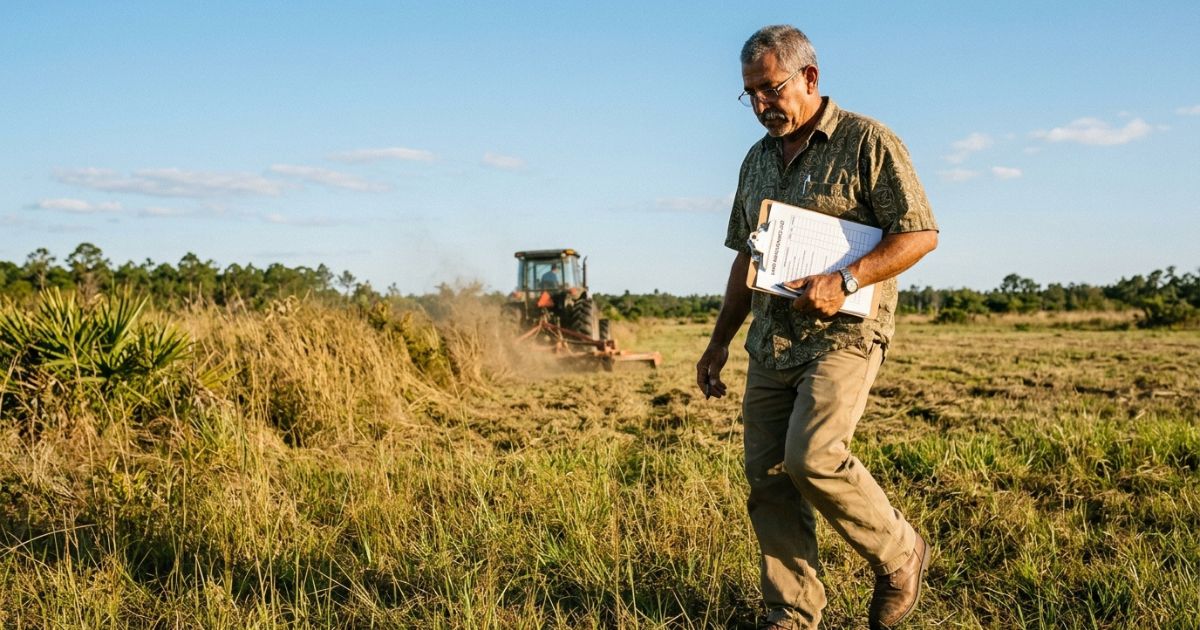
If you just closed on a vacant lot in Florida, the visible part of the process — finding the right parcel, negotiating price, signing paperwork — is already behind you. The real risk starts now: vacant land with no maintenance, no updated county records, and no zoning check can rack up fines, attract trespassers, and lose value within months. Here’s what experienced buyers do right after signing.
Most people assume buying the land is the hard part. In practice, the post-purchase phase is where quiet mistakes get expensive — because nobody tells you that vacant land, unlike a house, still demands active attention even with no one living on it.
Table of Contents
- Why what happens after closing matters just as much
- First steps: what to do in the first week
- Land maintenance: what the county requires
- Taxes and fees that continue after closing
- Security and protecting the land from trespassing
- Managing it yourself vs. working with a professional
- Common mistakes after the purchase
- Hidden costs of owning vacant land
- FAQ — Frequently Asked Questions
- 📚 Glossary
- ✅ Immediate Actions — Start Now
Why what happens after closing matters just as much {#why-matters}
Short answer: vacant land keeps generating legal and financial obligations even without construction — vegetation upkeep, property taxes, zoning compliance, and protection against trespassing are responsibilities that begin the day you close, not the day you start building.
Many buyers treat closing as the finish line. In reality, it’s the start of a new phase of responsibility:
- The county continues monitoring the lot for overgrown vegetation, accumulated debris, and fire-risk conditions
- Property taxes shift into the new owner’s name starting from the transfer date
- Zoning and permitted-use rules need to be confirmed before any future plans move forward
- A lot with no fencing or visible signage is more exposed to unauthorized use by third parties
Ignoring these points in the first few months is the most common reason buyers end up with a surprise county notice or discover a problem only once they’re ready to build.
First steps: what to do in the first week {#first-steps}
Short answer: in the first week after closing, buyers should confirm the deed was recorded with the county, update their mailing address to receive tax notices, and physically locate the property boundaries using the land survey.
These steps sound like paperwork, but skipping them causes real problems later:
- Confirm the deed was recorded on the county recorder’s website to make sure the transfer was processed correctly
- Update your mailing address with the county property appraiser so you don’t miss property tax notices or code enforcement letters
- Locate the survey markers on the actual lot, so you know exactly where the property boundaries begin and end
- Take photos of the land’s current condition, documenting its state at the time of purchase — this helps if boundary or trespassing disputes come up later
- Keep a digital copy of every document — deed, survey, title insurance policy — somewhere easy to access
This initial checklist takes little time but resolves most of the administrative issues before they turn into something urgent.
Land maintenance: what the county requires {#maintenance}
Short answer: most Florida counties require vacant land to be kept free of overgrown vegetation, accumulated debris, and fire-hazard materials, and will fine the owner for failing to comply.
Vacant land isn’t “no-responsibility” land. Local code enforcement typically requires:
- Regular clearing of vegetation, especially near public roads or neighboring properties
- Removal of debris, junk, or abandoned vehicles left by previous occupants or third parties
- Control of invasive species that could spread onto neighboring lots
- Proper drainage maintenance, avoiding standing water that attracts mosquitoes
Failing to comply can trigger a code enforcement notice, and in repeat cases, daily fines until the issue is resolved. Many buyers purchasing from a distance only find out about these requirements once a fine has already piled up.
Taxes and fees that continue after closing {#taxes}
Short answer: property taxes on vacant land in Florida are billed annually by the county based on the parcel's assessed value, and they continue regardless of whether the land is being used or built on.
Closing on the land doesn’t end your financial relationship with the county. Ongoing obligations include:
- Annual property taxes, calculated by the county property appraiser based on the assessed value of the land
- HOA fees, if the lot sits inside a community with a homeowners association
- Special assessments, one-time county charges for infrastructure like roads or drainage in the area
- Land insurance, where applicable, especially in flood-zone areas
A common mistake is assuming “vacant land means no cost.” In practice, the cost simply changes shape — from purchase price to ongoing ownership obligations.
Security and protecting the land from trespassing {#security}
Short answer: vacant land with no fencing, signage, or regular visits is more exposed to unauthorized use, illegal dumping, or squatting — problems that are far easier to prevent than to reverse.
After closing, it’s worth considering:
- Installing identification signage with the owner’s name or a private property notice
- Fencing the perimeter, even a simple one, to make the property line clear
- Visiting the lot periodically or hiring someone local you trust to check on it regularly
- Keeping a photo and date log of each visit, creating a monitoring record for the lot
For buyers who live outside Florida or outside the U.S. entirely, these simple measures significantly lower the risk of discovering a problem only after it’s already gotten out of hand.
Managing it yourself vs. working with a professional {#comparison}
Short answer: managing vacant land on your own is possible, but it takes time, local presence, or a network of contacts in the area — professional guidance takes on part of that work, lowering the risk of fines and issues going unnoticed from a distance.
| Post-purchase responsibility | Managing it yourself | With expert guidance |
|---|---|---|
| Vegetation monitoring and clearing | Must hire and supervise on your own | Referrals to trusted local providers |
| Tracking county notices | Relies on checking mail and online systems | Support identifying and responding to notices |
| Future zoning verification | Requires your own research with the county | Bilingual guidance on permitted use |
| Communication in Portuguese | Depends on your own translation | Direct bilingual support |
| Periodic visits to the land | Requires physical presence or a local contact | Network of contacts for lot inspections |
Neither option is wrong — it comes down to how much time, local presence, and familiarity with the U.S. system a buyer has available to take this on alone.
Common mistakes after the purchase {#common-mistakes}
Assuming vacant land doesn’t need attention
A lot with no construction still generates maintenance obligations, taxes, and code compliance requirements.
Not updating your mailing address
Property tax notices and code enforcement letters go out by mail — missing them can lead to fines for failing to respond in time.
Ignoring the survey markers
Without confirming the physical boundaries, it’s possible to build a fence or structure outside the actual lot line, creating a dispute with neighbors.
Not visiting or monitoring the land periodically
Lots without regular visits are more prone to illegal dumping, vegetation overgrowth, or unauthorized use.
Failing to check for zoning changes
Land use rules can change after the purchase — not tracking those updates can limit future building plans.
Hidden costs of owning vacant land {#hidden-costs}
Short answer: beyond property taxes, vacant land can generate costs for vegetation clearing, debris removal, code enforcement fines, HOA fees, and remote monitoring services — expenses that rarely show up in the initial investment math.
- Regular vegetation clearing, required by most counties to reduce fire risk
- Debris or junk removal, if third parties misuse the land
- Code enforcement fines, applied when maintenance isn’t handled in time
- HOA fees, when the land sits inside a community with an association
- Inspection or remote monitoring services, hired by owners who can’t visit the lot often
Individually, these costs are usually small, but they can add up when land goes unattended for long stretches.
FAQ — Frequently Asked Questions {#faq}
Do I need to do anything with the land if I’m not building right away?
Yes. Even without construction, the land needs vegetation upkeep, property tax payments, and compliance with county rules to avoid fines.
How soon after closing does the property tax bill switch to my name?
The county property appraiser typically updates ownership records shortly after closing, and property tax billing shifts to the new owner starting with the following tax year.
What happens if I don’t clear the vegetation on the lot?
The county can issue a code enforcement notice, and if the issue isn’t corrected within the given deadline, daily fines can apply until it’s resolved.
Do I need to fence the land after buying it?
It’s not required in most cases, but fencing or signing the property significantly reduces the risk of unauthorized use, illegal dumping, or boundary disputes with neighbors.
How do I know if the zoning rules for my land have changed?
The best approach is checking periodically with the county zoning department or working with bilingual guidance, since zoning changes aren’t always communicated directly to the property owner.
📚 Glossary {#glossary}
Code enforcement — the county department responsible for enforcing local codes, including maintenance requirements for vacant land.
Property appraiser — the county office responsible for assessing the value of land for property tax purposes.
Survey — a topographic assessment that defines the exact boundaries of a piece of land.
Zoning — county rules that determine the permitted use of a parcel.
HOA (Homeowners Association) — an association that can impose rules and fees on land within certain communities.
Special assessment — a one-time county charge used to fund infrastructure improvements in a specific area.
✅ Immediate Actions — Start Now {#immediate-actions}
- Confirm the deed was recorded on the county recorder’s website
- Update your mailing address with the property appraiser
- Locate the survey markers directly on the land
- Check the maintenance requirements enforced by local code enforcement
- Consider installing identification signage or fencing the perimeter
- Talk to TerraNoble for bilingual guidance on post-purchase responsibilities
Conclusion
Buying vacant land in Florida is just the first step in a process that continues well beyond closing. Vegetation maintenance, updated records, property tax payments, and monitoring against trespassing are all responsibilities that, when ignored, turn a solid investment into a source of fines and headaches.
TerraNoble offers bilingual support — in English and Portuguese — to guide Latin American buyers not just in choosing the right parcel, but in understanding the responsibilities that come after the purchase. Get in touch with our team to talk about your specific situation.