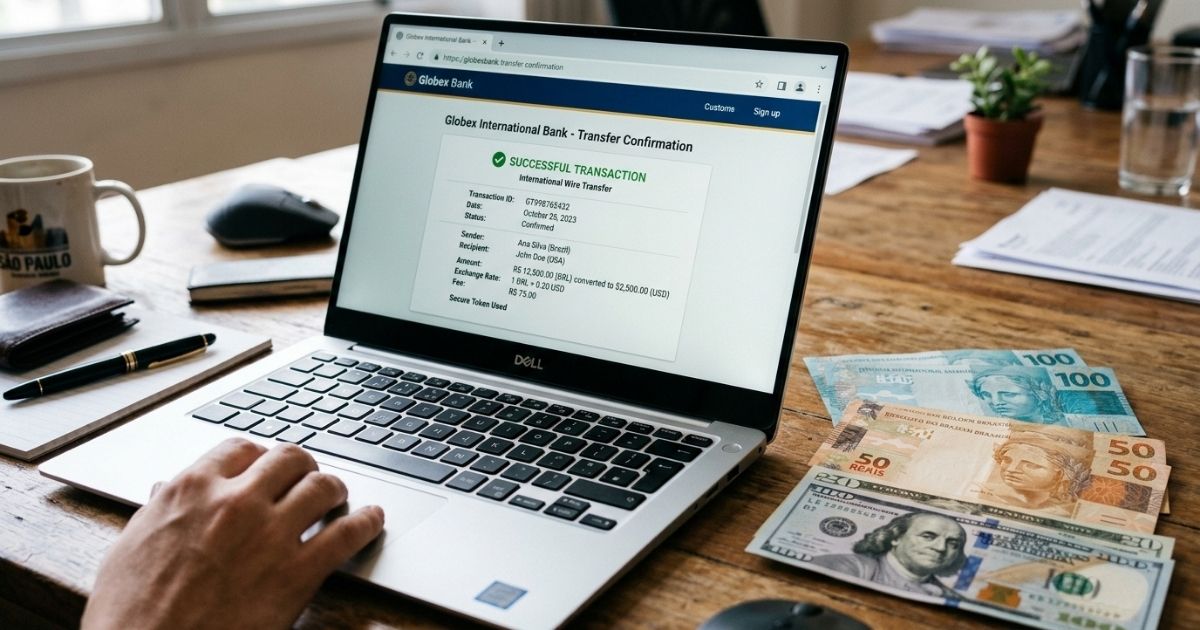
Important notice: this article is for informational and educational purposes only. It does not constitute legal, tax, or financial advice, and does not replace consultation with a licensed accountant, attorney, or authorized currency exchange broker. Rules on Brazilian IOF tax, remittance limits, and reporting obligations change over time — always confirm current rates and thresholds with a licensed professional before moving money.
If you’ve already put a Florida land parcel under contract and closing is approaching, the next step — wiring the money from Brazil to the United States — feels like the easy part. It isn’t. The biggest risk in this step has nothing to do with exchange rates. It’s sending the right amount of money to the wrong account, because someone intercepted the wiring instructions and swapped the bank details right before the deadline. This exact scam has cost real estate buyers in the US millions of dollars, and once a wire transfer is confirmed, the money is almost never recoverable.
Most buyers focus on getting the best dollar exchange rate. That matters, but it isn’t what actually determines whether your money arrives safely. What decides that is the channel you use, how carefully you verify the destination account, and the paperwork you keep afterward for Brazil’s Banco Central and Receita Federal once the funds have landed in the US.
Table of Contents
- Which channels are legal for sending money from Brazil to the US
- Bank vs. currency broker vs. fintech: which one to use
- The safe step-by-step process for wiring your closing funds
- Wire fraud: the biggest real risk in your Florida land purchase
- IOF, Banco Central, and what you need to declare
- Common mistakes buyers make when wiring closing funds
- Hidden costs of an international wire transfer
- FAQ — Frequently asked questions
- 📚 Glossary
- ✅ Immediate Actions — Start Now
Which channels are legal for sending money from Brazil to the US {#legal-channels}
Short answer: in Brazil, international transfers for a real estate purchase must go through an institution authorized by the Banco Central do Brasil to operate in the foreign exchange market — a traditional bank, a licensed digital bank, or a registered currency exchange broker. Using an unauthorized intermediary ("doleiro") is illegal and leaves no formal paper trail for the money.
Every foreign exchange operation in Brazil — converting reais into dollars and sending them abroad — has to be processed by an institution authorized by the Banco Central. That applies to traditional banks, licensed currency exchange brokers, and international remittance fintechs operating under that same authorization. The receipt this operation generates, known as the contrato de câmbio (exchange contract), is the document that proves the lawful origin of the money and the declared purpose of the transfer — in this case, purchasing real estate abroad.
That same document later supports the declaration of the property with Brazil’s federal tax authority (Receita Federal) and, when applicable, with the Banco Central. Without it, a Brazilian buyer has no documentary trail showing how the money left the country — a gap that can resurface years later, whether at the time of a future sale or during a tax audit.
Bank vs. currency broker vs. fintech: which one to use {#comparison}
Short answer: traditional banks tend to be more expensive and slower but offer in-person support; specialized currency exchange brokers and remittance fintechs usually charge a smaller spread and move faster, but buyers need to verify carefully that the platform is in fact authorized by the Banco Central do Brasil.
| Criteria | Traditional Bank | Currency Exchange Broker | Remittance Fintech |
|---|---|---|---|
| Typical exchange rate spread | Usually the highest | Mid-range, negotiable on larger amounts | Usually the lowest |
| Transfer speed | 1 to 3 business days | 1 to 2 business days | A few hours to 1 business day |
| Per-transaction limit | High, but may require prior scheduling | High, suited to full closing amounts | May cap out below full closing amounts |
| Support | In-branch and phone support | Dedicated advisory for large transactions | Digital, chat or email support |
| Issues a formal exchange contract | Yes | Yes | Depends on the provider — confirm first |
| Best suited for | Buyers who prefer an existing bank relationship | Full closing amounts or high-value transfers | Smaller amounts, such as an earnest money deposit |
For the full closing amount on a land purchase, most Brazilian buyers use a traditional bank or a currency exchange broker, precisely because these channels issue the complete exchange contract and are equipped to handle larger sums without friction. Remittance fintechs work well for smaller amounts, like the earnest money deposit, but confirm in advance whether the provider can process the full closing amount without splitting the transaction.
The safe step-by-step process for wiring your closing funds {#step-by-step}
Short answer: closing funds should only be sent after verifying the wiring instructions by phone directly with the title company or escrow agent handling the transaction — never based on an email alone, even one that looks like it came from the right source.
- Receive the wiring instructions — typically sent by the title company or escrow agent handling the closing, after the purchase contract is signed.
- Call the title company using a number you already know — not the number listed in the email’s signature, but one verified independently through the company’s official website or a prior confirmed contact — and confirm the receiving bank’s name, account number, and ABA/routing number verbally.
- Choose your exchange channel — bank, currency broker, or fintech — and state the purpose of the transfer as a real estate purchase abroad.
- Confirm the exchange rate and the final USD amount before authorizing the transaction, including all fees involved.
- Send a small test amount first when possible, especially for very large transfers — some brokers support this — and send the balance only after confirming it arrived correctly.
- Keep the exchange contract and the SWIFT confirmation from the transaction — you’ll need both for tax reporting in Brazil.
- Ask the title company to confirm receipt before the closing date, to make sure the full amount arrived on time.
Wire fraud: the biggest real risk in your Florida land purchase {#wire-fraud}
Short answer: the most common fraud in US real estate transactions isn't currency exchange risk — it's an intercepted email carrying fake wiring instructions, redirecting the buyer's money into an account controlled by criminals, with no way to recover it once the transfer is confirmed.
This scheme, known in the US as wire fraud or business email compromise, works like this: a criminal hacks or spoofs the email account of one of the parties involved in the closing — buyer, agent, or title company — and, close to the wire date, sends “updated” bank details asking that the funds be sent to a new account. The email often looks legitimate, sometimes reproducing the exact visual style of previous correspondence, and it tends to arrive right as the buyer is preparing to send the closing funds.
Unlike a domestic transfer that can sometimes be reversed, a confirmed international wire is, in practice, irreversible. Once the sending bank processes it, recovering the money depends on fast legal action in the US and cross-border banking cooperation — a process that’s uncertain, expensive, and rarely returns the full amount. The FBI’s Internet Crime Complaint Center (IC3) and the American Land Title Association (ALTA) both publish regular warnings about this exact scheme targeting real estate closings.
Red flags to watch for:
- Wiring instructions that arrive only by email, with no phone contact before or after
- A last-minute change to the bank, account number, or beneficiary name — even if the email appears to come from the same sender
- Unusual urgency (“wire today or you’ll lose the property”)
- Small typos in the sender’s email domain, nearly identical to the real one
- A request not to verify the instructions by phone “to save time”
The most effective safeguard remains the simplest one: never send closing funds based solely on instructions received by email. Always verify by phone, using a number obtained independently of the email itself.
IOF, Banco Central, and what you need to declare {#iof-bacen}
Short answer: a remittance to buy property abroad is subject to Brazil's IOF tax on foreign exchange operations, and the property must be declared as a foreign asset on your Brazilian income tax return; depending on the total value of assets held abroad, you may also need to file a separate report with the Banco Central — confirm current rates and thresholds with an accountant, since they change by regulation.
Every foreign exchange transaction in Brazil is subject to IOF (Imposto sobre Operações Financeiras), a federal tax whose rate depends on the declared purpose of the remittance. Because these rates are set by decree and can change with little advance notice, the exact rate applicable to your transfer should be confirmed directly with your bank or currency broker at the time of the transaction — not assumed from a number found elsewhere.
Once the purchase closes, the property needs to be reported under “Bens e Direitos” (Assets and Rights) on your annual Brazilian income tax return, valued in reais at the exchange rate on the acquisition date. Separately, individuals holding foreign assets above a certain threshold have an obligation to file the Declaração de Capitais Brasileiros no Exterior (CBE) with the Banco Central — that threshold is also set by Banco Central regulation and should be confirmed for the relevant reporting year, since it has changed in the past.
Keeping the exchange contract, the SWIFT confirmation, and the US closing statement is what allows these declarations to be filled out accurately — and protects you if the Receita Federal or the Banco Central ever ask you to substantiate where the money came from and where it went.
Common mistakes buyers make when wiring closing funds {#common-mistakes}
Trusting wiring instructions received only by email
This is the mistake that causes the most direct, irreversible financial loss. Every bank detail should be verified by phone before any money is sent.
Choosing a channel based only on the advertised exchange rate
An attractive advertised rate can hide a wide exchange spread or flat fees that only show up on the final receipt. Compare the net amount that actually lands in US dollars, not just the quoted rate.
Waiting until the last few days before closing to start the transfer
Large foreign exchange transactions can take more than one business day to clear. Delays in the funds arriving can put the agreed closing date at risk.
Sending money directly to the seller instead of the escrow account
In a properly structured purchase, closing funds go into an escrow account managed by the title company — not directly to the seller. Any instruction suggesting otherwise should be treated with suspicion.
Not keeping the paperwork from the exchange transaction
Without the exchange contract and the SWIFT confirmation, proving the lawful origin of the funds and completing Brazilian tax filings correctly becomes much harder.
Hidden costs of an international wire transfer {#hidden-costs}
- Exchange rate spread — the gap between the market’s reference dollar rate and the rate actually applied to your transaction, usually the largest real cost of the transfer even when it isn’t itemized as a “fee.”
- Wire fees — charged by the sending institution in Brazil and, in some cases, by an intermediary bank and the receiving bank in the US.
- Correspondent bank fees — transfers routed through international correspondent banks can have an additional fee deducted from the amount before it reaches its final destination, quietly reducing the received amount.
- IOF on the exchange transaction — applied to the converted amount, based on the rate in effect for the declared purpose of the remittance.
- Resend costs from incorrect bank details — incorrect or outdated wiring instructions can trigger a returned transfer, with new fees charged on resubmission.
FAQ — Frequently asked questions {#faq}
Is it legal to transfer money from Brazil to buy land in the United States?
Yes. There’s no legal restriction preventing Brazilians from buying real estate in the United States, and the transfer is permitted as long as it goes through a foreign exchange channel authorized by the Banco Central do Brasil, with the purpose correctly declared.
Is there a maximum limit for sending money from Brazil abroad?
There’s no fixed legal cap for remittances with a documented lawful purpose, but individual financial institutions can set their own operational limits per transaction or per day. Very large amounts are typically handled through specialized currency exchange brokers, better equipped for transfers of that size.
Can I send the money directly to the land seller?
That’s not the safe or standard procedure in the US real estate market. Closing funds should be sent to the escrow account managed by the title company handling the closing, which distributes the funds according to the closing statement.
How do I know if the wiring instructions I received are real?
Call the title company using a phone number obtained independently of the email you received — from the company’s official website or a previously confirmed contact — and verbally confirm the receiving bank’s name, account number, and ABA/routing number before authorizing any transfer.
Do I need to declare the land purchase to Brazilian tax authorities?
Yes, the property acquired abroad must be reported under “Bens e Direitos” on your annual Brazilian income tax return. Depending on the total value of assets held abroad, you may also need to file a report with the Banco Central. Check with an accountant to confirm the thresholds and deadlines in effect for the year of the transaction.
📚 Glossary {#glossary}
Wire transfer: an electronic transfer of funds between banks, used as the standard method for paying closing funds in US real estate transactions.
Exchange contract (contrato de câmbio): the document issued by an authorized Brazilian institution that records a currency exchange transaction and the declared purpose of the remittance.
Exchange rate spread: the difference between the reference dollar rate and the rate actually applied to a transaction, usually the largest hidden cost in an international transfer.
IOF: Imposto sobre Operações Financeiras, a Brazilian federal tax applied to foreign exchange transactions, among others.
Escrow: an account held by a neutral third party — typically the title company — that receives and distributes closing funds according to the agreement between buyer and seller.
Wire fraud / business email compromise: a scam in which criminals intercept or spoof email communications to trick a buyer into sending money to a fraudulent bank account.
Declaração de Capitais Brasileiros no Exterior (CBE): a report required by the Banco Central from individuals and entities holding foreign assets above a set threshold, updated periodically by regulation.
✅ Immediate Actions — Start Now {#immediate-actions}
- Choose a foreign exchange channel authorized by the Banco Central do Brasil — a bank, currency broker, or licensed fintech.
- Never send closing funds based only on instructions received by email.
- Call the title company using an independently verified phone number before any transfer.
- Compare the net USD amount across different channels, not just the advertised rate.
- Start the transfer with enough lead time before the closing date.
- Keep the exchange contract, the SWIFT confirmation, and the closing statement for tax purposes.
- Talk to an accountant about IOF, foreign asset declarations, and Banco Central reporting obligations.
- Contact TerraNoble for bilingual guidance through the closing and escrow process in Florida.
Conclusion
Wiring money from Brazil to close on a Florida land purchase is, in practice, less about chasing the best dollar rate and more about protecting the money at the exact moment it leaves your control. The exchange channel needs to be authorized by the Banco Central, the transaction paperwork needs to be kept for Brazilian tax filings, and — above all — the receiving bank details need to be verified by phone, never by email alone.
TerraNoble offers bilingual support — in English and Portuguese — to guide Brazilian buyers through the closing process in Florida, including coordination with the title company handling escrow. Tax and currency exchange questions should always be confirmed with a licensed accountant or currency broker before any funds are sent.